| Learning Objectives: 1. Define historical thinking and analyze the influence of postmodern theory on the study and interpretation of history. 2. Explain the processes through which historical knowledge is constructed, including the role of sources, interpretation, and narrative. 3. Describe how Latin American history is periodized and evaluate the implications of different periodization frameworks. |
Timeline: Mexico | Latin America
STARTING WITH THRESHOLD CONCEPTS
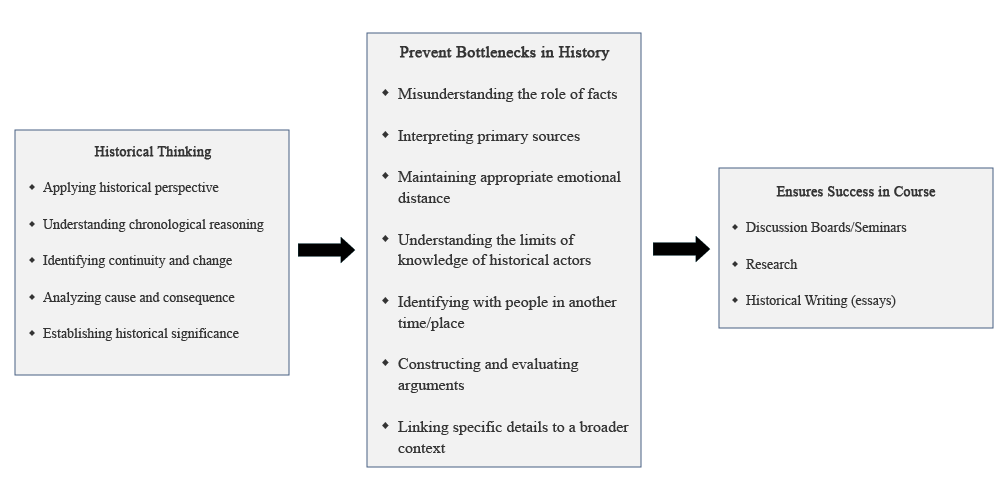
I would like to begin this topic by introducing you to Threshold concepts. What is it? Threshold concepts, a learning theory developed by Jan H.F. Meyer and Ray Land, “represent a transformed way of understanding, or interpreting, or viewing something without which the learner cannot progress.” These are not content knowledge or course objectives like the ones listed in the syllabus, but rather ways of thinking that are specific to disciplines and academic cultures. For example, historians have a particular method for constructing knowledge about the past. This method, called historical thinking, involves analyzing evidence, understanding context, identifying bias, and constructing interpretations based on multiple perspectives.
Introducing students to threshold concepts helps remove barriers to learning, such as epistemological, procedural, and even emotional challenges. For example, students might struggle with understanding how historians use evidence to build interpretations of the past (an epistemological bottleneck), or they may find the process of crafting a historical analysis overwhelming (a procedural bottleneck). Threshold concepts give students the tools to overcome these challenges by helping them think like specialists in the field.
Equally important, understanding threshold concepts allows students to appreciate how experts in different academic disciplines approach their work. By mastering historical thinking, you will not only gain insights into the discipline of history but also develop critical skills—like analytical thinking and evidence-based reasoning—that are valuable in many areas of study and professional life.
HISTORICAL THINKING
Historical thinking is widely regarded as a threshold concept—a transformative idea that opens the door to deeper disciplinary understanding. Far from being a mere exercise in recalling dates, names, or isolated facts, historical thinking entails a distinctive, structured approach to engaging with the past. It requires learners to adopt a critical mindset, questioning not just what happened, but why it happened, what it meant at the time, and how its interpretations have evolved over time.
As numerous scholars have emphasized, the discipline of history is grounded in an integrated system of ideas—a framework that includes concepts such as causation, change and continuity, historical context, evidence-based reasoning, and the multiplicity of perspectives. Thinking historically, therefore, involves recognizing that historical narratives are constructed rather than simply discovered, and that they are shaped by the questions we ask, the sources we prioritize, and the values of the present.
To truly engage with history on its own terms, one must move beyond surface-level learning. This means analyzing the underlying causes and ripple effects of events, interrogating primary and secondary sources for bias and reliability, and grappling with the complexity and contingency of human experiences. In doing so, students of history begin to see the past not as a fixed story, but as a dynamic interaction of interpretation, debate, and meaning-making.
DO YOU TEACH THE REAL HISTORY?
That’s a great question—and my response leans more toward no than yes. Why? Because my understanding of Latin American history isn’t drawn from direct experience. Instead, it’s shaped by limited sources and filtered through modern interpretations of events that happened long ago. This very realization points to a crucial threshold concept in the study of history: we can never access the past exactly as it occurred. What we engage with are interpretations—reasoned, evidence-based beliefs about the past that may approach the truth, but are never absolute.
Philosopher Paul Boghossian captures this distinction well when he says, “If a belief is to count as knowledge, it must not only be justified; it must also be true.” But herein lies the historian’s dilemma: how can we claim to know the past if we can never verify its ultimate truth? This question doesn’t render the study of history futile; rather, it invites a more nuanced approach.
In this course, our objective is not to unearth some singular, definitive account of Latin America’s past. Instead, we explore a narrative—one possible interpretation of the global past. This course is designed to help you recognize that historical understanding is a process, one that demands critical thinking, self-awareness, and engagement with diverse perspectives. This in itself makes iftdifficult to arrive at that one singular and definitive account of Latin America’s past. If not so, there would only be one book on this subject matter. Instead, there are a limitless number of historical works authored on this historical topic.
Through this lens, the study of history becomes less about memorizing what happened and more about thinking historically—evaluating sources, questioning narratives, acknowledging ambiguity, and reflecting on how the past continues to shape our present beliefs. History isn’t just a record of what we know; it’s an ongoing conversation about how we come to know—and why it matters.
Keith Lehrer, a philosopher by trade, makes a fascinating observation about knowledge when he explains that “all agree that knowledge is valuable, but agreement about knowledge tends to end there.” Lehrer’s insight is particularly relevant to the study of history, where the nature of historical knowledge is often contested. One of the greatest challenges students encounter in this discipline—and one I have taken pains to emphasize—is the question of whether we can ever truly know the past as it was.
This question becomes even more complex when viewed through the lens of postmodernism, which has brought profound changes to how historians think about the construction of knowledge. Postmodernism challenges the idea of history as a neutral recounting of facts and instead frames it as a narrative shaped by power, perspective, and interpretation. What does this mean for our ability to “know” the past? How do these theoretical shifts impact the way we study and assess history? By exploring the implications of postmodern perspectives, we can better understand the challenges—and possibilities—of engaging with history today..
THE POSTMODERN PARADIGM
The study of history and the construction of historical knowledge have come under the scrutiny of postmodern critical theory in recent decades. While I am not a postmodernist theorist, their ideas about history are worth contemplating. Postmodernism, which emerged in the mid-twentieth century as a response to the perceived failures and limitations of modernist ideals, challenges the principles of rationality, scientific reasoning, and universal truth that have long guided our understanding of the human condition. As Professor Tom Drake explains, modernism relies heavily on “the role of reason, rationality, and scientific reasoning in guiding our understanding of the human condition and . . . nature itself.”
Postmodernism, however, critiques these assumptions, arguing that knowledge—historical or otherwise—is always partial, subjective, and constructed. For historians, this means questioning whether the past can ever be objectively represented or if historical narratives are shaped primarily by the perspectives, contexts, and biases of those who write them. Emerging in the aftermath of global upheavals like World War II and the decline of colonial empires, postmodernism’s skepticism toward grand narratives invites us to rethink how we approach the study of history.
As we explore the implications of postmodernism for historical scholarship, we must grapple with how these ideas reshape our understanding of history, truth, and the role of the historian.
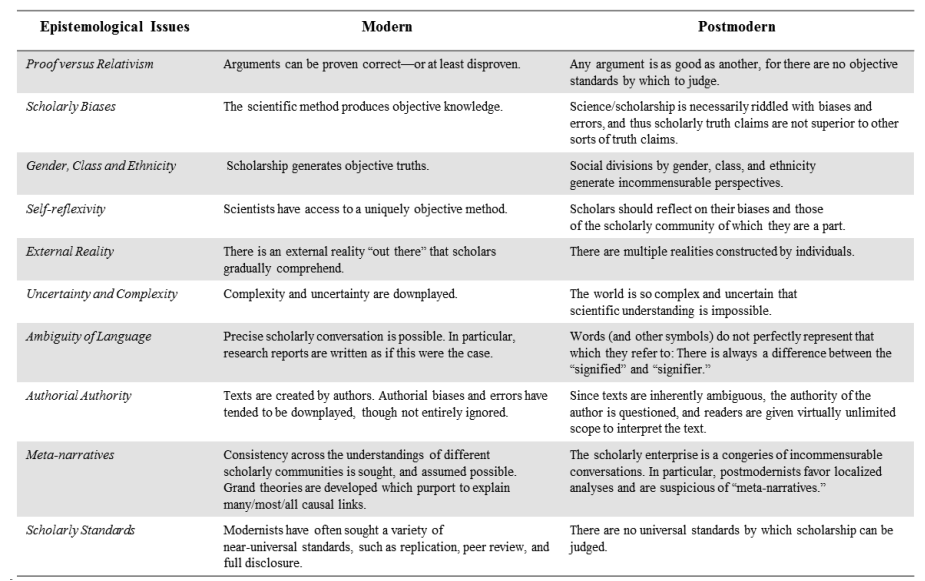
When applied to history, Trygve R. Tholfsen, from Teachers College, Columbia University, explains that postmodernists “have emphasized the intrinsic fictionality of historical writing, derided the factualist empiricism that purportedly governs the work of professional historians, dismissed the ideal of objectivity as a myth, and rejected the truth claims of traditional historiography.” This critique highlights the stark differences between modern and postmodern approaches to constructing historical knowledge. Postmodernists argue that historical writing is not a transparent recounting of the past but rather a creative act of interpretation shaped by the historian’s perspective, biases, and narrative choices. For them, objectivity and truth are not fixed ideals but contested and constructed concepts.
The postmodernist approach, when considered carefully, challenges all traditional methods of constructing historical knowledge. For example, ‘intrinsic fictionality’ suggests that historical writing inherently involves storytelling, as historians must organize and interpret evidence to craft a coherent narrative. This undermines the idea that history can present a purely factual account of the past. Additionally, postmodernists critique ‘factualist empiricism’—the reliance on observable evidence as the sole foundation of historical truth—as overly simplistic and blind to the interpretative nature of historical work. These critiques raise provocative questions about how historians can accurately represent the past or whether such a goal is even achievable.
The table below contrasts key epistemological issues from modern and postmodern perspectives, such as the role of objectivity, the interpretation of evidence, and the construction of truth. As you analyze the table, ask yourself how each perspective views the construction of historical knowledge and whether the past can ever be accurately captured. This comparison challenges us to consider not only the methods historians use but also the fundamental assumptions about truth and knowledge that underpin their work.
DECONSTRUCTING HISTORY
I would like to pursue Tholfsen’s explanation in more depth through Alun Munslow’s classic work Deconstructing History, a work every history major should read. In this study, Munslow specifically explores the study of history and the construction of historical knowledge through a postmodernist lens. Through this lens, Munslow explains that “history cannot claim to be straightforwardly scientific in the sense that we understand the physical sciences to be because it does not share the protocol of hypothesis testing, does not employ deductive reasoning, and neither is it an experimental and objective process producing incontrovertible facts.” This distinction between history and the physical sciences sets the stage for Munslow’s deeper exploration of how historical knowledge is constructed. What historians do, according to Munslow, is “translate historical evidence into facts” through the narrative they construct. Consequently, Munslow argues that when students study history, they are, in reality, engaging with narratives about the past constructed by historians as they believe it was. This perspective raises provocative questions about the role of interpretation and creativity in historical scholarship. If all history is narrative, how do we evaluate competing versions of the past? Munslow’s critique underscores the challenges inherent in representing the past ‘as it was,’ inviting us to reconsider how historical truth is both constructed and conveyed.
This is why Munslow takes great care to distinguish between the past as it was and how the writing of history portrays that past. This distinction lies at the heart of Munslow’s critique of traditional historiography. For Munslow, it is essential to recognize that history is not a direct account of the past but a narrative constructed by historians based on evidence, interpretation, and narrative choices. He writes, “We do not retrieve the past, we interpret it,” underscoring the idea that the past as it truly was is inaccessible.
By emphasizing this separation, Munslow challenges the notion that history can ever provide a purely objective account of past events. Unlike physical sciences, which rely on hypothesis testing and deductive reasoning to uncover universal truths, history relies on subjective processes of selection and narrative construction. Consequently, Munslow forces us to grapple with the implications of this distinction. If all history is a constructed narrative, then what we study is not the past itself but the way historians choose to represent it. This shift in perspective destabilizes traditional notions of historical truth and invites us to consider the power dynamics, biases, and creative processes inherent in the production of historical knowledge.
So, what historians produce is not history, but rather a narrative that has translated historical evidence into fact based on its perceived truth. Using this idea as a springboard, Munslow further argues that “History is the study not of change over time per se, but the study of the information produced by historians as they go about this task.” It is, as Andrew Shyrock, Thomas R. Trautmann, and Clive Gamble explain, a blending of “narrative, chronology, and . . . evidence to produce an account that seems full and convincing.”
It is this understanding of history that moves Munslow to conclude, “Instead of beginning with the past, we should start with its representation because it is only by doing this that we challenge the belief that there is a discoverable and accurately representable truthfulness in the reality of the past.”
PRIMARY SOURCES
Enough of the philosophical side of history. Let us focus our efforts now on exploring how historians construct historical knowledge. What methods do historians use to compose the narratives we read to learn about the past? In creating historical knowledge, the first step begins with historians analyzing and interpreting evidence that has survived from the past to the present. This evidence, termed primary sources, can take the form of written documents, artifacts, fossil records, architecture, artwork, and much more. The historical record for a given period is composed of all the identified primary sources.
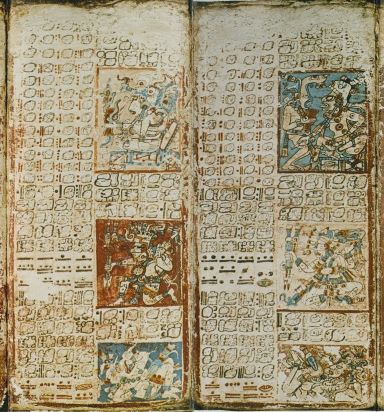
From this historical record, historians infer meaning, construct knowledge, and present it to an audience in narrative form. They rely on methods such as contextual analysis, comparative studies, and critical reading to assess the reliability and significance of their sources. They also weigh conflicting evidence and acknowledge gaps in the record, recognizing that their interpretations are shaped by the evidence available and the frameworks they use. As Munslow would argue, this process reflects not just the discovery of facts but the creation of a representation—a narrative about the past that blends evidence, interpretation, and storytelling.
By understanding how historians construct narratives from the surviving fragments of the past, we can better appreciate both the creativity and the challenges inherent in the study of history. This semester, as we analyze primary sources like written texts and artwork, we will explore not just the events of the past, but how these sources are transformed into the historical narratives we rely on to understand them.
Primary sources, while invaluable, often present a fragmented and biased picture of the past. They reflect the perspectives, priorities, and prejudices of those who created them, frequently excluding marginalized voices or distorting events based on the priorities of the time. Additionally, the survival of sources is often arbitrary, leaving historians to work with an incomplete and potentially unrepresentative record. Even when evidence survives, it requires careful contextualization, as its meaning is inseparable from the cultural, political, and social circumstances in which it was produced. This dependence on primary sources limits historians’ ability to achieve a fully accurate reconstruction of the past.
To navigate these challenges, historians employ various strategies. They cross-examine multiple sources, compare conflicting accounts, and situate evidence within broader historical contexts to mitigate biases and gaps. Nevertheless, the interpretive nature of this work means that the narratives historians construct are shaped as much by the evidence available as by the questions they bring to it. the reliance on primary sources forces historians to grapple with both the power and the limits of historical inquiry. Ultimately, this reliance highlights the difficulty of fully reconstructing the past. Historians do not have direct access to past realities but instead engage with the traces left behind—traces that are fragmentary, subjective, and incomplete. This underscores the need to approach historical narratives critically, acknowledging the constraints that shape them while appreciating the creativity and rigor that underpin their construction.
SECONDARY SOURCES
In reconstructing the past, historians also use “the findings of writers who were not participants in a historical episode but have investigated primary evidence of it.” These accounts are termed secondary sources. Secondary sources take many forms, including specialized monographs and scholarly articles. In many cases, historians use secondary sources as foundations to analyze primary sources more effectively, providing essential context and interpretive frameworks. Most students of history gain their understanding of the past from secondary source narratives.
Because of the question as to whether a historian can reconstruct an objectively knowable past, the academic field of history regularly experiences interpretive debate and revisions of once-held historical orthodoxies. This aspect of history is evident in the vast number of publications on any given topic. The uncovering of new primary sources or the reexamination of existing primary sources through new theoretical frameworks and methodologies drives the revision of historical scholarship. Secondary sources often play a key role in this process, as they synthesize and interpret primary evidence, offering insights that guide historians in their work.
HISTORIOGRAPHY
Because historical narratives are regularly revised, historians must also be familiar with historiography. What is it? Historiography is defined by Professor Peter Conolly-Smith as “the history of the history of the event: the way it has been written, the sometimes-conflicting objectives pursued by those writing on it over time, and the way in which such factors shape our understanding of the actual event at stake, and of the nature of history itself.” Essentially, historiography describes how historical arguments, theories, and interpretations have evolved over time and how schools of thought on particular events have changed. To put it simply, historiography can be defined as the history of the writing of history.
Studying historiography is crucial because it allows historians to critically evaluate existing narratives and understand how interpretations of events have shifted over time. This awareness reveals the influence of cultural, political, and intellectual contexts on historical scholarship. Historiography also informs the practice of historical revisionism, as it enables historians to trace the evolution of ideas and identify opportunities for new interpretations. By uncovering historiographical trends, historians can reassess established narratives and build upon—or challenge—the work of previous scholars.
Ultimately, the interplay between primary and secondary sources, historiography, and historical revisionism reflects the dynamic nature of history as a discipline—one that is constantly evolving as new evidence emerges and old interpretations are challenged. Understanding these processes allows historians to engage more thoughtfully with the past and contribute meaningfully to ongoing debates about the nature of historical knowledge.
Mark Brilliant argues that historiography is essential because it reveals how interpretations of historical events evolve over time. He explains that “history refers to what happened in the past, while historiography refers to what historians write about what happened in the past.” By studying historiography, we gain insight into the priorities, perspectives, and methods of historians across different eras, as well as the ways in which these factors shape the narratives they construct. In this sense, historiography serves as a lens through which we can better understand not just the past, but the process of writing about the past.
An understanding of historiography reveals that historical knowledge is not static or objective; it is a dynamic and interpretive process. Historians do not simply record facts—they analyze evidence, construct arguments, and craft narratives shaped by their own contexts, biases, and theoretical frameworks. Historiography underscores that history is often a reflection of the time in which it is written as much as it is a study of the time being written about. As new evidence emerges or new methodologies are developed, historical narratives are revisited and revised, further highlighting the evolving nature of historical knowledge.
Moreover, historiography shows that there is rarely a single, definitive interpretation of any historical event. Instead, it reveals a multiplicity of views, shaped by differing priorities, perspectives, and scholarly debates. This insight encourages us to approach historical narratives critically, understanding that they are products of interpretation rather than absolute truths.
Ultimately, historiography reminds us that the study of history is not only about uncovering the past but also about understanding how the past has been interpreted, debated, and reframed over time. By engaging with historiography, we develop a more nuanced appreciation of the complexity of historical knowledge and the role of historians in shaping our understanding of the world.
DESIGNATION OF ERAS
The Western tradition uses a civil calendar known as the Gregorian calendar. This calendar, named after Pope Gregory XIII (r. 1502–1586), was a reform of the Roman Julian calendar introduced by Julius Caesar in c. 46–45 B.C.E. The designations used for eras in the Gregorian calendar have traditionally been B.C. (Before Christ) and A.D. (Anno Domini, or “in the year of our Lord”). Dionysius Exiguus (470–544), a monk, was the first to divide time using the life of Christ (Jesus of Nazareth), designating the birth of Christ as occurring in A.D. 1. However, modern scholars now recognize that this calculation was likely inaccurate, as historical evidence suggests Jesus was born several years earlier, between 6 and 4 B.C.E.
In recent decades, historians and educators have increasingly adopted the more neutral designations C.E. (Common Era) and B.C.E. (Before the Common Era). These alternatives aim to make historical discourse more inclusive by removing explicitly Christian references from the calendar’s terminology, especially in multicultural and interfaith contexts. Despite this shift in language, it is important to note that the chronological dividing line—traditionally linked to the birth of Christ—remains unchanged. Whether labeled as 1 A.D. or 1 C.E., the calendar still pivots around the same historical moment.
Ultimately, the use of the Gregorian calendar reflects not only a legacy of Western Christian influence but also the complex ways in which time, belief systems, and historical memory intersect in our understanding of the past.
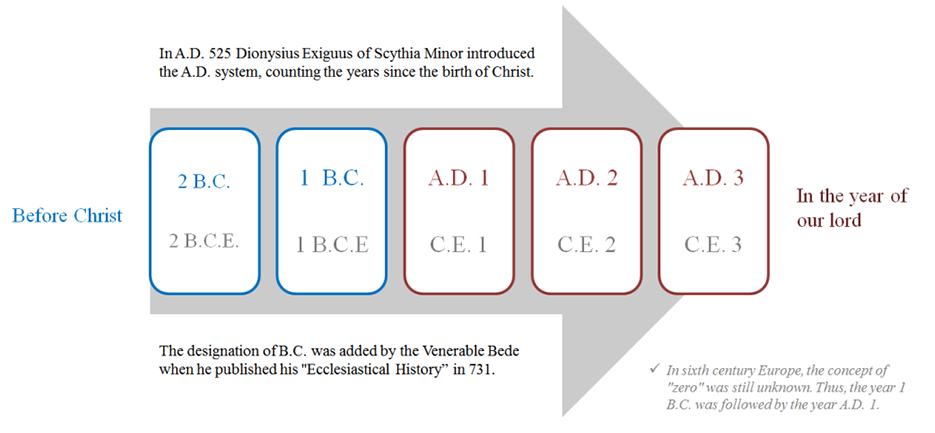
In this course, we will use the era designations of B.C.E. and C.E., as they are the academic standard for promoting religious neutrality and inclusivity in the study of history. This approach helps us focus on the events and developments of the past while respecting the diversity of perspectives in the modern world.
CHRONOMETRY
Chronometry is the process of measuring time and dating. Before the 20th century, historians relied heavily on written records to establish scales of time and order the course of history and its events. This methodology, however, had its limitations. As historian Leopold von Ranke (1795–1886) observed, “History cannot discuss the origin of society, for the art of writing, which is the basis of historical knowledge, is a comparatively late invention.” Similarly, David Christian notes that “When pushed to their limits, written records could take scholars back at most 5,000 years, for that was when writing first appeared.” Written records, while invaluable, are incomplete, often reflecting the perspectives of literate societies and excluding vast swaths of human prehistory.
This limitation began to change with the advent of the 20th century, which witnessed a revolution in chronometry. Advances in the fields of biology, geology, and cosmology, fueled by scientific innovation, made it possible to document human history and the history of the Earth far beyond the boundaries of the written record. For example, radiometric dating uses the decay of radioactive isotopes to determine the age of rocks and fossils, offering precise timelines for events millions or even billions of years in the past. Geological time divides Earth’s history into vast epochs and eras, providing a framework for understanding processes that shaped the planet long before humans existed. Genetic dating analyzes DNA mutations to trace the evolutionary history of species, offering valuable insights into human migration and ancestry.
These innovations have fundamentally redefined the scope of historical study. No longer limited to written records, historians can now integrate evidence from the deep past, encompassing the origins of humanity, the development of life on Earth, and even the formation of the universe. This broader perspective has facilitated the possibility of constructing a single historical continuum—an interconnected narrative that unites human history with the vast timescales of geological and cosmic history.
Ultimately, this transformation challenges traditional notions of history as being confined to human civilizations. Instead, it frames history as an interdisciplinary effort that draws on the natural sciences to understand humanity’s place within the broader story of the Earth and the cosmos. With these innovations, the study of history has evolved from the documentation of events to the exploration of existence itself.
PERIODIZATION
Historians do not only struggle with how to interpret the past; they also grapple with how to organize it. This is where periodization comes into play. William A. Green defines periodization as “the organizing principles upon which we write history, the priorities we assign to various aspects of human endeavor, and the theories of change we adopt to explain the historical process: all are represented in periodization.” Like historical knowledge, periodization has an “interpretive” quality, meaning that not everyone organizes the past in the same way.
Chronological periodization is one of the simplest and most commonly used methods, but historians often adopt thematic approaches or combine thematic and chronological frameworks to organize the past more effectively. For example, one historian might focus on the political upheavals of the 18th century, while another might organize the same period around cultural or social transformations. Additionally, periodization varies across cultures and regions. While European historians frequently use periods such as the Renaissance or Enlightenment, these labels may have little relevance in other parts of the world, where histories might be divided according to dynastic changes, colonial experiences, or regional developments. Such is the case for Latin American history.
| TRADITIONAL CHRONOLOGICAL PERIODIZATION |
| Pre-Columbian Era: Before 1492 Encounter and Conquest: 1492–1570 Colonial Period: 1570–1810 Wars of Independence: 1810–1830 Post-Independence Nation-Building: 1830–1870 Export Boom / Oligarchic Republics: 1870–1930 Populism and Reformism: 1930–1960s Revolutionary and Military Regimes: 1960s–1980s Democratic Transitions / Neoliberalism: 1980s–2000s Leftward Shift: 2000s–2010s Contemporary Era: 2010s–present |
| THEMATIC PERIODIZATION |
| Indigenous Histories Periodization *Early Formative Period (2000 BCE–500 CE): Early agriculture and sedentary societies. *Classic Period (500–1000 CE): Height of Maya civilization. *Postclassic Period (1000–1500 CE): Rise of Aztec and Inca Empires. Economic Periodization *Colonial Mercantilism (16th–18th centuries) *Post-Independence Disarticulation (early 19th century) *Liberal Export Economies (1870–1930) *ISI and Developmentalism (1930–1980) *Neoliberal Globalization (1980s–present) Environmental History Periodization *Anthropogenic Pre-Columbian Landscapes *Columbian Exchange and Ecological Imperialism (1492–1600s) *Colonial Extractivism *Industrial Development and Urbanization *Climate Crisis and Eco-Social Movements (21st century) Gender and Social Movements Periodization *Colonial Patriarchy and Casta System *Liberal Reforms and Gender Roles (19th Century) *Feminist Awakening and Political Participation (20th Century) *Intersectional Activism and LGBTQ+ Movements (21st Century) |
This interpretive quality of periodization underscores why Munslow argues that “the past is not discovered or found . . . [but rather] . . . is created and represented by the historian as text which in turn is consumed by the reader.” Even the decision of how to represent the scales of time reflects the historian’s priorities and interpretive lens. For example, a historian emphasizing economic structures might define historical periods around events like the Industrial Revolution, whereas a historian focused on cultural shifts might use eras such as the Romantic period or the Age of Exploration. These choices influence how the past is presented and understood.
METHODOLOGIES
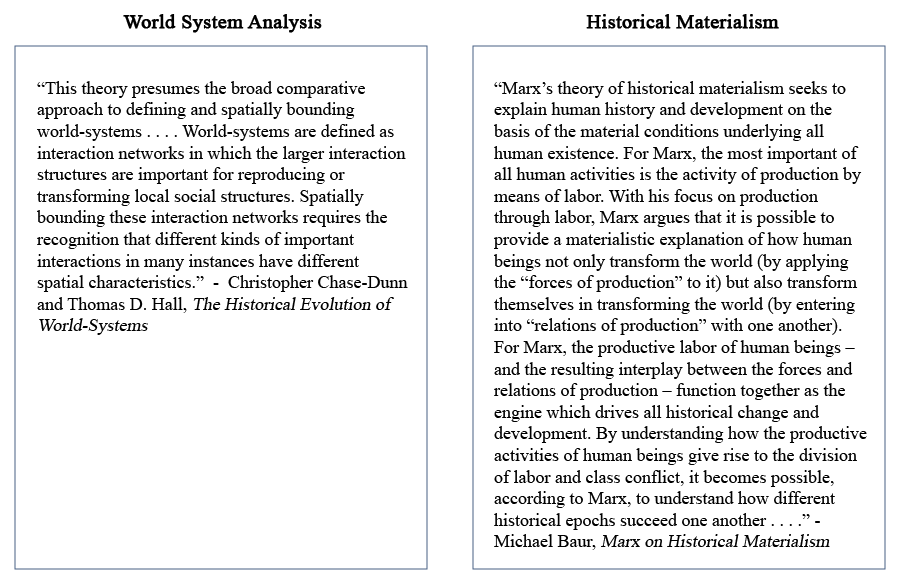
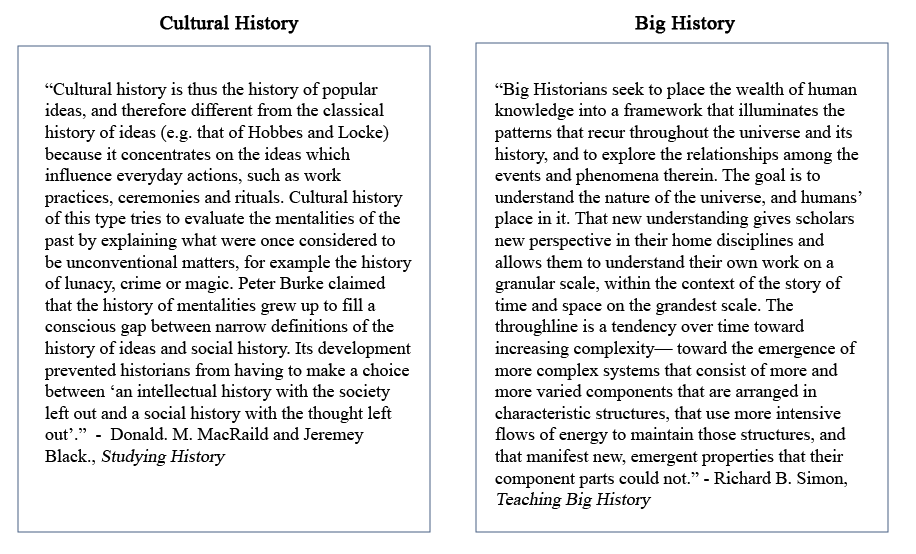
One more important consideration is the role of methodologies in shaping historical narratives. Historians subscribe to particular approaches or schools of thought when analyzing evidence and writing about the past. For instance, Marxist historians emphasize economic systems and class struggle, while cultural historians prioritize ideas, beliefs, and cultural practices. These methodologies not only influence how historians interpret the past but also shape how they make it accessible to readers.
As noted in the previous section, the interpretive nature of history—whether in periodization or in methodology—makes revision and debate essential to the discipline. To better understand this process, let us explore some of the major schools of historical thought and the conceptual frameworks they use to reconstruct the past. By doing so, we can appreciate the diversity of historical perspectives and the ways historians shape and reshape narratives of the past.
IN CLOSING
So, we have now reached the end of this first topic. If you are wondering which historical theoretical frameworks we will use in this course to explore early world history, the answer is all four of the ones you were introduced to. Sometimes they will be applied in unison, and other times individually, depending on what we are specifically trying to interpret about the past.
At this point in time, I would like to take a moment to set into context what I hope to accomplish with you this semester. While this course is organized around large spatial and temporal scales, it is important to acknowledge that it is impossible to cover everything about Latin American history in a single semester. Because of the scope of this course, we will focus on key themes that provide a unified continuum to the temporal and spatial scales of time we will be exploring together. These themes will allow us to make meaningful connections across different regions and periods, bringing cohesion and a sense of understanding to the fascinating story of us.
The four theoretical frameworks—chronological, thematic, spatial, and comparative—will guide our exploration of Latin America’s past. These lenses will help us interpret this past from multiple perspectives, deepening our understanding of both the diversity and the shared experiences of this region of the world. Sometimes these frameworks will overlap, while other times we will focus on one specific lens to address the unique aspects of a particular topic.
As always, be sure to contact me or visit me during office hours should you have any questions about the content we have covered or the assignments that you need to complete.
 World History Portal