Before you begin this topic take a moment to review the terms provided below.
| Semasiographic Systems: “Idea-based writing – independent graphic languages not tied to any one spoken language.” Glottographic Systems: “Language-based – use visible marks to represent elements of a specific spoken language.” Writing system: “A set of visible or tactile signs used to represent units of language in a systematic way.” Epigraphy: “The science concerned with the study, classification and interpretation of inscriptions.” Script: “The graphic form (visual representation) of a writing system.” Decipherment: “The recovery of the key to an extinct writing system.” Transcription: “The systematic recording of signs into Latin characters.” Transliteration: “The conversion of a transcription into the reconstructed spoken language.” Translation: “The conversion of the recorded language into understandable English in our case.” Syllabogram: “A sign that represents a phonetic syllable.” Logogram: “A sign that represents a word or idea but does not directly indicate pronunciation.” Hieroglyph: “Writings consisting of signs which are (assumed to be) non-phonetic.” Codex/Codices: “An ancient book written by hand.” |
ABOUT WRITING
It is important to understand that writing is not a language in itself, although many specialists link it closely to spoken language. When studying writing systems in world history, it is more accurate to define writing as “the communication of relatively specific ideas in a conventional manner by means of permanent, visible marks.” Writing consists of marks made on a prepared surface—such as clay, stone, or paper—designed to convey meaning. These marks can follow either a glottographic approach (representing spoken language) or a semasiographic approach (conveying ideas directly, without reference to speech). Scholars view writing as a relatively recent technological innovation with broad applications in human society. It serves a mnemonic function, supporting memory and record-keeping; an aesthetic function, expressed through literature, poetry, and the arts; and a regulatory function, used to formalize laws, issue decrees, record populations, and preserve moral or social codes. Additionally, writing extends communication across time and space, vastly increasing the reach of human expression.
For many scholars, the invention of writing marks one of the greatest cultural achievements of humanity and is closely tied to the rise of early agrarian complex societies. Writing is often regarded as a cornerstone of modern life—so integral, in fact, that it is difficult to imagine a functioning society without it. As scholar Florian Coulmas notes in The Writing Systems of the World (1989), “Writing has to be seen as a result as well as a condition of civilization, as a product shaped by civilization and a tool shaping it.”
Early writing systems were highly complex, requiring the memorization of a vast number of visual symbols. Mastering these systems took years of intensive study, meaning the skill of writing was typically limited to a small, elite group—often members of a scribal or priestly class. Because of the time, cost, and exclusivity involved, mass literacy was not a goal of early civilizations. As one historian points out, one consequence of writing is that “it is a powerful instrument of social control.” Through writing, those in power could institutionalize authority, define religious orthodoxy, and maintain social hierarchies.
In pre-Columbian Mesoamerica, several cultures developed indigenous traditions of writing. Of the known writing systems, five have been either fully or partially deciphered: the Zapotec, Epi-Olmec/Isthmian, Mixtec, Maya, and Nahua. These systems employed both glottographic and semasiographic forms. Among them, the Epi-Olmec/Isthmian, Zapotec, and Maya writing systems are classified as primarily glottographic, designed to represent the sounds and structure of spoken language. These writing traditions played a key role in documenting lineage, religion, astronomy, and historical events, offering invaluable insight into Mesoamerican civilizations.

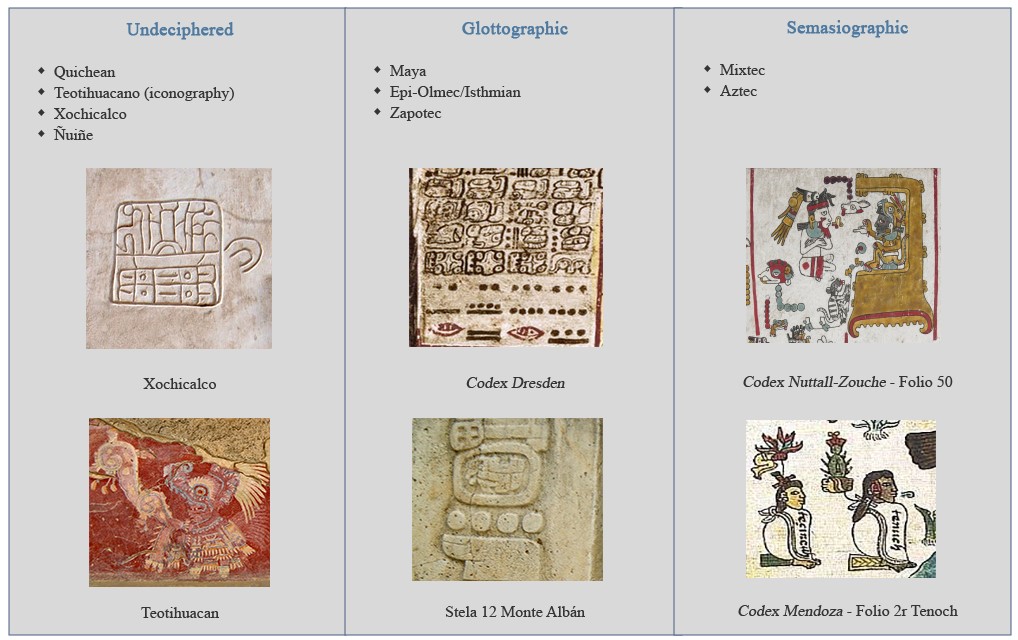
MAYA WRITING
Maya writing was the most sophisticated and complex of all Mesoamerican writing systems. It includes a corpus of around 1,000 individual signs, many of which are variant forms of the same core symbol. As a glottographic system, Maya writing combines two primary types of signs: logograms, which represent entire words or concepts, and syllabograms, which represent individual syllables. This mixed system allowed for flexible and nuanced expression, enabling the Maya to record dynastic histories, ritual practices, astronomical observations, and mythological narratives with remarkable detail and precision.
In fact, under this system, a Maya scribe had the flexibility to represent a word using a logogram (a single sign for the entire word) or to spell it out syllabically using a series of syllabograms. This dual approach allowed scribes to vary their writing for artistic, spatial, or linguistic reasons, demonstrating both the versatility and complexity of the Maya script.
Surviving Maya writing comes down to us in two forms. There are inscriptions found on a variety of mediums and from codices. Presently, there are only four Maya codices that have survived. These are the Dresden Codex, the Paris Codex, the Grolier Codex, and the Madrid Codex. A fifth is still under debate as to its authenticity. You will have an opportunity to practice Maya decipherment in this topic’s discussion board.
Maya writing is composed of glyph blocks. These glyph blocks could combine two to nine Maya glyphs at a time to convey a word or phrase. Classic Maya writing organized glyph blocks in vertical columns. The inscriptions were read two columns at a time from left to right using a zig zag pattern. Using the first four columns of the Yaxchilán Stela 11 (see image to the right) as an example, the inscriptions would be read in the following order:
- A1
- A2 B3
- A4 B5
- A6 B7
Having completed reading the first two columns (A and B), one would next move to the next two columns (C and D):
- C8 D9
- C10 D11
- C12 D13
- C14 D15
Should the last column not be paired with another, it is then read vertically.

There are several challenges one faces when reading the Maya writing system. First, Maya scribes had a wide latitude of flexibility on how they drew their glyphs, or whether they chose to use logograms or syllabograms.

Along with these factors, what also impacts the appearance of glyphs and glyph blocks is that in Maya writing more than one glyph could be used to make a particular sound. For example, in our writing system each letter of the alphabet has a particular sound attached to it. In the Maya writing system, more than one glyph can share a sound.
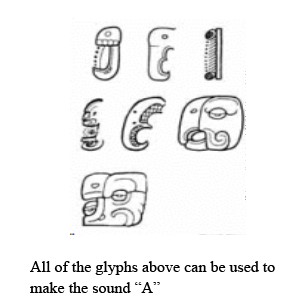
Maya scribes had iconographic forms to select from when writing which could be mixed. Most commonly used were geometric variants and head variants.

A Maya scribe could write using glyphs that denote a word or glyphs that denote a sound.

Glyphs identified as main signs are the largest group in Maya writing. More than 700 types of glyphs have been identified. These glyphs were rendered larger than others and many times served as a logogram. If there was more than one main glyph, overlapping, conflation, or infixation was applied by the scribe.

Affixes formed another category of glyphs of which there exist several hundred. In appearance, they are smaller than the main glyphs and can take the form of a prefix, postfix, superfix, subfix, and infix. The affixes modified the main sign’s value by:
- Spelling a word in conjunction with the main sign
- Complementing the main sign
- Grammatical functions ranging from third-person possessive pronouns to numerical classifiers

Maya numerical system compared.


As always, be sure to contact me or visit me during office hours should you have any questions about the content we have covered or the assignments that you need to complete.
 World History Portal