Timeline of Writing
Ice Ages Proto-writing, i.e. pictographic communication, in use
c. 8000–1500 B.C.E. Clay ‘tokens’ in use as counters, Middle East from
c. 3100 B.C.E. Cuneiform script, Mesopotamia; hieroglyphic script, Egypt
c. 2500 B.C.E. Indus Valley seal inscriptions, Pakistan/northwest India
c. 1750 B.C.E. Linear A script, Crete
c. 1450–1200 B.C.E. Linear B script, Crete/Greece
c. 1200 B.C.E. Oracle bone inscriptions in Chinese characters
c. 1000 B.C.E. Phoenician alphabet, Mediterranean
c. 900 B.C.E. Olmec inscriptions, Mexico from
c. 730 B.C.E. Greek alphabet
c. 221 B.C.E. Qin dynasty reforms Chinese character spelling
c. 2nd century C.E. Maya glyphic script, Mexico; Runic alphabet, northern Europe
Timeline source: Andrew Robinson, Writing and Script: A Very Short Introduction.
Specialists regard the invention of writing as a relatively recent technology with widespread applications. Writing performs several critical functions:
- Mnemonic Function: It supports and extends human memory.
- Aesthetic Function: It enables the creation of literature, poetry, and other artistic expressions.
- Regulatory Function: It facilitates social organization by recording laws, issuing decrees, registering community members, and referencing standards of human conduct.
- Communicative Range: It expands the ability to communicate over vast distances.
For many scholars, writing is considered one of humanity’s greatest cultural achievements, emerging alongside early agrarian complex societies. It is seen as a ‘cornerstone of modern life.’ As Florian Coulmas aptly summarizes in his The Writing Systems of the World (1989), ‘writing has to be seen as a result as well as a condition of civilization, as a product shaped by civilization and a tool shaping it.’
Mesopotamia
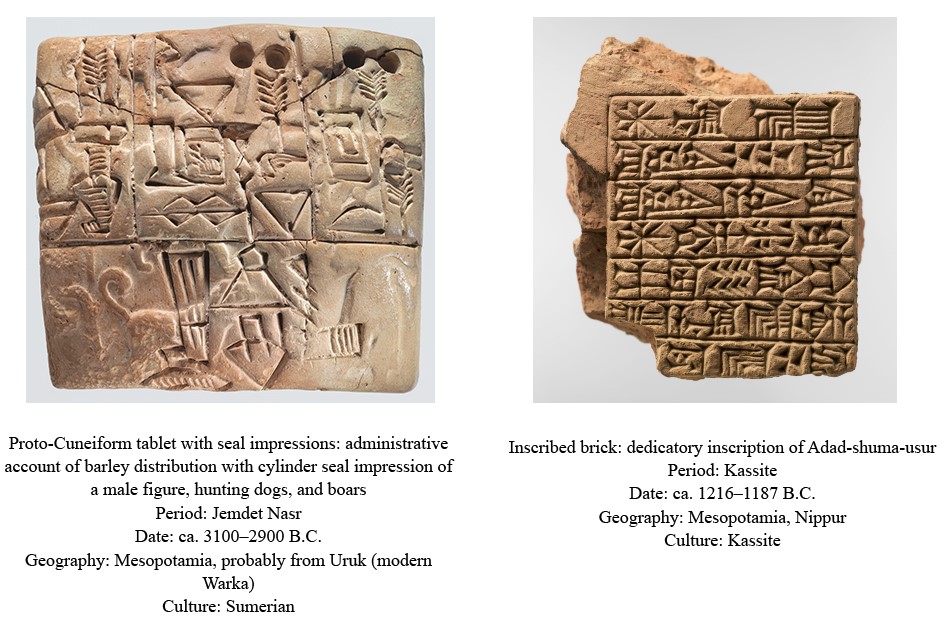
The Sumerians are credited with developing cuneiform (from the Latin cuneus, meaning ‘wedge’), a writing system that was adopted by several languages in Mesopotamia, including Akkadian, Babylonian, and Assyrian. Clay was the primary material used for writing in Mesopotamia. Because curved lines are difficult to draw on clay due to the tool sticking to the surface, cuneiform evolved into a linear script as scribes pressed wedge-shaped tools into the clay.
Initially, cuneiform began as a system of pictographs, with symbols representing objects either by their shape or a part of their shape. Over time, these pictographs were simplified and conventionalized, eventually incorporating phonetic elements. The earliest examples of writing in this region are found on tablets from Uruk and Jemdet Nasr. The Sumerian writing system comprised over 1,200 symbols.
Cuneiform was studied in the edubba (tablet house), where scribes underwent rigorous training involving extensive memorization and copying. Most scribes came from the upper stratum of society and were responsible for producing a wide variety of texts. These cuneiform records provide modern historians with invaluable insights into Mesopotamia’s history, culture, and governance.
Egypt
The discovery of the Rosetta Stone in 1799 by French forces at the port of el Rashid (Rosetta) was pivotal in recovering knowledge about ancient Egyptian writing. This granite slab is inscribed with the same text in three scripts: hieroglyphs, demotic (a cursive form of Egyptian writing), and Greek (see three-dimensional view of the Rosetta Stone).
The presence of Greek on the Rosetta Stone is explained by Egypt’s conquest by Alexander the Great (356–323 BCE), who established a Greek/Macedonian influence in the region. After Alexander’s death, the Ptolemaic dynasty, a Greek ruling family, governed Egypt. The Greek section of the Rosetta Stone revealed that the text was a decree dated to the reign of Ptolemy V (196 BCE). It detailed the lands and privileges of Egyptian temples. This information was repeated in both hieroglyphs and demotic.
Scholars used the Greek text as a foundation to gradually decipher the hieroglyphs and demotic inscriptions. The final breakthrough in decoding Egyptian hieroglyphs is credited to Jean-François Champollion (1790–1832), whose work unlocked the secrets of this ancient writing system.
Unlike in Mesopotamia, where clay was the primary writing medium, Egyptians wrote primarily on papyrus—a form of paper made from reeds that grew along the banks of the Nile. Scholars believe the term papyrus is derived from the Egyptian phrase pa-en-peraa, meaning ‘material of the Pharaoh.’ This papyrus was crafted from a now-extinct sub-species of Cyperus papyrus, which the Egyptians referred to as mehyt or tjufy.
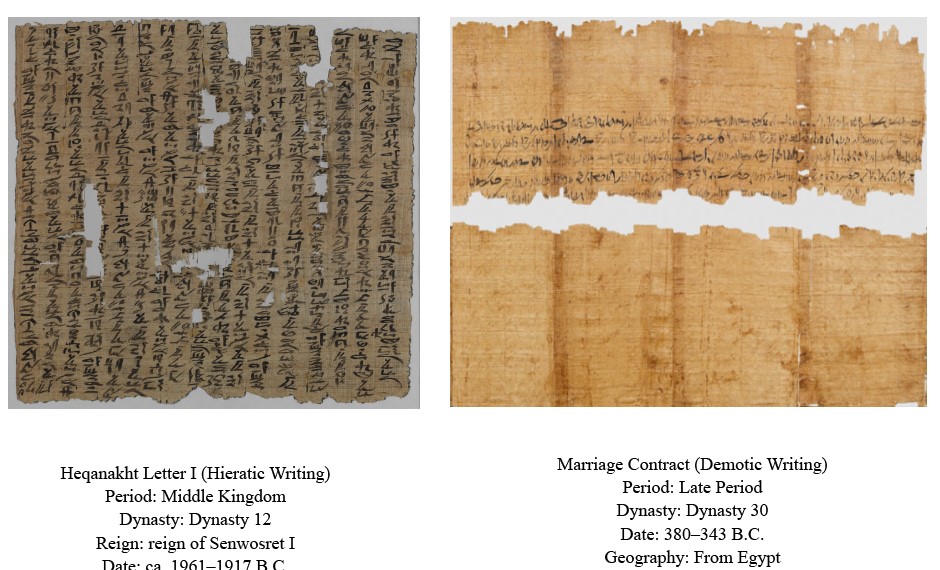
Egyptian writing evolved in different forms throughout various periods of their history. Hieroglyphs, a term derived from the Greek words hiero (‘sacred’) and glyphika (‘carvings’), were primarily used for religious texts and found on temples, religious structures, and papyrus with spiritual themes, such as The Book of the Dead. While several thousand hieroglyphic signs were created, only about 800 were commonly used in practice.
Hieroglyphs, while visually striking, were time-consuming to produce and impractical for documenting everyday activities. To address this, the Egyptians developed a cursive script known as hieratic, derived from the Greek word hieratikos, meaning ‘priestly.’ Evidence suggests that scribes initially learned hieratic before advancing to the more intricate hieroglyphic script.
The earliest extensive hieratic document dates back to the 5th Dynasty (c. 2600 BCE), with its use continuing until the third century CE. Later, another cursive script called demotic emerged, further streamlining writing for administrative and practical purposes in the evolving needs of Egyptian society.
Indus Valley
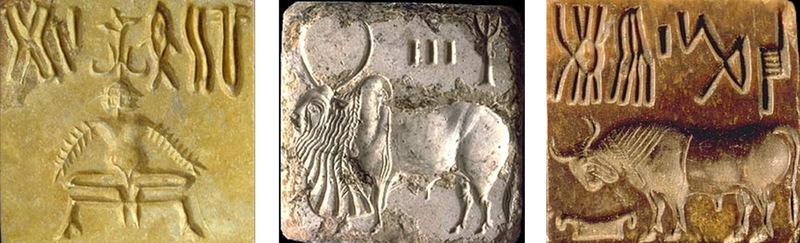
The Harappan system of writing remains undeciphered, leaving the archaeological record as the primary source for understanding this ancient civilization. Much of what is known about Harappan script comes from seals, which are typically flat and square or rectangular in shape. These seals often depict human figures or animals alongside inscriptions in the Harappan script. They were used to create impressions on various mediums, likely for administrative or trade purposes.
Scholars have identified nearly 400 distinct signs that make up the Harappan script, but the lack of a bilingual inscription, like the Rosetta Stone, has hindered efforts to interpret their meaning.
China
The origins of China’s writing system can be traced back to the Shang Dynasty (c. 1600–1050 BCE). Shang characters were first inscribed on oracle bones, which were used for divination to address concerns such as military campaigns, harvest predictions, and administrative matters. These inscriptions were typically made on turtle shells or animal bones (see three-dimensional view of oracle bone).
To date, over 150,000 oracle bone fragments have been uncovered, and more than 4,000 distinct characters identified. Of these, close to 40% have been deciphered. The Shang writing system was logographic, meaning that each symbol represented a word or idea. Over time, writing on oracle bones was replaced by inscriptions on other materials, including bamboo slips, silk scrolls, wooden plates, and eventually paper (1st century CE).
The writing system developed in China was highly influential, later adopted and adapted by neighboring cultures in Korea, Japan, and Vietnam, shaping the written traditions of East Asia.
Mesoamerica
Maya writing is recognized as the most complex of the Mesoamerican writing systems. It consists of approximately 1,000 signs, many of which are variations of the same symbol. As a glottographic writing system, Maya script incorporates both logograms (signs representing entire words) and syllabograms (signs representing syllables), allowing for a versatile and intricate method of communication.

Under the Maya writing system, scribes had the flexibility to represent a word using either a logogram or by spelling it out syllabically. Maya texts were typically arranged in a grid pattern and read from left to right.
Surviving examples of Maya writing exist in two primary forms: inscriptions on various mediums (such as stone, ceramics, and monuments) and codices. Currently, only four confirmed Maya codices have survived: the Dresden Codex, the Paris Codex, the Grolier Codex, and the Madrid Codex. A fifth codex remains a subject of scholarly debate regarding its authenticity.
In this topic’s discussion board, you’ll have an opportunity to practice deciphering Maya writing, exploring the intricacies of this fascinating script.
Maya writing is composed of glyph blocks, which could combine two to nine individual glyphs to represent a word or phrase. In Classic Maya writing, these glyph blocks were organized into vertical columns, with inscriptions read in a zigzag pattern—two columns at a time, from left to right.
For example, using the first four columns of the Yaxchilán Stela 11 (refer to the image to the right), the reading order would proceed as follows:
- A1
- A2 B3
- A4 B5
- A6 B7
Having completed reading the first two columns (A and B), one would next move to the next two columns (C and D):
- C8 D9
- C10 D11
- C12 D13
- C14 D15
Should the last column not be paired with another, it is then read vertically.

There are several challenges inherent in reading the Maya writing system. One significant difficulty is the flexibility afforded to Maya scribes in how they drew their glyphs. Scribes could vary the artistic style of glyphs significantly, sometimes making them elaborate and ornate. Additionally, scribes had the option to use either logograms (symbols representing whole words) or syllabograms (symbols representing syllables), which added another layer of complexity to interpreting the script.

Another factor influencing the appearance of Maya glyphs and glyph blocks is the multiple representations of sounds within the writing system. Unlike modern alphabetic systems, where each letter corresponds to a specific sound, the Maya writing system allowed for more than one glyph to represent the same sound. This variability added another level of complexity for readers and scribes alike, as the choice of glyphs could depend on stylistic, contextual, or aesthetic preferences.
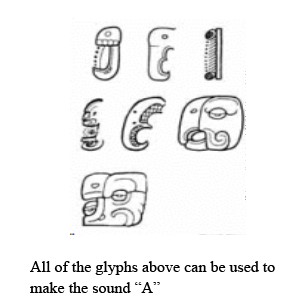
Maya scribes had a variety of iconographic forms to choose from when composing their inscriptions, and they often mixed these forms within the same text. The most commonly used were geometric variants, which featured stylized and abstract shapes, and head variants, which depicted glyphs as human or animal faces, adding an intricate and artistic dimension to the writing.

A Maya scribe could write using glyphs that denote a word or glyphs that denote a sound.

Glyphs classified as main signs form the largest group in Maya writing, with over 700 types identified. These glyphs were typically rendered larger than others in inscriptions and often served as logograms, representing entire words.
When multiple main glyphs were used in a single glyph block, scribes employed techniques such as overlapping, conflation, or infixation to combine them seamlessly while maintaining the aesthetic and functional integrity of the script.

Affixes constituted another significant category of glyphs in Maya writing, with several hundred identified. These glyphs are smaller in size compared to the main signs and could be positioned as prefixes, postfixes, superfixes, subfixes, or infixes within a glyph block.
Affixes modified the value of the main sign by:
- Spelling a word in conjunction with the main sign.
- Complementing the main sign.
- Grammatical functions ranging from third-person possessive pronouns to numerical classifiers.

Maya numerical system compared.


 World History Portal