INTRODUCTION
This topic explores the transformative period between 800 and 200 B.C.E., termed the Axial Age by philosopher Karl Jaspers. Religious and philosophical developments during the Axial Age significantly influenced the evolution of human societies, shaping philosophical and religious traditions that continue to impact the modern world. Key points in this topic include:
- Definition and Significance: The Axial Age represents a pivotal era in human history when profound philosophical and religious ideas emerged independently across various regions, laying the foundations for modern thought and world religions.
- Pre-Axial Religious Practices: Prior to this period, religions were predominantly collective, emphasizing rituals and sacrifices conducted by designated agents on behalf of the community to ensure prosperity and social order.
- Characteristics of Axial Age Thought: This era introduced a shift towards individual introspection, ethical considerations, and the pursuit of spiritual enlightenment. It questioned existing social structures and religious doctrines, leading to the development of philosophies and religions that emphasized personal transformation and moral conduct.
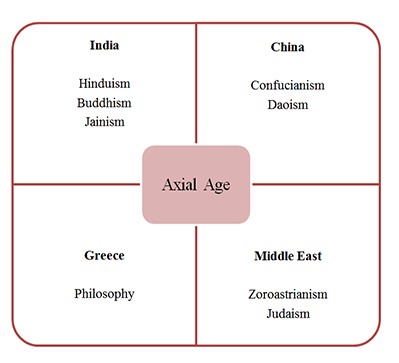
- Geographical Scope: The Axial Age witnessed the rise of influential thinkers and movements in regions such as Greece, Israel/Palestine, India, China, and Iran, including the emergence of Buddhism, Jainism, Hinduism, Daoism, Confucianism, and the foundations of Western philosophy.
- Impact on Social Structures: The new modes of thought challenged existing power dynamics and class structures, promoting ideas of equality, justice, and the importance of individual moral responsibility.
KARL JASPERS AND THE AXIAL AGE
The concept of the Axial Age, as framed by Karl Jaspers (1908–1969) in his seminal 1949 work The Origins and Goal of History, represents a pivotal hypothesis in understanding human history. While not without its critics, the idea is worth examining due to its assertion that parallel cultural developments between 800 and 200 BCE in regions such as China, Greece, India, Iran, and Israel-Palestine marked a global turning point toward modernity. Jaspers regarded this era as a transformative period, referring to it as “the most crucial turning point in history,” during which, in his view, “man as he is today was born.” For Jaspers, the Axial Age symbolized the foundation of many intellectual, spiritual, and philosophical traditions that continue to shape humanity.
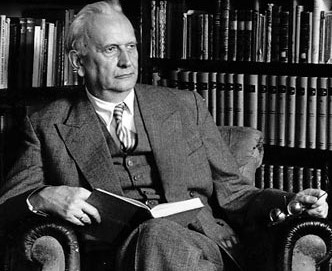
Jaspers explains, that “What is new about this age . . . is that man becomes conscious of being as a whole . . . asks radical questions . . . he strives for liberation and redemption.” Jaspers concludes that in the Axial Age “were born the fundamental categories within which we still think today, and the beginnings of the world religions, by which human beings still live, were created.”
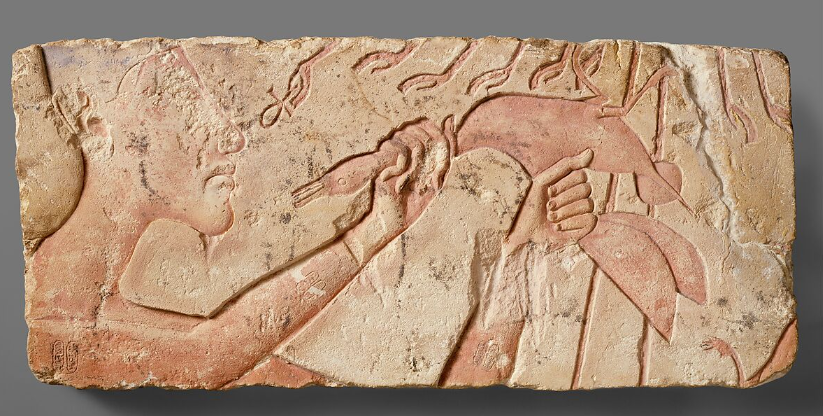
Before the Axial Age, religion was deeply intertwined with social life, emphasizing the primacy of the collective over the individual. Human relationships with the gods were defined collectively rather than personally, with communal rituals taking precedence over individual spiritual experiences. These rituals, often controlled by designated agents acting on behalf of the community, were central to religious practice, leaving little room for direct interaction between individuals and the divine. The primary focus of these early religions was on achieving human flourishing—securing prosperity, long life, freedom from disease, and protection from natural catastrophes. Rituals, often involving sacrifices, were performed to appease the gods and ensure a prosperous life. However, an important consequence of these religions, particularly within early state religions, was the reinforcement of social hierarchies and systemic inequality. By linking domination and exploitation to the sacred, these religions contributed to the entrenchment of societal structures, as their primary aim was to maintain social order.
The civilizations that developed between c. 1000-500 B.C.E. built upon the achievements of the river-valley civilizations. These new civilizations differed from earlier ones in the following ways:
- The creation of empires with a larger geographic range.
- The extension of a common culture.
- The expansion of commercial activity.
- Increased socio-political complexity.
- Increased cosmopolitanism.
- Increased presence of writing and record keeping technologies.
- Increased warfare/inter-civilizational conflict.
In the eyes of many historians, these factor fermented an environment that facilitated the shift in religious/philosophical thought represented in the Axial Age.
WHAT DID THE AXIAL AGE QUESTION?
The Axial Age marked a transformative period that challenged the structure and doctrines of early religions across five key regions: Greece, Israel/Palestine, India, China, and Iran. During this time, people began to question the traditional beliefs and practices that had dominated earlier religious systems, seeking deeper understanding of life, the nature of the world, and the principles by which one should live. This era laid the foundations for many of the modern religions and philosophical systems we recognize today, including Buddhism, Jainism, Hinduism, Daoism, Confucianism, and Judaism, while also sparking the emergence of Greek philosophy. By reexamining the purpose and meaning of existence, the Axial Age set the stage for a more introspective, ethical, and universal approach to religion and thought.
The Axial Age not only revolutionized existing religious and philosophical traditions but also paved the way for the later development of Christianity and Islam. This period of cognitive and behavioral awakening redefined the highest human goals, moving beyond the earlier focus on material prosperity and human flourishing. As a result, a new ideal emerged—one centered on salvation, transcending the traditional understanding of worldly success. The Axial Age inspired humanity to grapple with deeper, more profound questions about life, its purpose, and its ultimate aim, encouraging a shift toward meaningful, spiritual, and existential exploration that continues to shape human thought and belief systems.
When examining the outcomes of the Axial Age, it becomes clear that the movements of this period fundamentally challenged the established traditions and structures of their time. Existing power dynamics, social hierarchies, and the religious and philosophical systems that legitimized these structures were subjected to critical scrutiny. One significant area of focus was class structures—the organizing socioeconomic principle of early civilizations. While there was no uniform approach to class across the various cultures of the Axial Age, a shared thread among its thinkers was the belief in “individual self-determination in the most important affairs of life” and the idea that “humans are equally capable of thought and, therefore, had access to the new enlightenment.” In some cases, this belief fostered an egalitarian ethic, or at least a willingness to entertain the possibility of greater social equality.
The legitimacy of the ruling elite and the rituals and theological justifications that upheld their authority were often critiqued during this era. In their place, emphasis shifted to religious and philosophical systems that prioritized individual accountability and the idea that salvation, redemption, or liberation was attainable for each person with proper guidance. This shift marked a move away from ritualistic traditions toward moral and ethical frameworks as central tenets of spiritual and philosophical thought. Additionally, the Axial Age saw the rise of rationalism in certain regions, applying reason to political, ethical, and natural questions. This combination of moral introspection and rational inquiry marked a profound evolution in the way societies viewed governance, ethics, and the human condition.
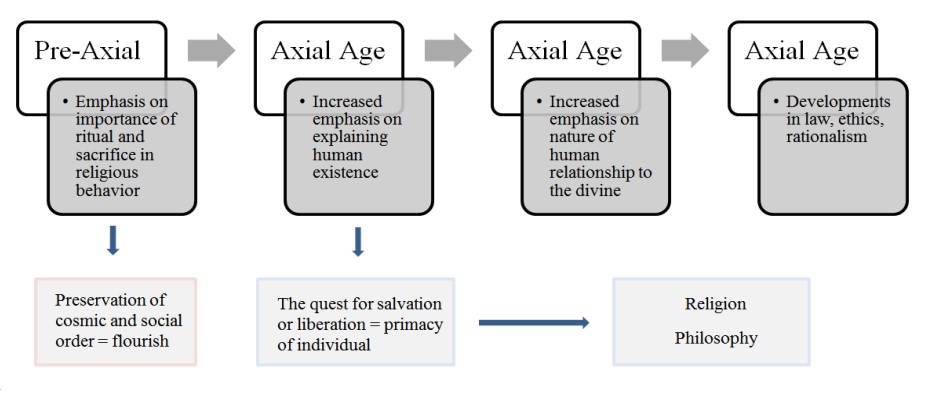
In the end, the critical evaluation of existing religious and philosophical traditions during the Axial Age placed its emerging systems of thought in direct tension with the pre-existing emphasis on human flourishing. This raises the question: what was the Axial Age, and why is it relevant to the study of world history? One historian describes the Axial Age as “a series of profound cultural transformations that occurred in some of the major civilizations of the Eastern Mediterranean, the Near East, and South and East Asia in the centuries around the middle of the first millennium B.C.E.” But was it primarily a socio-cultural process of transformation, or was it a spiritual awakening in the broader course of human history? Scholars continue to debate the nature of the Axial Age, with some questioning whether it can truly be identified as a specific period within a defined spatial and temporal framework.
IN CLOSING
Regardless of differing interpretations, what remains clear is that this era witnessed profound transformations in religious and philosophical thought, many of which continue to shape human beliefs and values today. Whether through the ethical systems it introduced, its emphasis on individual accountability, or its movement away from ritualistic practices toward moral and spiritual introspection, the Axial Age left an enduring legacy. Indeed, many of us still grapple with the questions posed by Axial Age thinkers as we seek to answer fundamental inquiries about the nature of existence, the purpose of life, and humanity’s place in the world. These profound questions have occupied human thought for millennia, shaping philosophical, religious, and scientific inquiry across cultures and eras. These timeless questions, urgent and evolving, invite each generation to revisit them, not only reflecting on our origins and destinations but also on the very journey of being human.
In the next series of topics we will explore some of these religious and philosophical movements that that had their origin in the Axial Age.
 World History Portal