LEARNING OBJECTIVES
- Explain what was Greek Humanism and trace the rise of Demorkratia.
- Explain the evolution of philosophy and identify some of its key sages.
- Explain the rise of Hellenism and the importance of libraries.
View Timeline: Ancient Greece
The Homeric Age
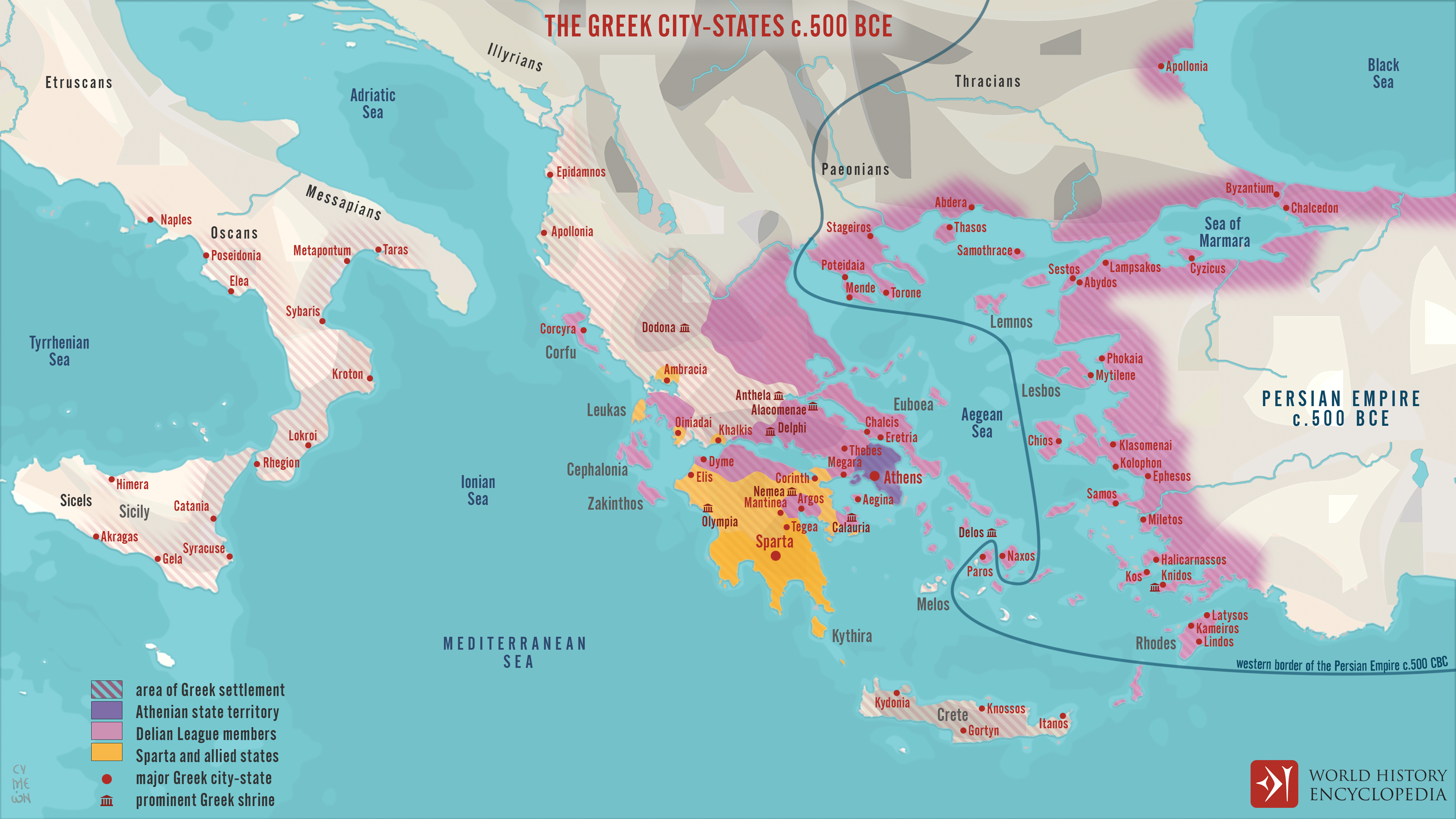
The collapse of Mycenaean civilization plunged ancient Greece into a period of depopulation and urban decline, often referred to by scholars as the Dark Age. This era also saw the disappearance of Linear B writing on mainland Greece, leaving historians with limited knowledge about the region’s history during this time. However, toward the end of the Greek Dark Age, around the 8th century B.C.E., Homer composed the epic oral poems the Iliad and the Odyssey. These epics offer valuable insight into the socioeconomic and political dynamics of the “Homeric” world. For instance, they reveal a society dominated by a warrior aristocracy, where warfare was a constant feature of life. In this unstable world, public standing and competitive values were paramount: warriors strove to “win glory in battle and, thereby, the public acknowledgment of their achievements.” In such a society, victory was everything, while public humiliation was to be avoided at all costs.
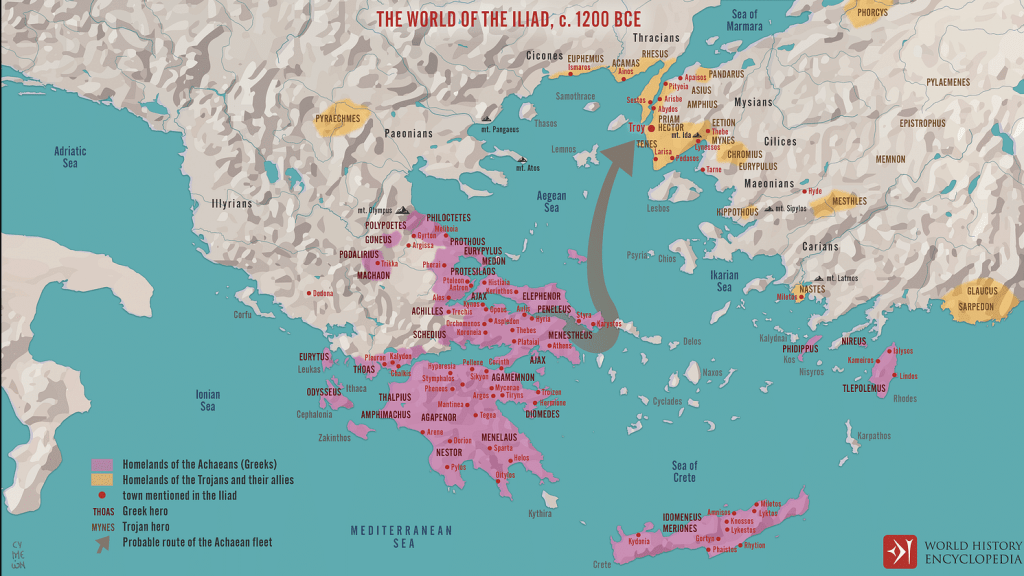
We learn from Homer’s work that heroes, such as Achilles, lived for areté, a term that loosely translates to greatness or excellence. The combination of areté (greatness/excellence) and nike (victory) led to kleos (fame) and timé (honor), and it was these two—fame and honor—that gave meaning and value to one’s life in the Homeric Age. Historians argue that through Homer’s work, we are also introduced to Greek humanism, which focuses on human potential and the capacity for achievement. Homer emphasizes this idea in a dialogue between the warrior Achilles and the wise Phoenix, who declares that a man of true worth is both a “speaker of words and a doer of deeds.” While religion remained a part of their lives, Greek life during this period was primarily dominated by a secular worldview that celebrated individualism and personal accomplishments.
The religion practiced in ancient Greece envisioned a universe governed by the Olympian gods, with Zeus, the king of the gods and “father of gods and men,” at its head. Hesiod, an epic poet of the late 8th or early 7th century B.C.E., deepens our understanding of these deities through his work Theogony, which details the origins of the gods and the universe. The Olympian gods, temporal in nature, reflected Homeric values and frequently intervened in the lives of humans. Greek religion, however, did not emphasize eschatological concerns, such as the soul or the afterlife, but instead focused on life on earth. What fundamentally distinguished the gods from humans was their immortality and their unmatched power.
Classical Greece
One historian has noted that “Classical Athenians were the first to articulate and implement the notion that ordinary citizens of no particular affluence or education could make responsible political decisions.”
This political concept was known as demokratia (demos = the people, kratos = rule). The fundamental ideal associated with demokratia was political liberty, meaning that Athenian citizens had the freedom to actively participate in the political process.
The Athenian concept of equality was confined to the political sphere and did not extend to the socio-economic realm. Political rights were exclusively granted to adult male citizens of Athens, while women, metics (foreign residents), and slaves were entirely excluded from participation in the political process.
Sources suggest that Athens was initially governed by a monarchy, which later transitioned to rule by leading noble families. By 594 B.C.E., economic problems and political discord had reached a breaking point in Athenian history. Farmers, in particular, were heavily burdened by accumulating debt, leading to widespread dissatisfaction. Many Athenians believed that greed had disrupted the cohesion of community life, making civil war seem inevitable.
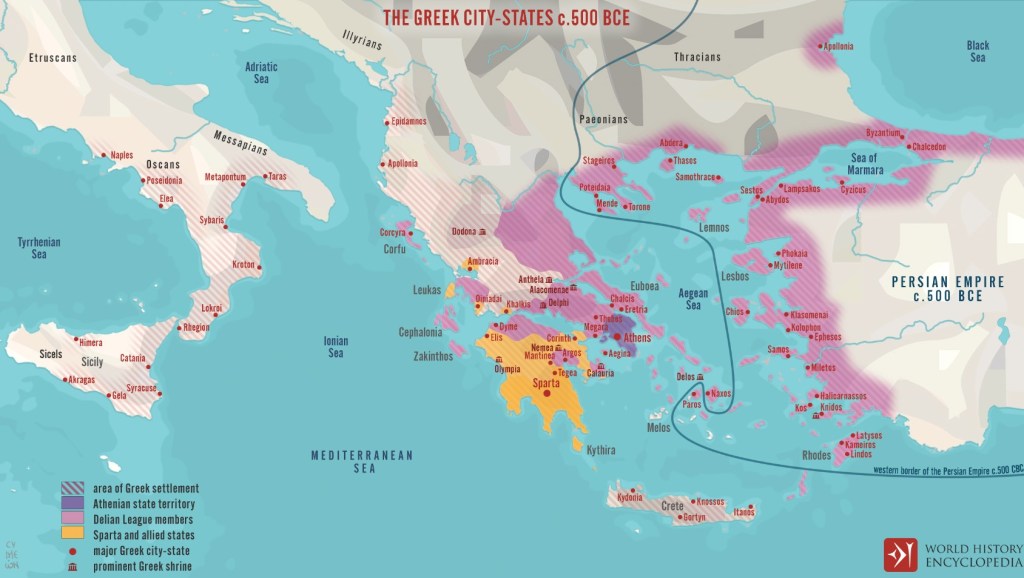
The origins of the Athenian political system can be traced back to the reforms introduced by Solon (640–559 B.C.E.). Historians suggest that Athens was initially governed by a monarchy, which later transitioned to rule by leading noble families. By 594 B.C.E., however, Athens faced a period of severe economic and political crisis. Farmers, in particular, were heavily burdened by insurmountable debts, and tensions between the social classes threatened the stability of the city-state. This critical juncture set the stage for Solon’s reforms, which aimed to address these issues and lay the foundation for a more inclusive political system.
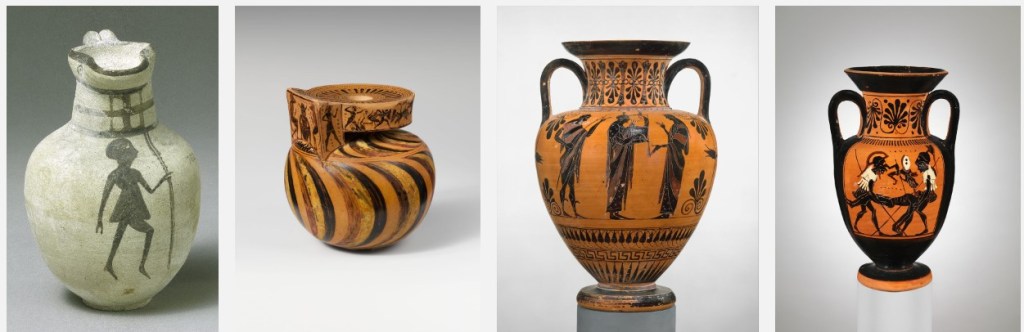
Many Athenians believed that greed had fractured community life in Athens, making civil war seem inevitable. Solon’s reforms sought to prevent class conflict and promote a sense of diké—the principle of communal justice. To address one of Athens’ greatest challenges, Solon eliminated the debts of the impoverished and freed those who had been enslaved due to their inability to repay them. His reforms extended beyond economic relief, introducing a new political system in which political privilege was determined by income or property rather than noble birth. This broadened political participation, allowing wealthy non-nobles to hold office alongside members of the noble families, thereby reshaping the foundations of Athenian governance.
The reforms of Kleisthenes (508 B.C.E.) are widely regarded as the foundation of demokratia in Athens. Through his reforms, Kleisthenes aimed to weaken the traditional power base of the Athenian nobility, who often engaged in rivalries that undermined the stability of the city-state. To achieve this, he dismantled the old tribal system of four Ionic tribes, which had been dominated by noble families and had allowed them to control Athenian politics. In its place, Kleisthenes reorganized Attica into three regions: city, coast, and inland. Each region was then divided into ten sections called trittyes, creating a total of 30 trittyes. The new tribes were formed by combining one trittye from each region—city, coast, and inland—thereby disrupting the traditional concentration of power and fostering a more inclusive and balanced political structure.
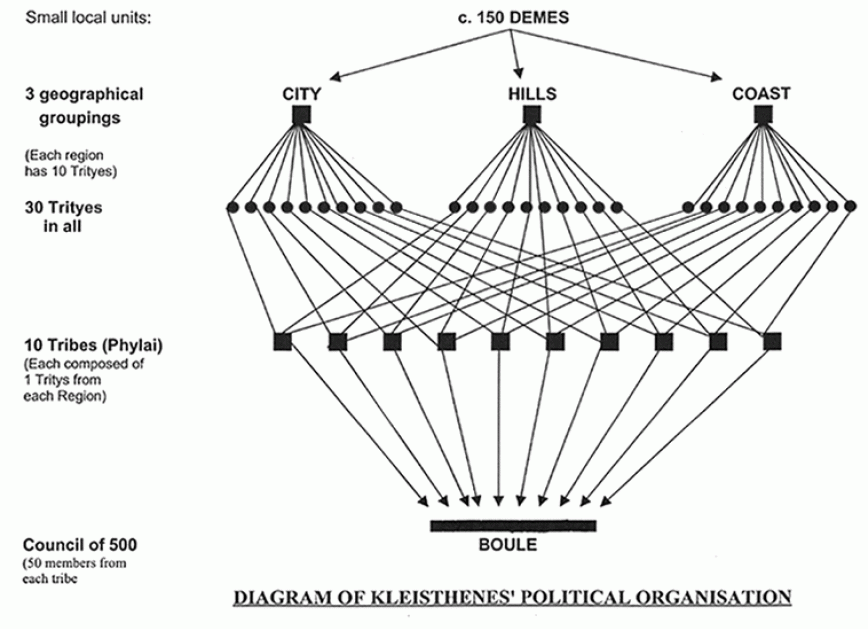
Kleisthenes also introduced the Council of 500, or Boule, to the Athenian government, granting it executive powers. This council was composed of 500 Athenian citizens, with each of the ten tribes contributing 50 members chosen by lot. To further safeguard Athens from the rise of tyranny, Kleisthenes implemented the practice of ostracism. This practice allowed citizens to inscribe the name of an individual they believed threatened Athenian political ideals onto a pottery shard, or ostrakon. The individual who received the most votes was exiled from Athens for a period of 10 years. Kleisthenes’ political reforms effectively dismantled local power structures and the dominance of the nobility, placing the control of the Athenian government firmly in the hands of its citizens..
Pericles (495–429 B.C.E.) transformed Athens into a maritime power, a hub of learning, and a city of architectural marvels. One of his key contributions to demokratia was the introduction of misthophoria—the practice of paying citizens for jury service. As described in The Constitution of the Athenians, “Pericles was the first man to provide payment for jury service as a political measure . . . . For when the people are masters of the vote in court, they become masters of the state.” Although the salaries were modest, this reform enabled any Athenian citizen, regardless of wealth, to participate in public service, ensuring broader involvement in the democratic process.
The Persian and Peloponnesian Wars
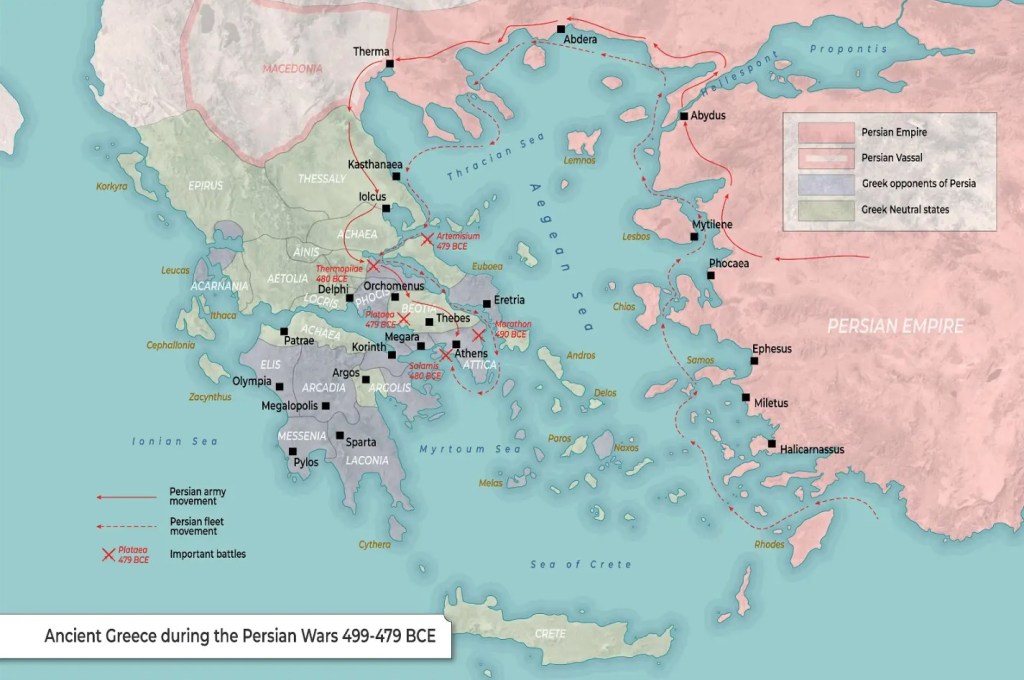
Athens’ rise to power was closely tied to its involvement in the Persian Wars (499–479 B.C.E.), which began in Ionia. In 546 B.C.E., the Persian ruler Cyrus (r. 559–529 B.C.E.) overthrew Croesus, King of Lydia, and incorporated Anatolia into the Persian Empire. Persian ambitions for territorial expansion continued under Darius I (r. 524–486 B.C.E.), who sought to extend Persian control into Thrace, a policy that directly threatened Athens, as the city depended heavily on grain imported from the region.
Persian expansion under Xerxes (r. 485–465 B.C.E.) next targeted the Cyclades, prompting Athens to take a leading role in the Greek resistance when Sparta, the most powerful Greek city-state, declined to engage in a distant military campaign. Athens, along with several other city-states, formed the Delian League to combat the Persian threat. However, the League’s success and Athens’ growing power alarmed many of its allies, ultimately sowing the seeds for internal conflict among the Greek city-states, culminating in the Peloponnesian War.
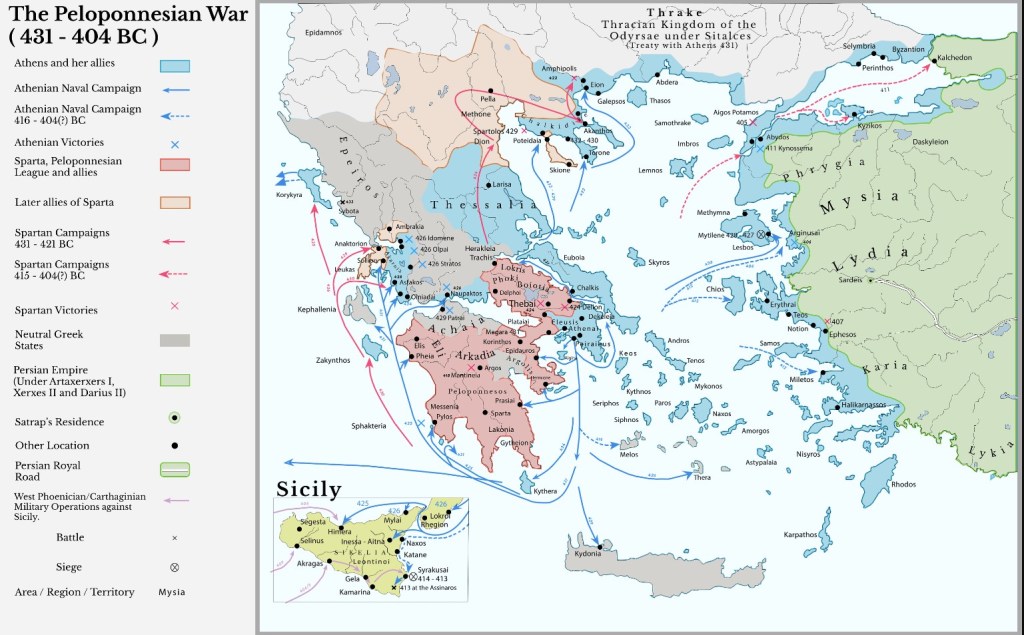
For many historians, Thucydides is regarded as the founder of political philosophy in the West. His History of the Peloponnesian War, filled with speeches and incisive analysis, portrays politics as driven by the “pursuit of material advantage and power.” Unlike earlier historians, Thucydides did not cloak Athenian expansion in idealistic or moral justifications. Instead, he openly acknowledged that Athens expanded simply because it had the power to do so, famously stating, “The weak suffer what they must.” The Peloponnesian War devastated mainland Greece, weakening city-states such as Athens, Sparta, and their respective allies. This widespread decline paved the way for a new regional power—Macedon—to rise. Macedon’s expansion, under leaders such as Philip II and Alexander the Great, ushered in the era of Hellenism, spreading Greek culture across the Mediterranean and beyond.
Philosophy
Historians believe that Greek philosophy, the systematic search for knowledge, originated in the coastal city-states of Ionia. Greek philosophers based their assertions on reason and critical thought, seeking to understand and explain the world around them. Many historians argue that the nature of Greek religion, which revealed aspects of human nature but lacked profound spiritual insight, made this intellectual pursuit necessary. Others suggest that Greek exposure to eastern sciences and worldviews, as well as the turmoil and disorder caused by the Peloponnesian War, motivated this shift in thinking. Regardless of the cause, the earliest Greek philosophers, based in Ionia, focused on the natural world, striving to uncover the fundamental principles that governed it and to explain the origins of all that could be seen.
Thales of Miletus (c. 624–546 B.C.E.), regarded as one of the first Greek philosophers, exemplified this intellectual shift. Although none of Thales’ works survive, his ideas are known through later writers such as Herodotus and Aristotle. In Metaphysics, Aristotle explains that Thales proposed water as the material source of all things. Another Ionian thinker, Pythagoras of Samos (c. 571–496 B.C.E.), founded a community in Croton (southern Italy) that emphasized a “strong scientific” spirit. According to tradition, the Pythagoreans believed that all things were quantifiable, and thus numbers were the ultimate principle of all existence.
Unlike these early speculative philosophers, the Sophists turned their attention to practical concerns. They applied rational thought to human culture, society, and politics rather than the natural world. Sophists traveled throughout the Greek world, offering instruction and lectures on subjects such as rhetoric, politics, grammar, history, and mathematics. Their teaching aimed to prepare citizens for active participation in political life, equipping them with the skills necessary for success in the public arena. However, because they accepted payment for their services, the Sophists were criticized by philosophers such as Plato, who viewed their work as less noble. Despite this criticism, their influence on Greek education and politics was profound, as they provided free citizens with tools to navigate and excel in the political life of the polis.
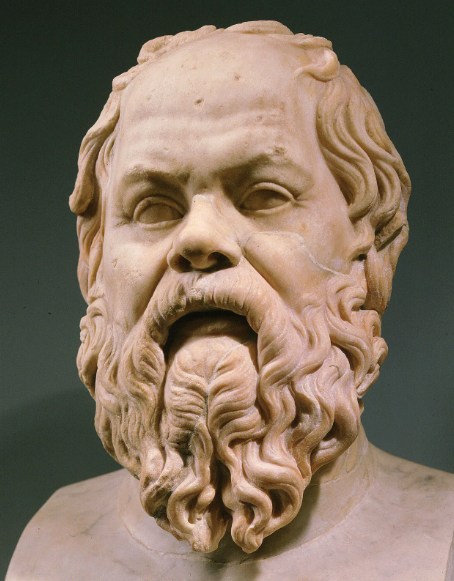
Of all the ancient Greek philosophers, Socrates (c. 449–399 B.C.E.) stands as a cultural cornerstone of the Western intellectual tradition. Unfortunately, Socrates left behind no written works, and our understanding of his philosophy comes primarily from the dialogues of his student Plato. Socrates’ central concern was the pursuit of moral excellence, which he believed could be achieved through human reason rather than reliance on a god or gods. Above all, Socrates was devoted to the search for truth in all aspects of life.
What most distinguishes Socrates is his method of inquiry, which sought to help individuals attain self-knowledge. He famously asserted that recognizing one’s own ignorance was the first step toward gaining true knowledge. For Socrates, no belief or assumption should go unquestioned, and he subjected everything to dialectics—rigorous logical discussion—believing that this process was essential for uncovering truth and achieving wisdom.
Plato, also known as Aristocles (c. 429–347 B.C.E.), was a devoted student of Socrates and went on to become one of the most influential philosophers in Western history. He founded the Academy, a school of philosophy dedicated to continuing the intellectual traditions of his teacher. Unlike Socrates, Plato left behind a substantial body of written work, many of which have survived to the present day. However, Plato rarely, if ever, “speaks directly to his audience.” His works are composed in the form of dialogues, where characters engage in discussions to explore philosophical ideas.
Among Plato’s most well-known dialogues are the Apology, which details the philosophical life and defense of Socrates; the Phaedo, which introduces the theory of forms and discusses the immortality of the soul; and the Republic, which outlines Plato’s vision of an ideal society governed by philosopher-kings. These works continue to serve as foundational texts in the study of philosophy.
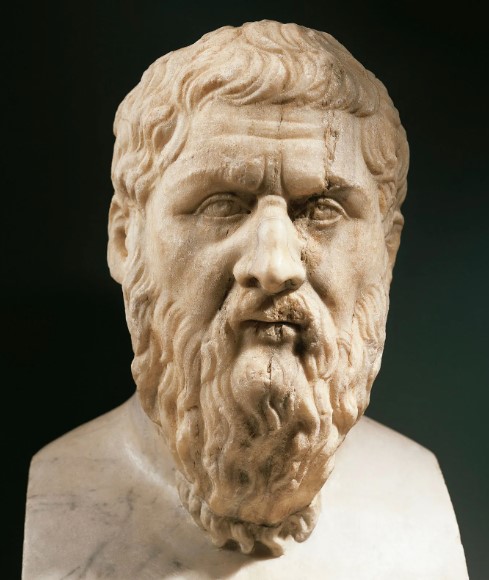
Plato believed that true knowledge could only be knowledge of eternal values, which were unchanging and not subject to the shifting impressions of the senses. These eternal values, according to Plato, resided in a “higher world of reality” that existed independently of the physical world we experience daily. Central to his philosophy was the Theory of Forms. Forms, residing in this higher realm, were ideal exemplars that served as perfect standards of judgment. For Plato, true wisdom could not be achieved through sensory experience but only through knowledge of these eternal Ideas.
Plato also applied his philosophy to envisioning an ideal state based on reason. Having lived through the chaos of the Peloponnesian War and the unjust execution of his mentor Socrates, Plato became deeply critical of Athenian politics. In his dialogue The Republic, he critiques the political systems of his time and proposes a model for a just state where power is guided by reason and philosophy. This work remains one of the most influential explorations of justice, governance, and the relationship between power and wisdom in Western thought.
Aristotle of Stagirus (c. 384–322 B.C.E.), a student of Plato, became one of the most influential thinkers in Western history. In 342 B.C.E., he served as a tutor to the young Alexander the Great and later established his own school in Athens, the Lyceum. Aristotle’s students were known as Peripatetics, a name derived from his habit of walking, or “strolling,” while delivering his lectures.
Aristotle’s philosophical interests were remarkably broad, encompassing fields such as ethics, politics, metaphysics, biology, physics, logic, and more. Many of his works, which are believed to be lecture notes, have survived to the present day. Due to the expansive nature of his studies, Aristotle is often referred to as the synthesizer of Greek knowledge, as he integrated and built upon the ideas of his predecessors while developing original contributions across a wide range of disciplines.
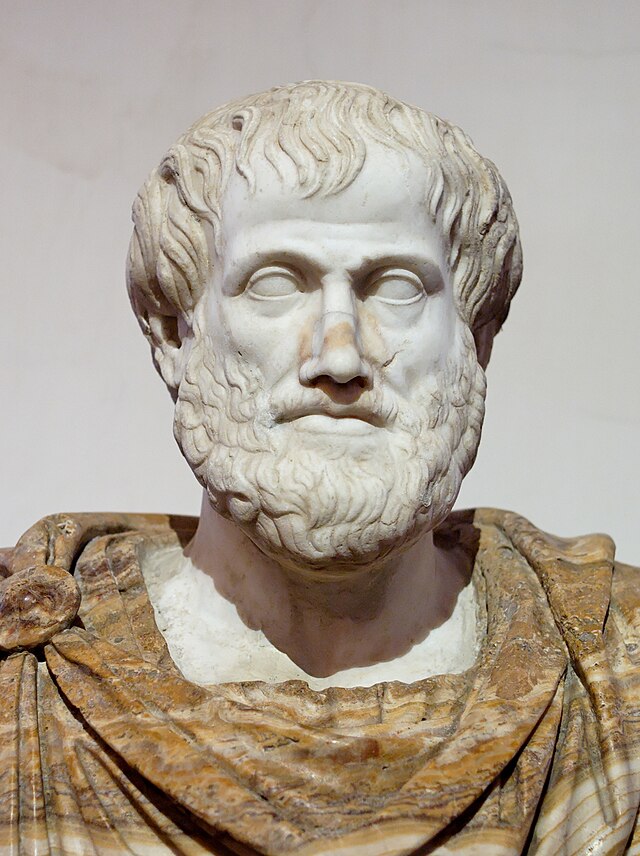
Some of Aristotle’s most significant works focused on logic, ethics, physics, natural history, metaphysics, and politics. Unlike Plato, Aristotle did not distrust the senses; instead, he relied on observation and experimentation to study the world. He was deeply interested in the nature of the universe and the components that make it up. Central to Aristotle’s philosophy is the concept of teleology—the idea that everything has a purpose or end goal.
In contrast to Plato’s belief in a higher world of eternal Forms, Aristotle rejected the existence of such a separate realm. Instead, he developed the Theory of Substance, which held that the individual things of this world are what truly exist. For Aristotle, Forms were not separate, abstract entities but were embedded within particular things. As a result, Aristotle believed that the answers to humanity’s questions could be found through the examination of the natural world, making this world—not a higher, idealized one—the focus of his philosophy.
The Hellenistic Period
The Classical Period eventually transitioned into the Hellenistic Period, an era marked by the diffusion of Greek culture throughout the Near East and as far as India. This cultural expansion was made possible by the conquests of Alexander the Great (r. 336–324 B.C.E.) and the earlier rise of Macedonian power. Macedon had been politically and geographically unified under King Perdiccas I (c. 7th century B.C.E.), but its political history was plagued by frequent dynastic conflicts. One such conflict arose in 360 B.C.E. following the untimely death of Perdiccas III. Philip II, the late monarch’s brother, was appointed regent for Perdiccas’s young son. However, after a few years, Philip II seized power by murdering his nephew and claiming the throne.
Philip II’s ambitions extended beyond Macedon. He sought control of the interior of Greece and its coastline, aiming to unify the fragmented Greek city-states under his rule. At the Battle of Chaeronea (338 B.C.E.), Philip decisively defeated the forces of Athens and Thebes, establishing Macedon as the dominant power in Greece. With Greece under his control, Philip set his sights on liberating the Greek cities of Ionia from Persian rule. However, his plans for a grand invasion of the Persian Empire were abruptly ended in 336 B.C.E., when he was assassinated. This left the task of conquest to his son, Alexander the Great, who would go on to forge one of the largest empires of the ancient world.
Alexander the Great succeeded his father, Philip II, as ruler of Macedon and embarked on one of the most ambitious military campaigns in history. In 333 B.C.E., Alexander crossed into Persia with an infantry of approximately 30,000 and a cavalry of 5,000. Over the next decade (333–324 B.C.E.), he created one of the largest empires the ancient world had ever seen. In 333 B.C.E., Alexander began his series of major battles against the Persian forces, and in 331 B.C.E., he founded the city of Alexandria, which would become the capital of the western region of his empire. That same year, Alexander achieved a decisive victory over the Persian army at the Battle of Arbela (Gaugamela) in Mesopotamia, cementing his control over the Persian Empire.
Alexander continued his campaigns into India but was forced to halt his eastward expansion in 326 B.C.E. due to a mutiny among his troops at the Hyphasis River. Returning to Babylon, Alexander’s campaigns came to an abrupt end with his death from a fever in 324 B.C.E. His untimely death led to the fragmentation of his empire, as his generals (the Diadochi) fought for control. Between 323 and 275 B.C.E., three major Hellenistic kingdoms emerged from his conquests: Ptolemy Soter I (367–283 B.C.E.) established the Ptolemaic Kingdom in Egypt, Seleucus Nicator I (358–280 B.C.E.) founded the Seleucid Kingdom in Mesopotamia, and Antigonus Gonatas I (382–301 B.C.E.) created the Antigonid Kingdom in Asia Minor and Macedon. These Hellenistic kingdoms thrived for a time but eventually succumbed to the expansion of Rome, which brought an end to the Hellenistic age.
To better govern their diverse subjects, the rulers of the Hellenistic kingdoms established royal libraries in their new capitals. These libraries were designed to collect the written works of the peoples they conquered, aiming to better understand their cultures and knowledge. Among the Hellenistic rulers, the Ptolemies were particularly ambitious in this endeavor, striving to gather the “world’s” knowledge and have it translated into Greek.
Two great libraries came to dominate the Hellenistic world: the Library of Pergamum (established around 196 B.C.E.) and the famous Library of Alexandria. The competition between these two institutions reflected the intellectual ambition of the age. The Library of Alexandria, in particular, became legendary for its vast collection of knowledge. Isidore of Seville (c. 560–636 C.E.) provides some insight into the significance of libraries in his Etymologies, explaining, “Library, bibliotheca, is a word of Greek origin . . . biblion, for books, theke, depository.” He also notes that the Library of Alexandria housed an impressive 70,000 volumes, underscoring its status as a center of learning and scholarship in the ancient world.
These libraries not only preserved the works of the conquered but also became hubs for translating, interpreting, and expanding knowledge, cementing the Hellenistic period as a golden age of intellectual and cultural exchange.
The Library of Alexandria is believed to have been established under the reign of Ptolemy II Philadelphus (r. 283–246 B.C.E.), who sought to create a repository of all human knowledge. Bishop Epiphanius (c. 403 C.E.) offers insights into its origins, describing how Ptolemy II envisioned the library as a place to collect, preserve, and translate the written works of different cultures into Greek. According to Epiphanius, Ptolemy II initiated the library’s creation by commissioning agents to acquire scrolls and manuscripts from across the known world, sparing no expense in this ambitious intellectual endeavor. This monumental project laid the foundation for what would become one of the most celebrated centers of learning in the ancient world.
“The second sovereign of Alexandria after Ptolemy, Ptolemy Philadelphus, was a man who loved beauty and culture. He founded a library the same city of Alexandria, in the district known as Bruchion, and he put one Demetrius Phalereus in charge of it, instructing him to collect together all the books of the world. The work proceeded, and books were gathered from all parts, until one day the king asked the director of the library, how many books have been collected. The director replied, there are about 54,800.”
Bishop Epiphanius’s, De mensuris et ponderibus
In Closing
What happened to the Library of Alexandria remains one of history’s enduring mysteries, and scholars continue to debate its fate. While the library’s exact destruction is uncertain, various theories have been proposed over the centuries.
One suggestion is that the library was partially destroyed during Julius Caesar’s siege of Alexandria in 48 B.C.E., when fires set to burn the Egyptian fleet may have spread and damaged parts of the city, including the library. Others argue that the library’s decline occurred gradually over time, as funding dwindled and wars took their toll on Alexandria’s cultural institutions.
Another theory places the blame on the arrival of Christianity in the late Roman period, pointing to decrees by Christian authorities who opposed pagan learning and sought to destroy symbols of the ancient world. Later, some suggest that the library may have suffered further destruction with the arrival of Islam in the 7th century C.E., when, according to tradition, the caliph Umar supposedly ordered the remaining manuscripts to be burned.
Ultimately, no single event is definitively responsible for the library’s destruction. Many historians now believe that the loss of the Library of Alexandria was the result of a combination of factors: war, religious conflict, and the slow decline of intellectual life in Alexandria over centuries. What remains clear is that the loss of the library marked a profound cultural and intellectual tragedy for the ancient world.
 World History Portal