LEARNING OBJECTIVES
- Identify the key factors that facilitated Rome’s rise as a major power in the Mediterranean.
- Explain how Rome was transformed from a republic to rule by one.
- Explain how Christianity drew from the traditions of Judaism and how it became a universal religion and the impact Rome had on the formation of Christianity.
View Timeline: Rome | Roman Empire | Chrsitianity
Before the Republic
The Phoenicians, renowned maritime traders, also made contact with the region as early as the 11th century B.C.E. Archaeological evidence suggests that merchants from Phoenician cities such as Tyre and Byblos traveled extensively, reaching as far west as Iberia. In the 9th century B.C.E., Phoenicians from Tyre founded the city of Carthage in North Africa (modern Tunisia). Carthage would later rise to prominence and engage in a legendary conflict with Rome—the Punic Wars—for control of the Mediterranean.
The history of Rome’s foundation is shrouded in myth and legend, making it difficult to fully unravel. According to Titus Livy (c. 59 B.C.E.–17 C.E.) in his History of Rome, the city-state was founded by Romulus sometime between 754 and 748 B.C.E. As the legend goes, Romulus and his twin brother, Remus, were abandoned as infants and raised by a she-wolf, eventually growing up to play pivotal roles in Rome’s foundation. Romulus, after a dispute with Remus, became the first king of Rome.
Over time, Rome came under the control of an Etruscan dynasty, whose influence shaped early Roman culture, architecture, and governance. However, in 510 B.C.E., the reign of the last Etruscan king, Lucius Tarquinius “Superbus” (c. 534–510 B.C.E.), came to an end when he was expelled from Rome. His removal marked the conclusion of Etruscan rule over the city in 509 B.C.E.
Livy provides a scathing critique of Tarquinius, writing that “he had nothing whatever by which to make good his claim to the crown except actual violence . . . he had no hope of winning the affections of the citizens, he had to maintain his dominion by fear.” It was this oppressive rule, rooted in violence and fear, that eventually drove the Romans to reject monarchy and establish a republican form of government—a turning point in Rome’s history that laid the groundwork for its future as a republic and, later, an empire.
The Roman Republic
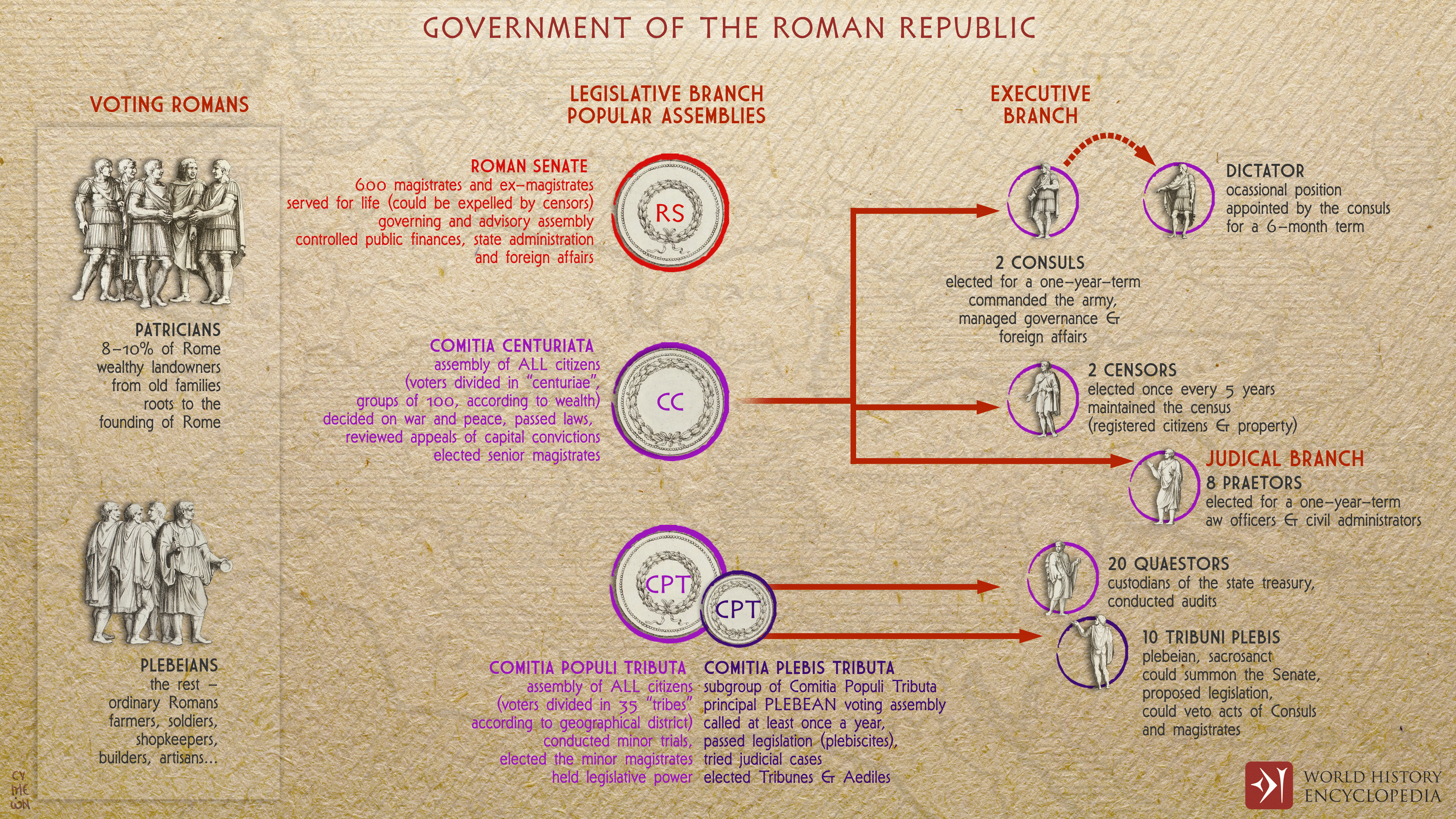
In its early history, Rome was marked by civic tensions between the Patricians (patres or “fathers”)—wealthy landowners who controlled the political and religious institutions of the state—and the Plebeians, the common people who were excluded from many of these privileges. This conflict, known as the Struggle of the Orders, saw the Plebeians challenge the dominance of the Patricians and push back against practices such as the arbitrary application of the law by the Senate.
The Plebeians’ grievances and demands for political representation and legal fairness, combined with Rome’s historical aversion to kingship following the tyranny of the Etruscan rulers, played a critical role in shaping the Roman Republic. It was this tension between social classes and the Plebeians’ persistent struggle for equality that influenced Rome’s transition to a republican form of government, which sought to balance power among different social groups while avoiding the concentration of authority in a single ruler.
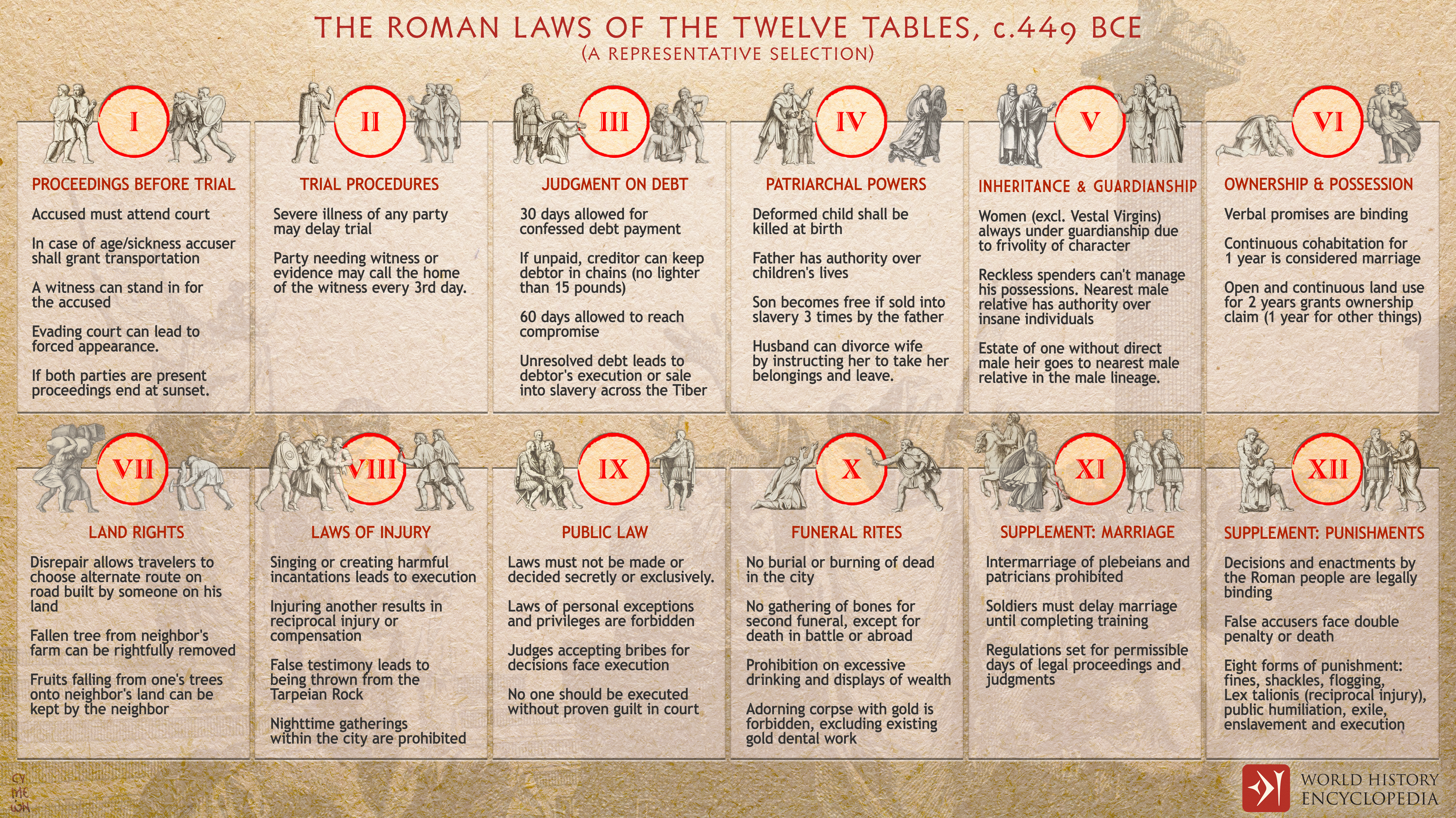
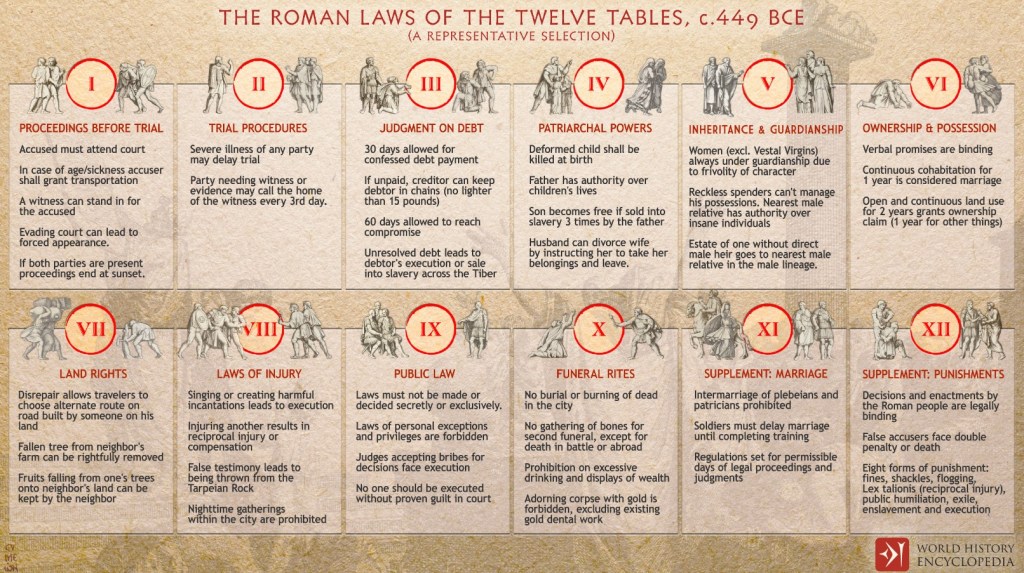
Fundamental to the Roman Republic was the establishment of law as a cornerstone of governance. The Twelve Tables, created in 451 B.C.E., were Rome’s first written law code and addressed key issues such as property rights, legal status, and marriage, applying to both Patricians and Plebeians. By codifying these laws, Rome ensured that legal decisions would no longer be arbitrary or subject to the whims of the ruling class.
Titus Livy emphasized the significance of this development, remarking that the creation of laws ensured that “liberty will be equal for all, from the highest to the lowest.” The Twelve Tables not only provided a foundation for Roman law but also represented an important step in the Plebeians’ struggle for equality, as they guaranteed transparency and fairness in legal matters. This milestone laid the groundwork for Rome’s enduring legal traditions and its reputation as a civilization rooted in the rule of law.
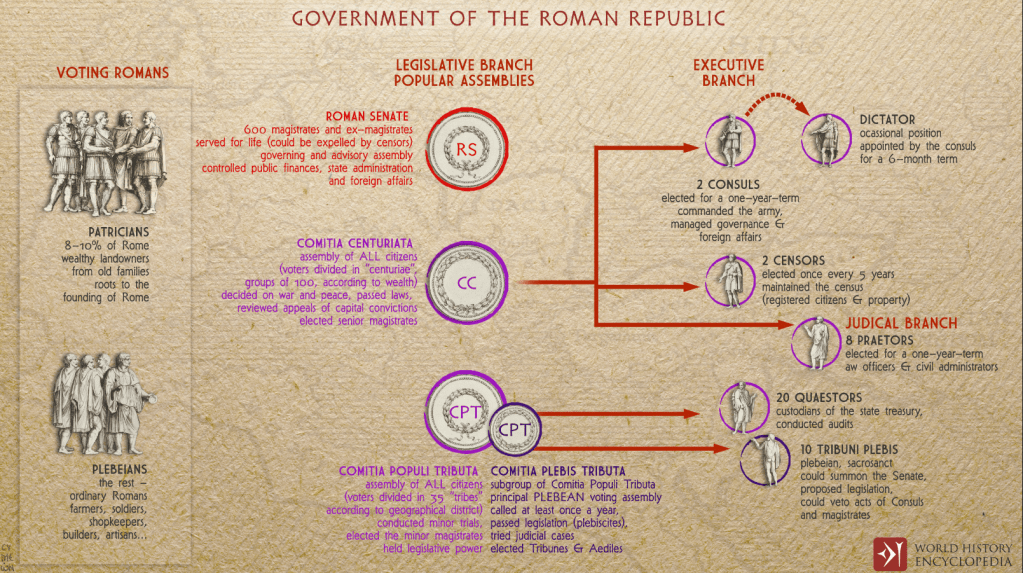
Rome’s aversion to rule by a single individual led to the creation of a government structured around a system of checks and balances, designed to prevent any one person or group from monopolizing power. Polybius (c. 205–123 B.C.E.), in his Histories, expressed great admiration for this balanced system, attributing Rome’s success and greatness to its well-structured government, alongside its powerful military.
While the Roman government included popular assemblies that allowed for some level of citizen participation, the reality was that the Patricians maintained significant control through their dominance of executive offices such as the Senate and the Consuls. This concentration of power among the elite underscored the ongoing tension between the ideals of Roman governance and its practical application, particularly in terms of social and political equality. Nonetheless, the system of checks and balances became a hallmark of Roman governance, influencing later political systems in the Western tradition.
The Punic Wars
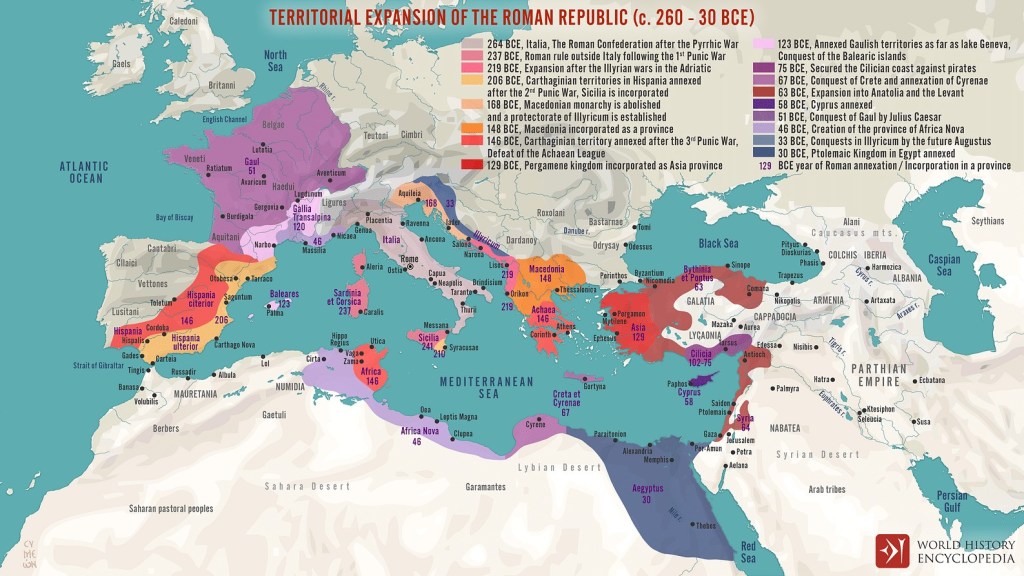
During the Struggle of the Orders, Rome also began uniting territories within Italy, laying the groundwork for further expansion. Rome’s ambitions soon extended beyond the Italian peninsula, leading to the Punic Wars, a series of three conflicts waged against Carthage. These wars, which occurred between 264–241, 218–201, and 149–146 B.C.E., were primarily rooted in competing economic interests. Polybius’s Histories serves as a key source for historians seeking to reconstruct the events of these wars.
Carthage, a dominant maritime power, had initially focused its expansion in the eastern region of North Africa. However, in 264 B.C.E., Carthage became entangled in a conflict over the control of Messana (in Sicily), prompting a request for Roman intervention. Rome responded by launching its First Punic War against Carthage, a conflict that spanned 23 years. The war concluded in 241 B.C.E., with Rome emerging victorious. As a result, Sicily became Rome’s first province, marking the beginning of its overseas empire. Additionally, Rome established itself as a formidable maritime power, while Carthage shifted its expansionist focus to Iberia in the aftermath of its defeat. This war marked a turning point in Roman history, setting the stage for further conflicts and Rome’s rise as a Mediterranean superpower.
Under the leadership of Hamilcar Barca (c. 275–228 B.C.E.), the Carthaginians shifted their focus to Iberia, where they established a new center of power at Carthago Nova (modern-day Cartagena). This strategic move allowed Carthage to rebuild its strength following its defeat in the First Punic War.
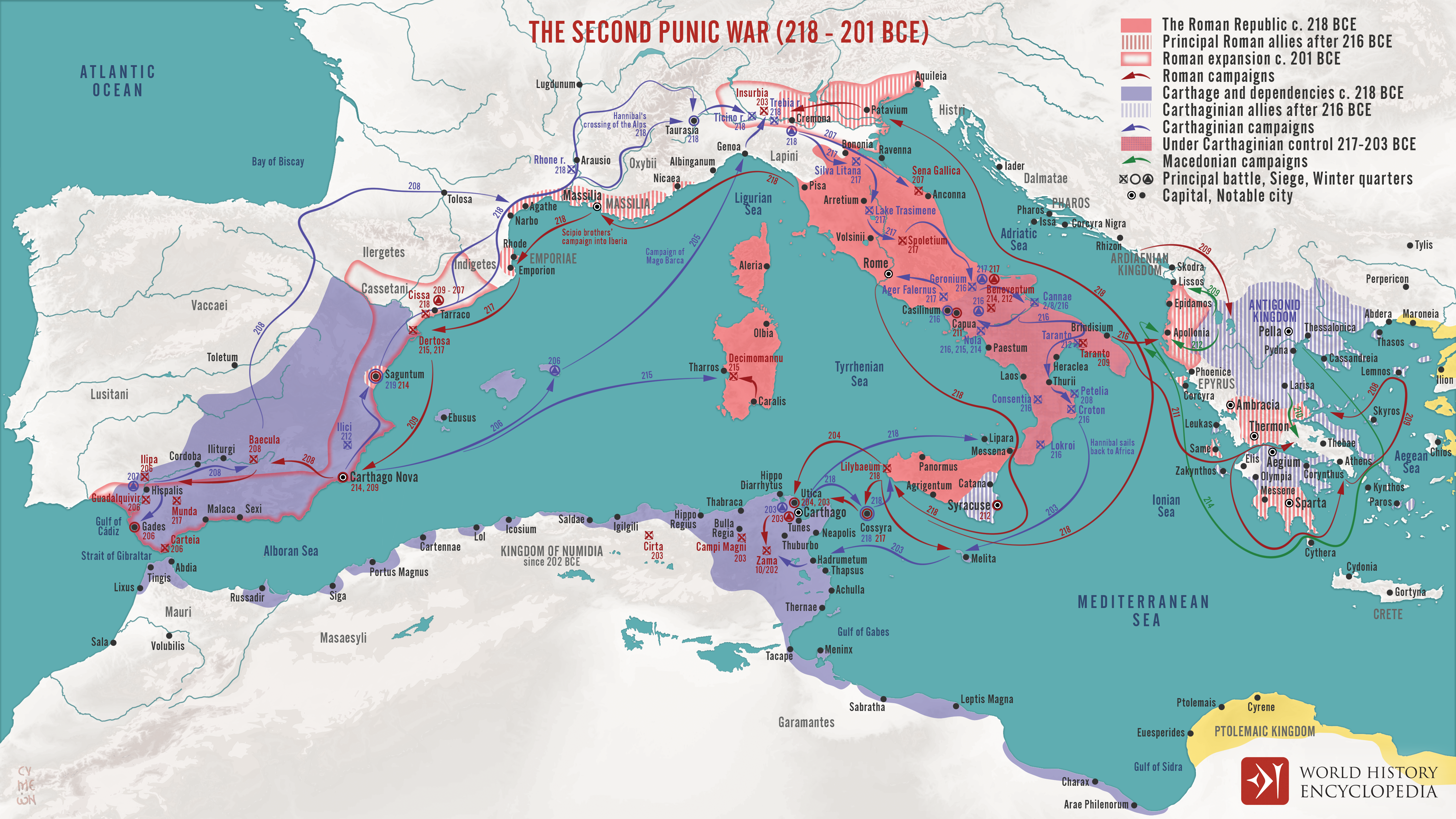
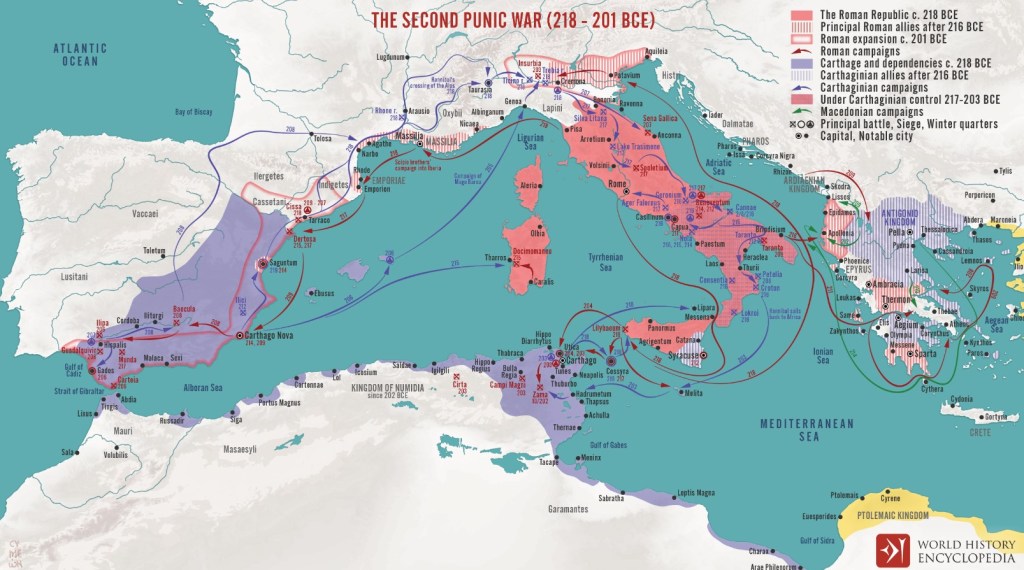
Hostilities between Carthage and Rome resumed in 218 B.C.E. with the outbreak of the Second Punic War. The conflict was triggered when Hannibal Barca (247–182 B.C.E.), Hamilcar’s son, laid siege to Saguntum, a city-state in eastern Iberia that was allied with Rome. Rome viewed this attack as a direct violation of its interests and a provocation that demanded retaliation, thus igniting one of the most famous wars in ancient history.
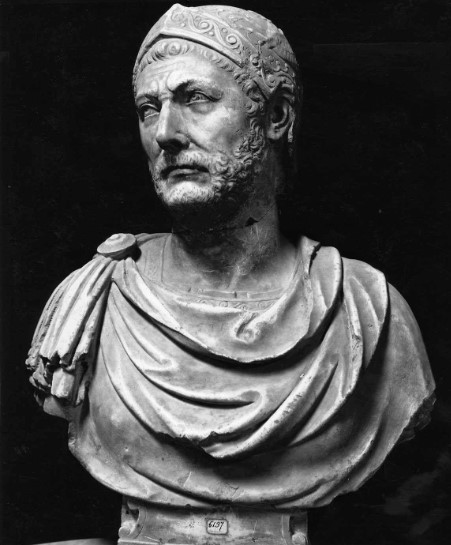
Hannibal’s actions in attacking Saguntum violated Carthage’s treaty with Rome, sparking the Second Punic War (218–201 B.C.E.), which was fought across three major theaters: Iberia, Italy, and Africa. Hannibal achieved remarkable early successes, including his legendary crossing of the Alps and his victories at battles such as Trebia (218 B.C.E.), Lake Trasimene (217 B.C.E.), and Cannae (216 B.C.E.), where he dealt devastating blows to Roman forces.
However, the tide of the war turned against Carthage when Publius Cornelius Scipio Africanus (c. 236–183 B.C.E.) led a successful Roman campaign in Iberia and later invaded North Africa. This forced Hannibal to return to defend Carthage. The decisive moment came at the Battle of Zama in 202 B.C.E., where Scipio’s superior strategy and the support of Numidian cavalry led to Hannibal’s defeat, effectively ending the war. The Roman victory at Zama marked the decline of Carthage as a major power and solidified Rome’s dominance in the western Mediterranean.
Polybius of Megalopolis (c. 200–c. 118 B.C.E.), the Greek historian who documented Rome’s ascent to power, remarked on the astonishing speed of its expansion following the conclusion of the Second Punic War. He noted that, “The Roman State was able to extend its domination over nearly all the inhabited world, and that in under fifty-three years.” This period saw Rome’s rapid transformation from a regional power into a dominant Mediterranean empire, as it consolidated its control over Iberia, North Africa, and much of the eastern Mediterranean through a series of wars, alliances, and conquests. Polybius attributed Rome’s success to its military prowess, political organization, and ability to integrate conquered peoples into its system of governance, laying the foundation for its imperial dominance.
New Challenges for the Republic
From 133 to 30 B.C.E., Rome underwent a revolutionary period as its Republican institutions struggled to cope with the challenges brought about by rapid conquests and territorial expansion. During this time, the Republic faced three major problems:
- The creation of latifundias (large estates) by patricians who manipulated new lands conquered and lands lost by displaced Roman farmers.
- The decline of the small farmer due to latifundias and competition from farmers from abroad.
- Lengthy military service also created financial woes for farmers as they returned home to find themselves in debt.
Many economically displaced farmers, forced off their land by the expansion of large estates (latifundia), migrated to Rome, creating significant social and political tensions. By 133 B.C.E., the Roman Senate had become divided into two opposing factions: the Optimates, who prioritized the interests of the wealthy and the senatorial class, and the Populares, who advocated for the welfare of the masses. Tiberius Sempronius Gracchus (168–133 B.C.E.), a tribune of the plebs, became the first major figure to address Rome’s growing economic and social problems by proposing agrarian reforms.
Tiberius sought to redistribute public land (ager publicus) to displaced farmers, aiming to restore the economic independence of Rome’s smallholders. His reforms led to what is known as the Gracchan Crisis (133–121 B.C.E.), caused by his attempts to achieve the following:
- Limit how much ager publicus (public land) one person could hold (330 acres maximum).
- Reduce the Senate’s monopoly of the ager publicus.
- Redistribute reclaimed lands among the poor.
Tiberius Gracchus’s decision to seek re-election as tribune, breaking with Roman political tradition, set off a chain of events that culminated in his violent death. What followed was a pivotal moment in Roman history, marking the first instance of political assassination within the Republic. Plutarch of Chaeronea (c. 46–120 C.E.) provides a vivid account of this fateful event in his Lives. His description highlights the brutal response of the senatorial elite, led by Scipio Nasica, who viewed Tiberius as a threat to the Republic’s stability and their own privileges.
Thus armed, they made towards Tiberius, knocking down those whom they found in front of him . . . . Tiberius tried to save himself by flight. As he was running, he was stopped by one who caught hold of his gown . . . . And stumbling over those who before had been knocked down, as he was endeavoring to get up again, Publius Satureius, a tribune, one of his colleagues, was observed to give the first fatal stroke . . . . This, we are told, was the first sedition amongst the Romans, since the abrogation of kingly government, that ended in the effusion of blood.
Plutarch
The backlash to Tiberius’s reforms was swift and violent. A group of senators and their supporters, fearing the erosion of their privileges, attacked and killed Tiberius and many of his followers. His death marked the beginning of a period of political violence and unrest in Rome, with his brother Gaius Gracchus later continuing his reformist agenda, further escalating tensions in the Republic. The Gracchan Crisis set the stage for the eventual breakdown of Republican institutions.
According to the historian Appian of Alexandria (95–165 C.E.), “violence ruled everything” during the final century of the Roman Republic, a time of deep political instability and frequent civil conflict. This period also saw the rise of the Roman military as a decisive force in personal and political advancement. Increasingly, political power in Rome depended on the support of the military, as ambitious leaders used armies to achieve their aims, often at the expense of the Republic’s traditional institutions.
The military reforms introduced by Gaius Marius (157–86 B.C.E.) in 107 B.C.E. played a pivotal role in shaping the trajectory of Roman history. Marius, a brilliant general and politician, addressed the Republic’s urgent need for soldiers by allowing the landless poor—many of whom had been displaced by Rome’s expansion and economic inequality—to enlist in the Roman army. These reforms transformed the military into a professional force, as soldiers were now paid and equipped by the state, with the promise of land or monetary rewards upon completion of their service. The reforms of Marius:
- Soldiers now also served long enlistments that kept them employed. Those who served were paid a salary.
- Marius eliminated property qualification for military service making it possible for the urban poor to serve.
- Also, they shared in the captured goods, and were granted land after 16 years of service.
While these changes strengthened Rome’s military capabilities, they also created a new dynamic in which soldiers became personally loyal to their generals rather than to the Republic itself. Generals like Marius, Sulla, Pompey, and Julius Caesar capitalized on this loyalty, using their armies as tools for political power and waging civil wars to achieve their ambitions. This shift in military allegiance undermined the Republic’s foundations and fueled the cycle of violence and power struggles that defined its final century. Marius’s reforms, while addressing immediate military needs, ultimately contributed to the erosion of Republican ideals and paved the way for the rise of imperial rule under Augustus.
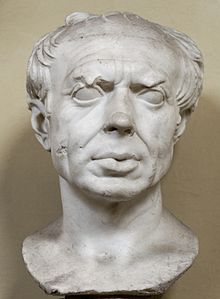
Thus, the Roman military was transformed from a citizen militia into a professional fighting force. This shift fundamentally altered the dynamics of power in Rome. Soldiers, who now relied on their commanders for pay, equipment, and promises of land or wealth, became personally loyal to their generals rather than to the state or Senate. This newfound loyalty allowed ambitious commanders to wield their armies as political tools, further destabilizing the Republic and contributing to the cycle of civil wars that ultimately led to its downfall.
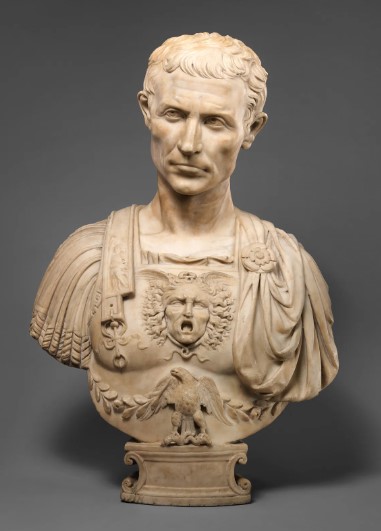
Gaius Julius Caesar’s (101–44 B.C.E.) rise to power demonstrates how the loyalty of Roman armies had shifted from the state to their commanders. His conquest of Gaul (58–51 B.C.E.) became the foundation of his political and military success, earning him immense wealth, widespread fame, and, most critically, the unwavering loyalty of his army. These achievements allowed Caesar to become a dominant figure in Roman politics.
In 60 B.C.E., Caesar joined forces with Gnaeus Pompeius Magnus (Pompey the Great, 106–48 B.C.E.) and Marcus Licinius Crassus (115–53 B.C.E.) to form the First Triumvirate. This unofficial political alliance bypassed the authority of the Senate, concentrating power in the hands of the three men. However, the alliance began to unravel after Crassus’s death in 53 B.C.E. during his ill-fated campaign in Parthia, leading to growing tensions between Caesar and Pompey.
By 49 B.C.E., the rivalry between Caesar and the Senate-backed Pompey came to a head. The Senate, alarmed by Caesar’s growing power, refused him a consulship and ordered him to disband his army. Caesar defied this command by leading his army across the Rubicon River, famously declaring, “Alea iacta est” (“The die is cast”). This bold move amounted to a declaration of war against the Senate and plunged Rome into a civil war.
The crossing of the Rubicon marked the point of no return for Caesar, as his decision to march on Rome not only solidified his position as a military and political leader but also signaled the beginning of the Republic’s final collapse. The ensuing civil war would ultimately pave the way for Caesar’s dictatorship and the transformation of Rome into an empire.
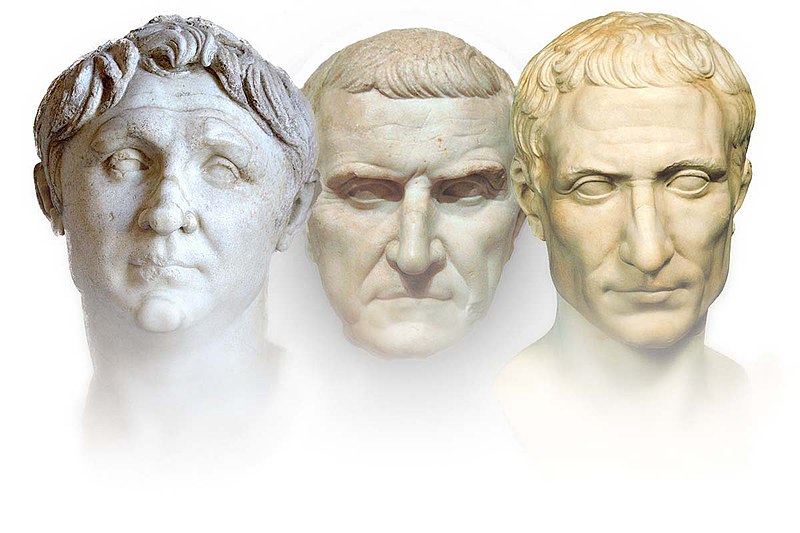
At the Battle of Pharsalus in 48 B.C.E., Caesar achieved a decisive victory over Pompeius and the senatorial forces, effectively consolidating his power and ending the immediate threat to his dominance. In 46 B.C.E., Caesar was granted the title of Dictator for Life, a position that alarmed many who feared he intended to establish himself as a king—a notion deeply antithetical to Roman Republican values. These fears culminated in a conspiracy among a group of senators who resolved to assassinate Caesar to restore the Republic.
On the Ides of March (March 15) in 44 B.C.E., the conspirators, led by Marcus Junius Brutus Caepio (85–42 B.C.E.) and Gaius Cassius Longinus, carried out the assassination in the Theatre of Pompey, where Caesar was stabbed to death. In a letter to Marcus Tullius Cicero (106–43 B.C.E.), Brutus later justified his actions, stating, “I was neither properly a full citizen while Caesar was alive, except when I had resolved upon doing that deed . . . .” These words reflect the belief of the conspirators that Caesar’s rule had stripped them of their rights as citizens and that his death was necessary to restore liberty to Rome.
However, rather than restoring the Republic, Caesar’s assassination plunged Rome into further chaos. The resulting power vacuum led to a series of civil wars, ultimately culminating in the rise of Caesar’s adopted heir, Octavian (later Augustus), and the establishment of the Roman Empire. Caesar’s death thus marked the final turning point in Rome’s transition from Republic to autocracy.
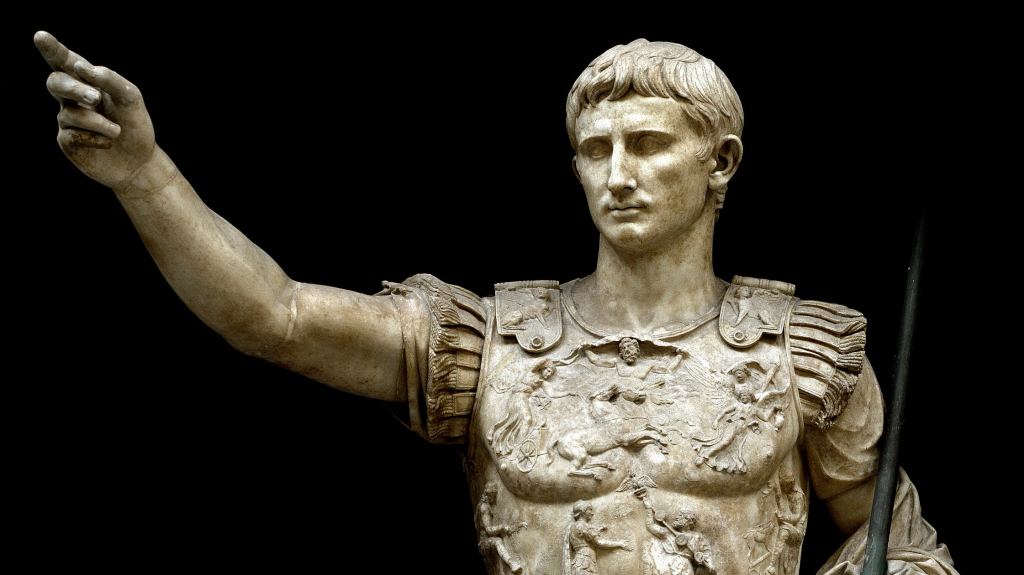
The assassination of Julius Caesar in 44 B.C.E. once again plunged Rome into civil war. In the wake of the chaos, a Second Triumvirate was formed in 43 B.C.E., consisting of Marcus Antoninus (Mark Antony, 82–30 B.C.E.), Marcus Aemilius Lepidus (d. 13 B.C.E.), and Gaius Octavius (Octavian, 63 B.C.E.–14 C.E.), Caesar’s great-nephew and adopted heir. This alliance was forged to consolidate power and defeat Caesar’s assassins, Brutus and Cassius, who had fled east to rally support.
The Second Triumvirate assumed control of Rome, effectively sidelining the Senate, and pursued their enemies. The forces of Brutus and Cassius were decisively defeated at the Battle of Philippi in 42 B.C.E., after which both leaders committed suicide. However, like the First Triumvirate, the Second Triumvirate eventually disintegrated due to internal rivalries. Lepidus was sidelined early on, leaving Octavius and Antoninus to vie for supremacy.
The final confrontation came at the Battle of Actium in 31 B.C.E., where Octavius’ fleet, commanded by Agrippa, defeated the forces of Antoninus and his ally, Cleopatra of Egypt. Following their defeat, Antoninus and Cleopatra fled to Egypt, where they both committed suicide the following year. With no rivals remaining, Octavius emerged as the unchallenged ruler of Rome.
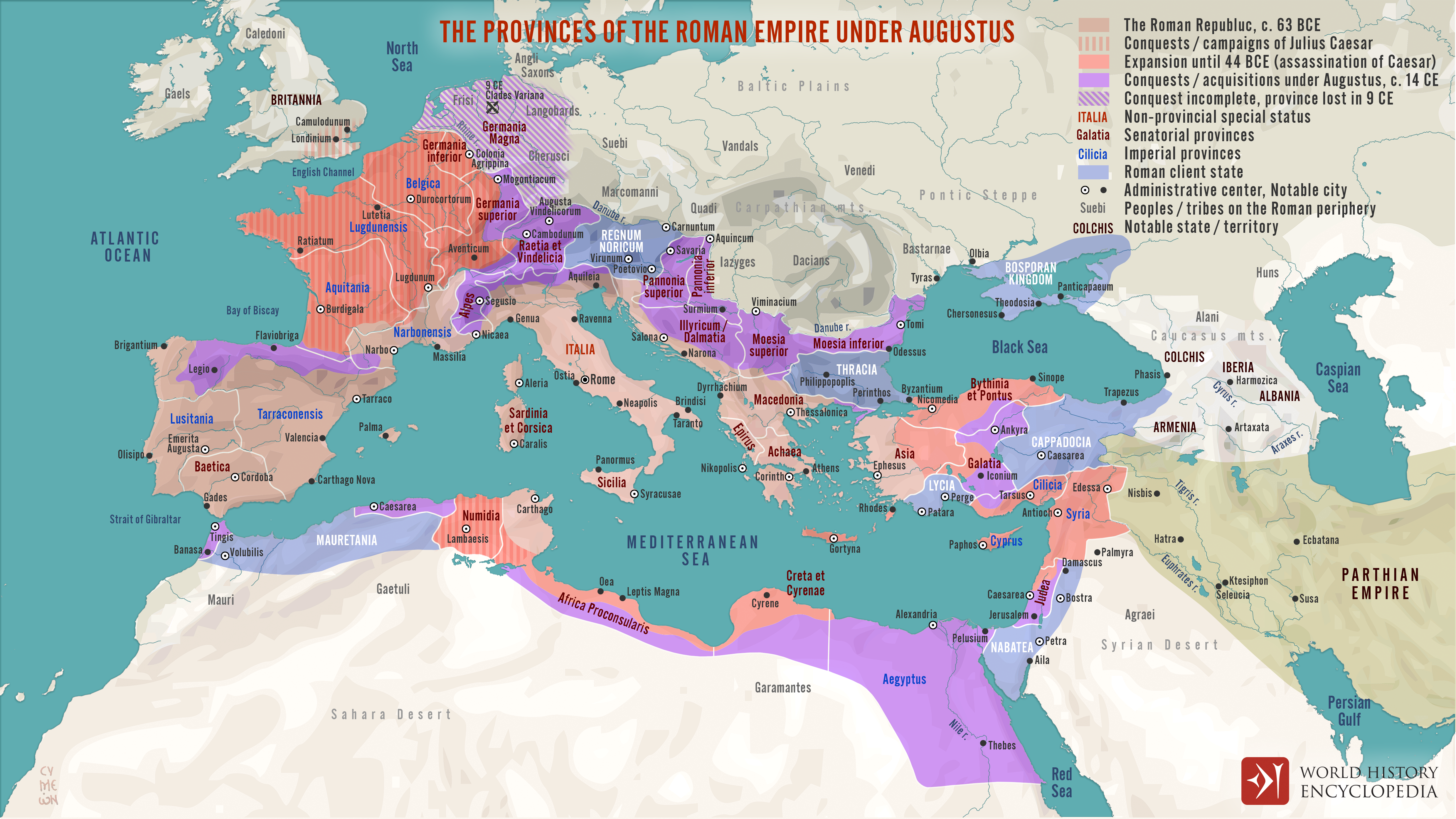
In 27 B.C.E., Octavius took steps to formalize his authority and establish a new political order known as the Principate. He was granted the titles of Augustus (“Revered”), Imperator (“Commander of the Army”), and Princeps (“First Among Equals”), signaling his dominance while maintaining the outward appearance of Republican traditions. This marked the beginning of the Roman Empire, with Augustus (r. 27 B.C.E.–14 C.E.) as its first emperor, ushering in a period of relative stability and prosperity known as the Pax Romana.
Rome Rule by One
With the collapse of the Republic, Rome transitioned to an imperial system ruled by emperors, marking the beginning of a new era in Roman history. This period saw the rise of imperial “dynasties,” such as the Julio-Claudians (27 B.C.E.–68 C.E.) and the Antonines (96–192 C.E.), each leaving its mark on Roman politics, culture, and military expansion. Under the leadership of the emperors, Rome extended its influence even further than during the Republic, controlling vast territories spanning Europe, North Africa, and the Near East.
Despite this impressive expansion, the Empire eventually began to show signs of decline. An economic crisis, fueled by overexpansion, heavy taxation, inflation, and reliance on slave labor, weakened the Empire’s foundations. Politically, instability grew as emperors were frequently overthrown, and periods of civil war and power struggles further eroded centralized authority. Additionally, invasions by Germanic tribes such as the Goths placed immense pressure on Rome’s borders, resulting in a slow but steady decline of Roman power.
By the 3rd century C.E., these combined factors—economic strain, political instability, and external invasions—began to unravel the unity of the Empire, setting the stage for its eventual division and the collapse of the Western Roman Empire in the 5th century C.E. Despite this decline, the legacy of the Roman Empire endured, profoundly shaping Western civilization through its legal systems, governance, culture, and infrastructure.
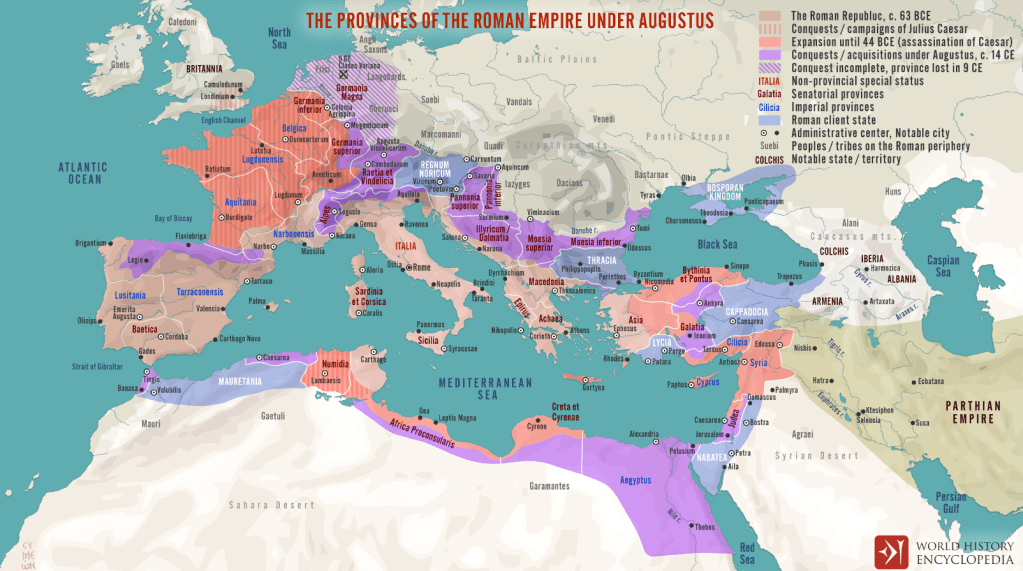
For historians, the study of Rome’s transition from Republic to Empire is enriched by a wealth of literary sources from Roman writers. Among these, Publius (Gaius) Cornelius Tacitus (c. 55–117 C.E.) is widely regarded as Rome’s greatest historian. His works provide critical insights into Roman politics, society, and the moral decline he believed accompanied imperial rule. Tacitus authored Germania, which examines the geography, customs, and tribes of the Germans; Historiae, a history of the Roman Empire from 69–96 C.E. (though only the first four books survive, covering 69–70 C.E.); and Annales, which focuses on political life and the erosion of liberty under the Julio-Claudian emperors.
Another significant figure, Gaius Suetonius Tranquillus (c. 70–140 C.E.), contributed to our understanding of imperial Rome through his biographical approach. His most important work, The Lives of the Caesars, chronicles the lives of emperors from Julius Caesar to Domitian (d. 96 C.E.), offering a mix of historical detail, personal anecdotes, and commentary on their character.
Tacitus, in particular, reflects on the question of why so many Romans became accepting of rule by one man, despite Rome’s foundation on the traditions of republican government. In Annales, Tacitus attributes this shift to a combination of factors: the weariness caused by decades of civil war, the consolidation of power by ambitious leaders like Augustus, and the growing dependence of the populace on the state for economic and social stability. He paints a picture of a people willing to sacrifice liberty in exchange for peace, order, and material benefits provided by imperial rule.
Tacitus famously laments this loss of republican ideals, stating:
At home all was tranquil, and there were magistrates with the same titles, there was a younger generation, sprung up since the victory of Actium, and even many of the older men had been born during the civil wars. How few were left who had seen the republic! Thus the State had been revolutionized and there was not a vestige left of the old morality. Stript of equality, all looked up to the commands of a sovereign with the least of apprehension . . . .
Through his writings, Tacitus offers a poignant critique of how the Roman Republic’s values were eroded by the allure of centralized power and the complacency of a people weary of conflict.
Around 258 C.E., the western borders of the Roman Empire began to experience significant pressure from the migrations of the Goths. These movements caused widespread destruction in Roman-controlled territories and contributed to what historians refer to as the Third Century Crisis. Writing in the 6th century C.E., Jordanes described the Goths as a “swarm of bees” in his The Origin and the Deeds of the Goths. Alongside foreign invasions, the 3rd century was further destabilized by internal conflict, as civil wars added to the chaos. Previously, Rome had maintained stability under the rule of strong individuals or dynasties, but this changed after the fall of the Severan Dynasty (193–235 C.E.). The military played a key role in this turmoil, frequently deposing emperors at will and intervening in political matters. Soldiers often blamed their leaders for the Empire’s problems, leading to constant changes in leadership and the lack of a stable ruling dynasty. Between 235 and 284 C.E., Rome saw the rapid succession of twenty different emperors, further weakening the Empire.
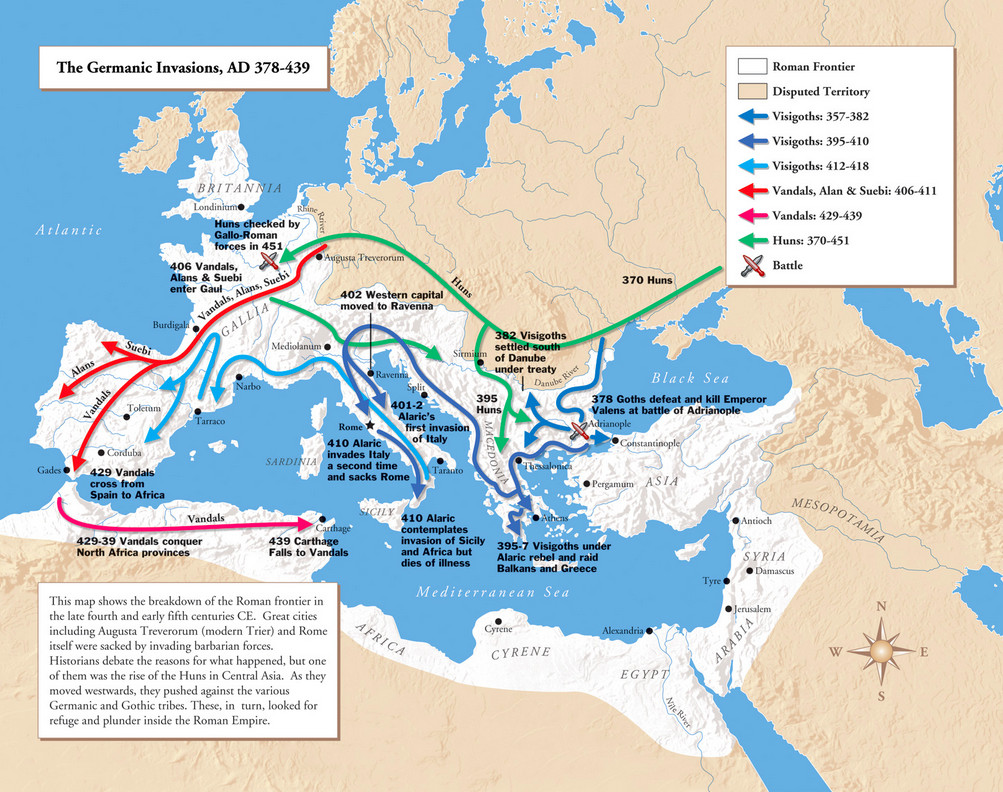
The political instability and pressure from the Goths during the Third Century Crisis led to a severe economic collapse. The sacking of towns and the destruction of crops and herds were primary contributors to this economic turmoil. Gold became increasingly scarce as the wealthy hoarded it, and widespread poverty created a social crisis throughout the Roman Empire. In such desperate times, could Rome be ready for a religious transformation?
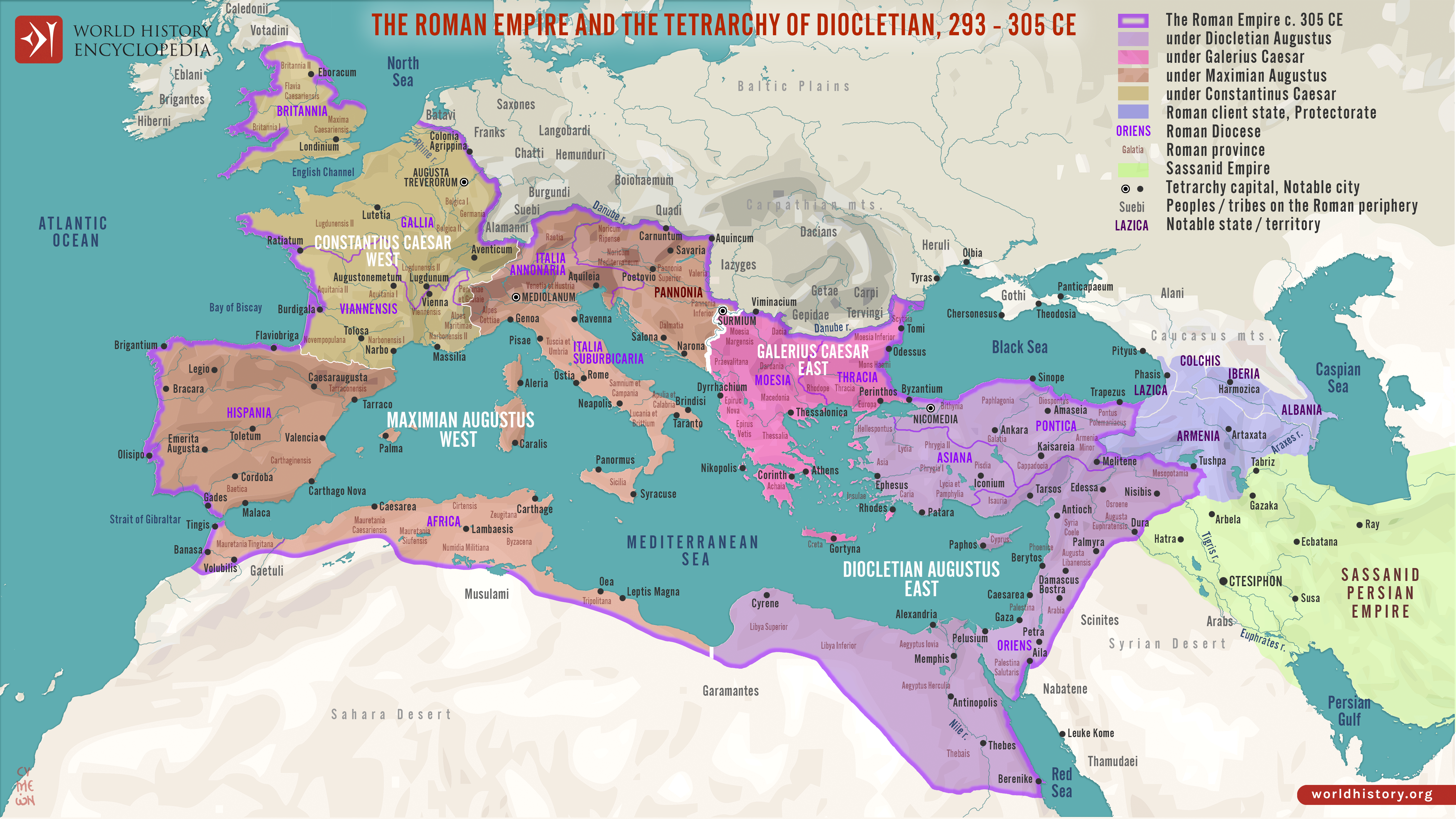
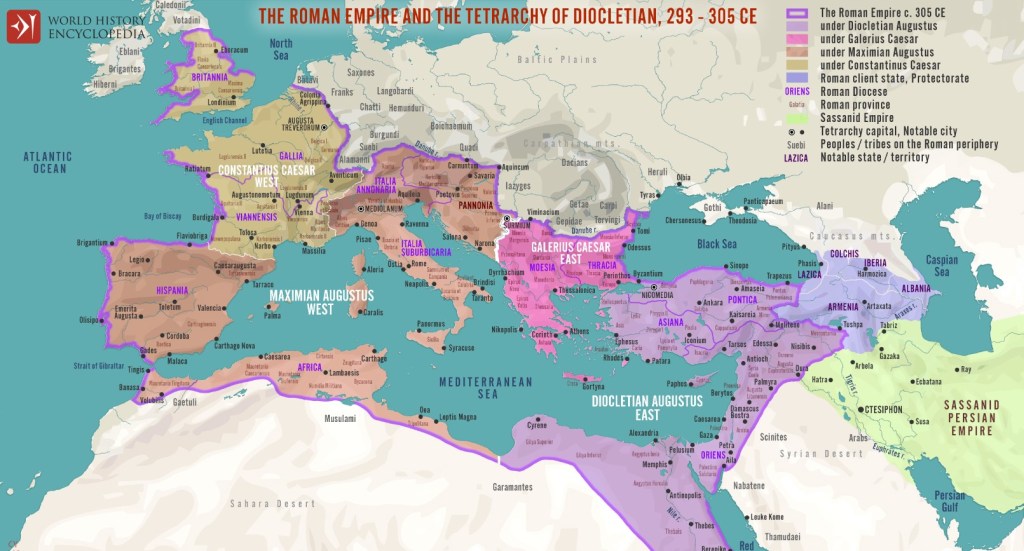
In 284 C.E., the Roman army elevated Gaius Aurelius Valerius Diocletianus (r. 285–305 C.E.) to the throne, ushering in a period of recovery. To better manage the vast and fragmented empire, Diocletian introduced the Tetrarchy, a system of governance that divided the empire into two halves—East and West—each ruled by a co-emperor (an Augustus). Additionally, each Augustus was supported by a junior emperor, or Caesar, who was groomed to succeed their senior partner. This system aimed to create stability through shared power and ensure a peaceful transfer of leadership.
However, this system of divided rule was short-lived. Flavius Valerius Constantinus (Constantine I, r. 306–337 C.E.) reestablished sole rule over the Roman Empire, marking the return to autocracy. Constantine also transformed the eastern part of the empire by founding a new capital, Constantinople, on the site of the ancient Greek colony of Byzantium. This city would later become a crucial center of power and culture for the Eastern Roman (Byzantine) Empire. Constantine’s reign not only re-centralized power but also set the stage for significant changes, including the eventual rise of Christianity as the empire’s dominant religion.
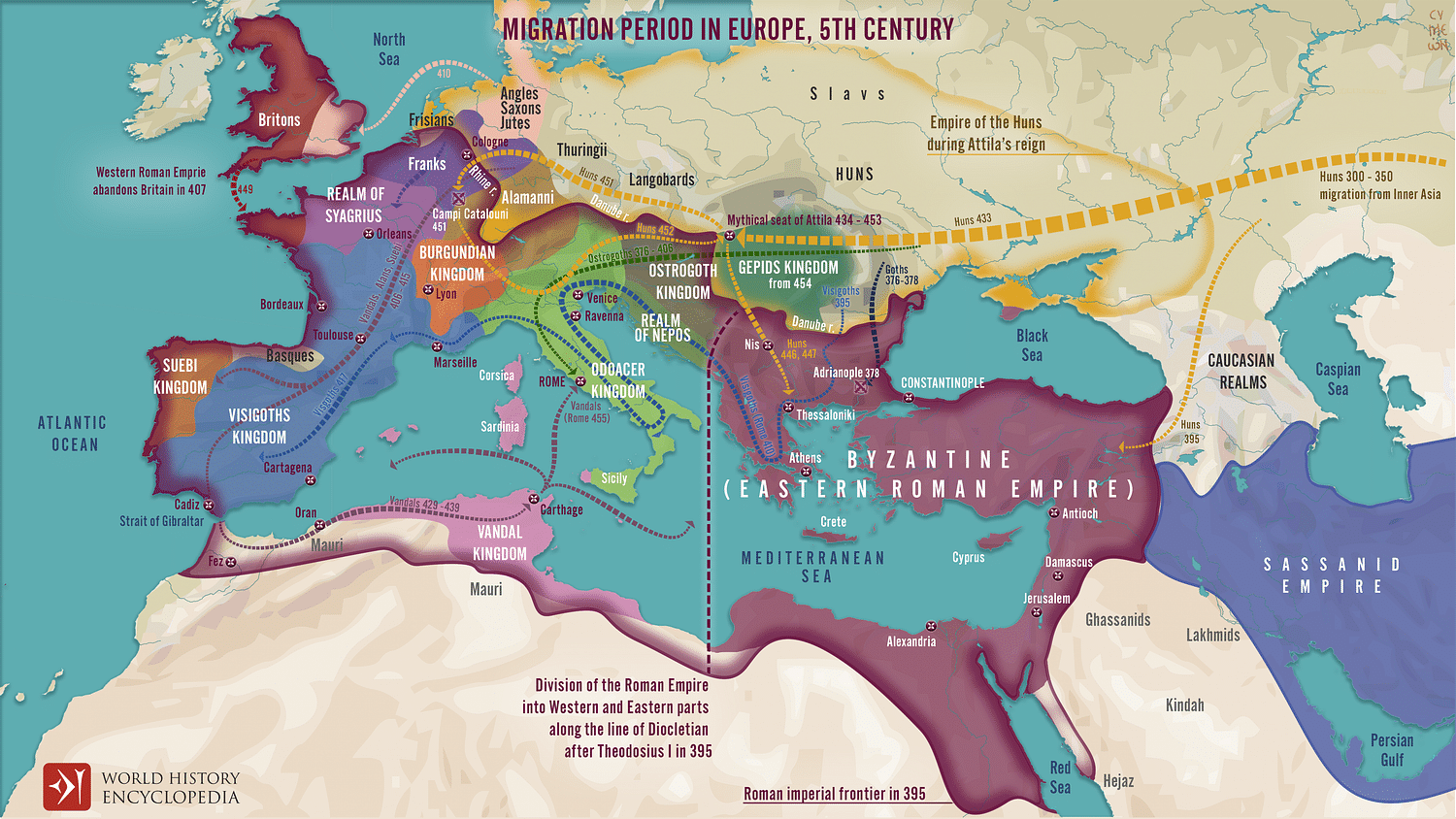
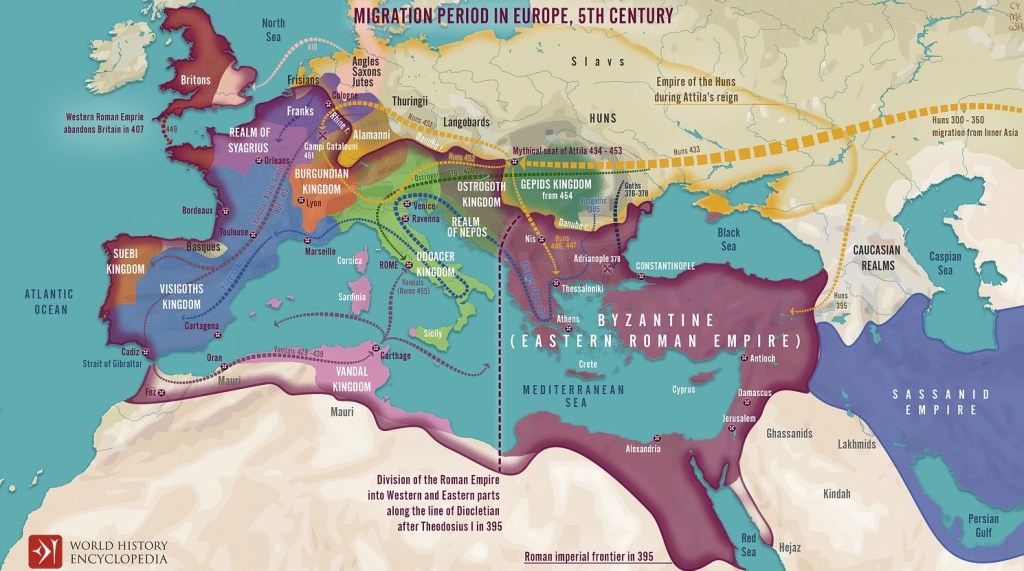
In the late 4th century, a powerful new force emerged from Central Asia that would have profound and devastating consequences for Rome: the Huns. Under the leadership of Attila, the Huns advanced into Europe, putting immense pressure on Germanic tribes such as the Visigoths, Vandals, and Franks. These Germanic peoples, in turn, crossed into Roman territory, seeking refuge and eventually establishing settlements within the Empire’s borders. This chain of events reached a shocking climax in 410 C.E., when Alaric, leader of the Visigoths, sacked Rome—a once unimaginable blow to the heart of the Empire.
The situation worsened in 476 C.E., when Odoacer, a Germanic general in the service of Rome, deposed the last Western Roman emperor, Romulus Augustulus. This event is traditionally seen as marking the fall of the Western Roman Empire. However, many historians argue that this was not the definitive end of the Roman Empire in the west but rather a transformation. The political structures of the Western Roman Empire evolved into a series of Germanic kingdoms that fused Roman traditions, Germanic customs, and Christianity. These new kingdoms became the foundations of medieval Europe, preserving and adapting elements of Roman culture and governance.
Meanwhile, in the East, the Roman Empire endured and thrived, becoming known as the Byzantine Empire. Centered in Constantinople, it retained Roman political and cultural traditions, blending them with Greek and Christian influences. This eastern continuation of the Roman Empire would last for nearly another millennium, shaping the medieval world and bridging the classical and modern eras.
After the collapse of the Western Roman Empire in 476 C.E., the question of who would hold authority in the West—secular rulers or the Christian Church—became a defining issue of the early Middle Ages. This tension between spiritual and temporal power is vividly illustrated in a letter written in 494 by Pope Gelasius I (r. 492–496) to the Eastern Roman Emperor Anastasius I. In the letter, Gelasius articulated the relationship between the Church and secular rulers, a concept that would foreshadow the power struggles of the medieval period.
Gelasius wrote: “Two there are, august emperor, by which this world is chiefly ruled, the sacred authority of the priesthood and the royal power. Of these the responsibility of the priest is more in so far as they will answer for the kings of men themselves at the divine judgment.” By this, Gelasius asserted that while both spiritual and secular powers were necessary for governing the world, the priesthood (representing the Church) held ultimate authority because it was responsible for guiding souls and even holding kings accountable before God.
This idea laid the groundwork for what would become a central theme of medieval European history: the ongoing struggle for supremacy between the Church and secular rulers. The Church sought to establish itself as the ultimate authority, claiming that spiritual power was superior to temporal power. Secular rulers, on the other hand, often resisted this subservience, leading to conflicts such as the Investiture Controversy of the 11th and 12th centuries. Gelasius’s letter serves as a critical precursor to this dynamic, encapsulating the tension between the sacred and the secular that would shape the political and religious landscape of medieval Europe.
Christianity and the Roman Empire
Christianity is rooted in the life and teachings of Jesus of Nazareth, a member of the Jewish community in first-century Palestine. His message and growing following led to tension with both Jewish authorities and the Roman government, culminating in his execution by Roman officials on charges of subversion. Initially, Christianity emerged as a sect within Judaism, but over time it developed into an independent religion, expanding beyond the borders of Palestine and its Jewish cultural framework.
A key factor in Christianity’s break from its Jewish heritage was the belief that Jesus was God incarnate—God in human form. This belief held that through his teachings, actions, death, and resurrection, Jesus became the savior of the world, offering salvation to humanity. This theological conviction set Christianity apart from Judaism, reshaping its identity as a distinct faith.
Reconstructing the life of Jesus requires turning to the gospel traditions contained in the New Testament. These texts serve as the primary sources for understanding Jesus’ life, ministry, and the early development of Christian beliefs.
- The gospels portray Jesus as a prophet who proclaimed the coming of God’s kingly rule, a teacher (parables/aphorisms), a healer, and an interpreter of law.
- The gospels also emphasize that the message, actions, and miracles of Jesus focused on the socially and religiously marginalized.
References to Jesus of Nazareth exist outside of the New Testament and can be found in the works of ancient historians such as Publius Gaius Cornelius Tacitus, Gaius Suetonius Tranquillus, and Titus Flavius Josephus (c. 37–100 C.E.). These mentions, while brief, provide valuable corroboration of the existence of Jesus and the early Christian movement from non-Christian sources.
- Tacitus (Annals, c. 116 C.E.): In his account of the reign of Emperor Nero, Tacitus refers to the persecution of Christians following the Great Fire of Rome in 64 C.E. He writes that the term “Christian” comes from “Christus,” who “suffered the extreme penalty during the reign of Tiberius, at the hands of one of our procurators, Pontius Pilate.” Tacitus’s mention confirms key details about Jesus’ execution and the early Christian community’s presence in Rome.
- Suetonius (The Lives of the Caesars, c. 121 C.E.): In his biography of Emperor Claudius, Suetonius refers to disturbances caused by “Chrestus” among the Jewish community in Rome. While the reference to “Chrestus” (likely a variant spelling of “Christus”) is vague, it is often interpreted as an indirect mention of Jesus or the tensions caused by his followers within the Jewish community.
- Josephus (Antiquities of the Jews, c. 93 C.E.): Josephus, a Jewish historian, provides the most detailed non-Christian reference to Jesus. In the so-called Testimonium Flavianum, Josephus describes Jesus as a wise teacher who performed surprising deeds, was crucified under Pilate, and was believed by his followers to have risen from the dead. However, some portions of this passage are debated among scholars, with many believing later Christian scribes may have embellished Josephus’s original text. A less disputed passage mentions James, “the brother of Jesus, who was called Christ,” further corroborating Jesus’ historical existence.
These sources, while not providing extensive detail, align with key elements of the New Testament narrative, confirming the historical presence of Jesus and the impact of the early Christian movement.
What were some of the key characteristics of early Christianity?
- Dualistic. Good and evil are pitted against each other. Also, the material and divine worlds are pitted against each other as humans were meant to focus on the latter.
- Transcendental. The ultimate aim is the divine world.
- Salvation religion. This is the primary concern of human beings. Attaining salvation
It is important to note that early Christians did not initially share a unified theology. This lack of consensus led to numerous debates and differing interpretations regarding their beliefs. One of the earliest and most significant debates among early Christians, as we have already explores, centered on Christology—the nature of Jesus of Nazareth.
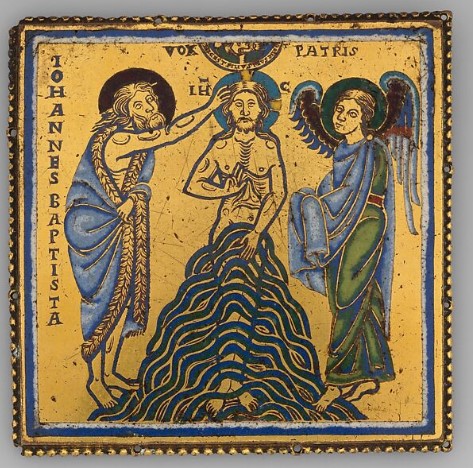
The central theme of Jesus’ teachings is the kingdom of God. Specifically, Jesus preached about the coming of “the kingdom of God” and described an impending apocalypse—a catastrophic end of the world—after which God would judge all people, rewarding those who had followed His will.
Jesus’ message was not focused on politics, such as subservience to Rome, nor was it centered on theology or legalistic discussions. Instead, his preaching emphasized morality and how individuals should live their lives. Unlike theologians who debated doctrine or rabbis who explored the details of the law, Jesus communicated through simple stories and parables—metaphorical or figurative lessons—making his teachings accessible and relatable.
What set Jesus apart was his unique connection between the doctrine of the kingdom of God and ethical behavior. For Jesus, moral actions such as repentance, love, charity, and nonviolence were essential requirements for acceptance into the kingdom of God. These values formed the foundation of his moral teachings and provided a clear guide for how people should conduct themselves in preparation for God’s judgment. Matthew 5:1-12 provides the essence of Christianity:
When Jesus saw the crowds, he went up the mountain; and after he sat down, his disciples came to him. Then he began to speak, and taught them, saying:
Blessed are the poor in spirit, for theirs is the kingdom of heaven.
Blessed are those who mourn, for they will be comforted.
Blessed are the meek, for they will inherit the earth.
Blessed are those who hunger and thirst for righteousness, for they will be filled.
Blessed are the merciful, for they will receive mercy.
Blessed are the pure in heart, for they will see God.
Blessed are the peacemakers, for they will be called children of God.
Blessed are those who are persecuted for righteousness’ sake, for theirs is the kingdom of heaven.
Blessed are you when people revile you and persecute you and utter all kinds of evil against you falsely on my account.
Rejoice and be glad, for your reward is great in heaven, for in the same way they persecuted the prophets who were before you.
The first sacred text of early Christians was the Hebrew Scriptures, which had been translated into Greek and was known as the Septuagint (c. 270 B.C.E.). Most of the early Christians, referred to as Nazarenes, came from the Jewish community centered in Jerusalem. The New Testament canon eventually became the recognized collection of Christian scriptures, but it is important to acknowledge the existence of other non-canonical Christian writings. This diversity arose partly due to conflicts and differing interpretations of Christian beliefs among early followers.
It was not until around 367 C.E. that historical sources mention the Christian Bible in a form resembling what we know today. Over time, Christianity spread to regions such as North Africa and Europe. Initially emerging within the Roman world as a mystery cult, Christianity faced persecution from approximately 100 C.E. to 137 C.E., largely because Christians refused to participate in Roman religious practices or serve in the Roman military.
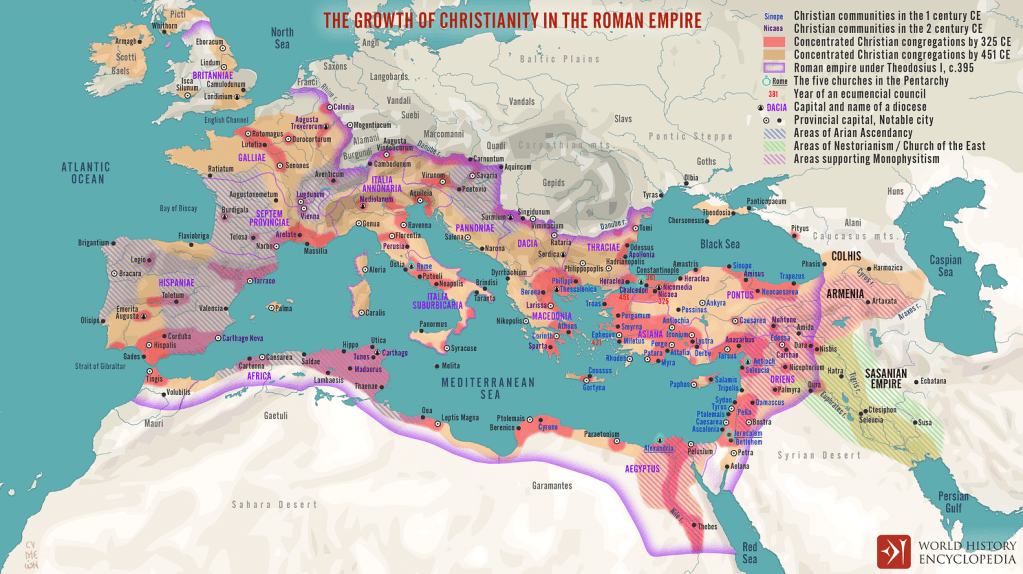
The Split from Judaism
Central to understanding the transformation of Christianity from a Jewish sect to a universal faith is the role of Paul (Saul of Tarsus). Born around 10 C.E. in Tarsus, Anatolia, Paul came from an orthodox Jewish family and was educated under the Pharisees. Initially a fierce persecutor of Christians, Paul experienced a profound vision on the road to Damascus in 33 C.E., which led to his conversion and commitment to Jesus as the Messiah. This moment marked the beginning of his missionary work, particularly his efforts to spread the gospel to Gentiles.
Paul is often regarded as one of the key architects of Christianity, primarily because of his missionary activities and his decisive break from Jewish law. He famously argued that “Gentiles do not need to keep the law of Moses before they become followers of Jesus,” emphasizing that faith in Jesus, rather than adherence to Jewish law, was the path to salvation. Paul’s belief that “God was now working through Jesus rather than the law to accomplish the salvation of humankind” fundamentally redefined Christianity as a faith independent of Jewish tradition.
Through Paul’s efforts, Christianity broke away from its roots as a Jewish heresy and emerged as an “independent” monotheistic tradition, open to people of all backgrounds. His teachings established faith, rather than the observance of Jewish law, as the central tenet of Christian identity, paving the way for Christianity to become a universal religion.
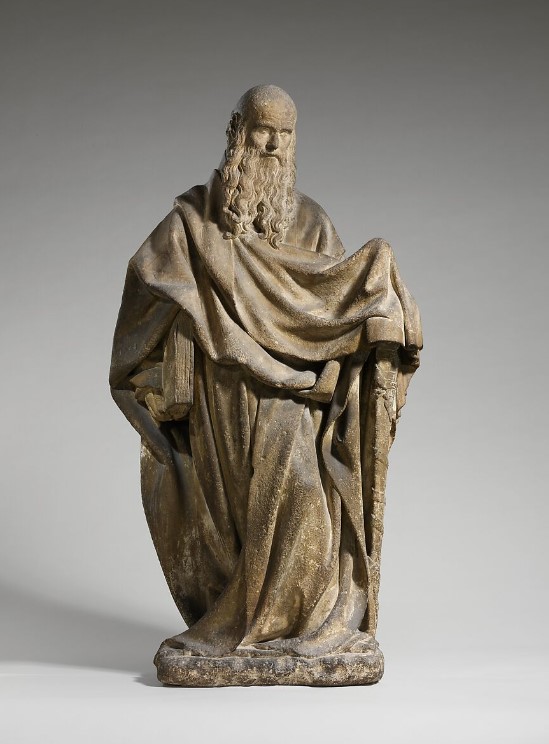
“We ourselves are Jews by birth and not Gentile sinners; yet we know that a person is justified not by the works of the law but through faith in Jesus Christ. And we have come to believe in Christ Jesus, so that we might be justified by faith in Christ, and not by doing the works of the law, because no one will be justified by the works of the law. But if, in our effort to be justified in Christ, we ourselves have been found to be sinners, is Christ then a servant of sin? Certainly not! But if I build up again the very things that I once tore down, then I demonstrate that I am a transgressor. For through the law I died to the law, so that I might live to God. I have been crucified with Christ; and it is no longer I who live, but it is Christ who lives in me. And the life I now live in the flesh I live by faith in the Son of God, who loved me and gave himself for me. I do not nullify the grace of God; for if justification* comes through the law, then Christ died for nothing.“
Galatians 2:16-21
Due to the lack of unity among early Christians, “interpretations of Jesus and his message varied greatly among the new followers.” However, one belief that united many early Christians was the conviction that after Jesus’ execution, he was “seen as the crucified and risen Messiah who would return from heaven at any moment and begin an apocalyptic reign.” What remained unclear and widely debated, however, was the exact nature of Jesus—whether he was divine, human, or a combination of both—and how his identity should be understood within the context of their faith.
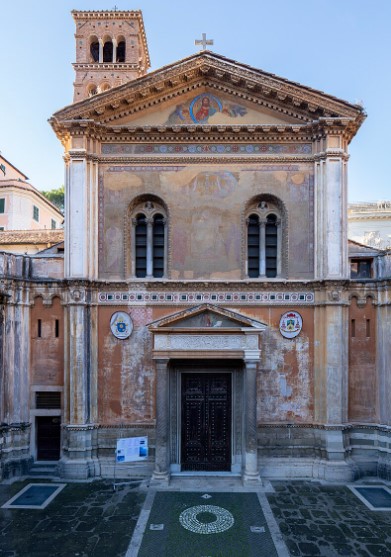
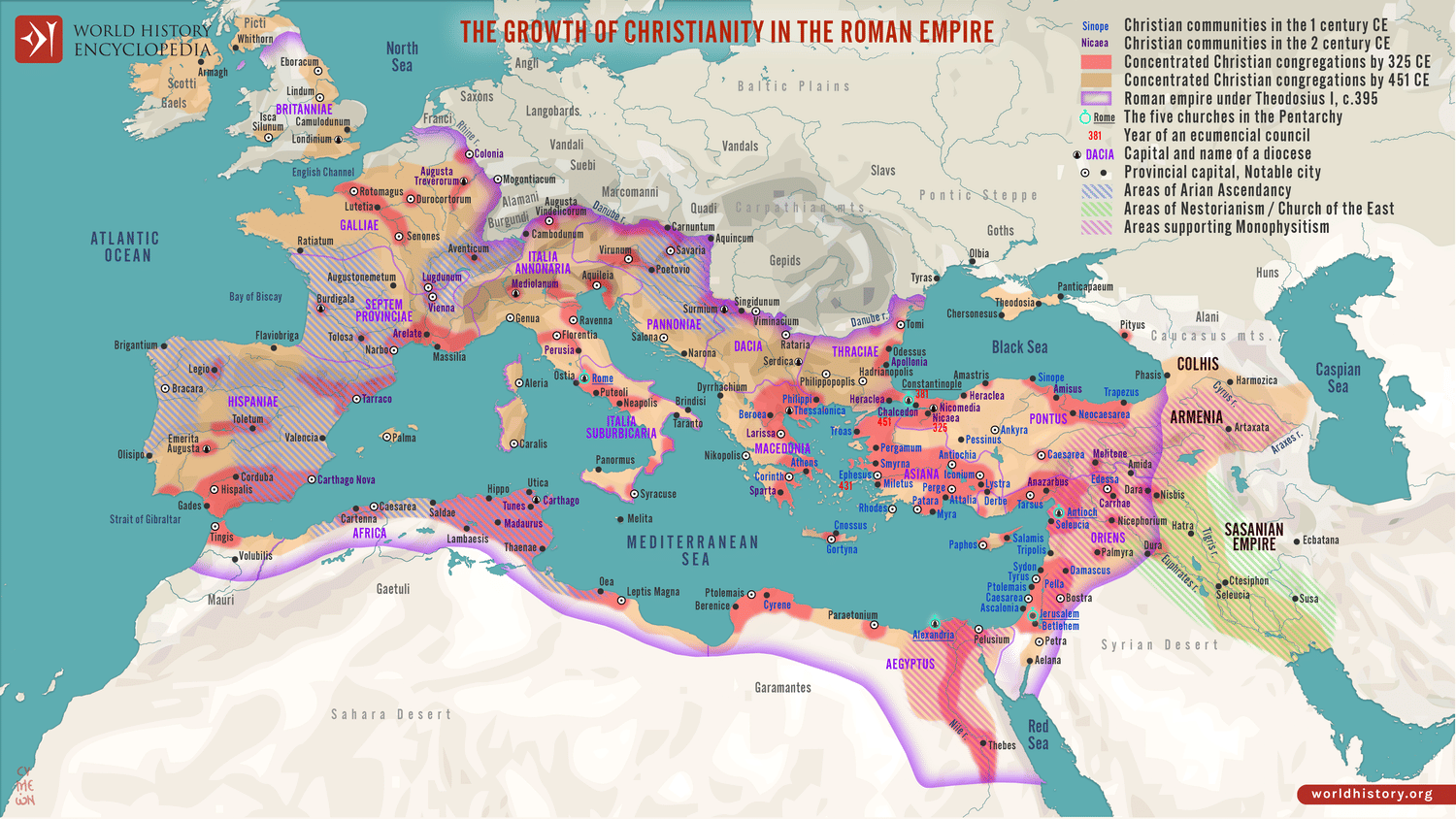
While early Christian leaders debated and struggled to establish official doctrine, Christian churches were rapidly being founded across the Roman Empire. These communities were led by bishops, regarded as the successors to the original Apostles, who oversaw the administration and growth of the new faith. Initially, the spread of Christianity was not a significant concern for Roman authorities. However, as the number of Christians grew throughout the empire, attitudes shifted dramatically. Over time, Christians came to be seen by Roman rulers as a subversive threat to the social and religious order, prompting systematic persecution of the faith and its followers.
The Patristic Period
After years of persecution, Emperor Constantine (272–337 C.E.) issued the Edict of Milan in 313, which ended official attacks on Christianity and granted religious tolerance throughout the Roman Empire. Constantine’s policy and eventual conversion to Christianity set a precedent for future emperors, many of whom would also embrace the faith. It was under Emperor Flavius Theodosius I (r. 378–395 C.E.), however, that Christianity was firmly established as the state religion of Rome. In 391–392 C.E., Theodosius banned pagan practices, effectively making Christianity the official religion of the empire.
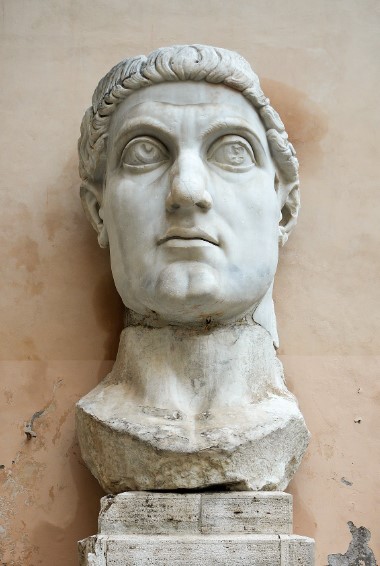
The mission of Rome had always been to impose order upon the world. After Christianity became the state religion of the Empire, this same commitment to order was extended to the Christian faith. To achieve unity and doctrinal consistency within Christianity, Roman emperors began sponsoring a series of Church councils. One notable example is the First Council of Nicaea, convened in 325 C.E. by Emperor Constantine in response to the Arian controversy. This theological dispute arose from the teachings of Arius (c. 250–336 C.E.), a Christian priest who claimed that Christ was created by God and was therefore not divine in the same way as God.
The Council of Nicaea addressed this controversy and sought to unify Christian doctrine by formalizing a creed. This creed aimed to provide “a convenient summary of Christian faith suitable for public occasions” and to establish a consensus among the diverse and often disunited early Christian communities. This creed not only clarified the nature of Christ as being fully divine and of the same essence (homoousios) as God the Father but also marked a significant step in the alignment of Christian theology with the authority of the Roman state. It laid the foundation for future councils and doctrinal developments that would shape the course of Christianity. Would you like a more detailed explanation of the Nicene Creed or its impact? Below is the creed established at this council, which became a cornerstone of orthodox Christian belief:
We believe in one God the Father all powerful, maker of all things both seen and unseen. And in one Lord Jesus Christ, the Son of God, the only-begotten begotten from the Father, that is from the substance of the Father, God from God, light from light, true God from true God, begotten not made, CONSUBSTANTIAL with the Father, through whom all things came to be, both those in heaven and those in earth; for us humans and for our salvation he came down and became incarnate, became human, suffered and rose up on the third day, went up into the heavens, is coming to judge the living and the dead. And in the holy Spirit.
The Patristic Period is regarded by mainstream Christian traditions—including the Anglican, Eastern Orthodox, Lutheran, Reformed, and Roman Catholic churches—as a crucial era in the development of Christian doctrine. These traditions see themselves as building upon, continuing, and, when necessary, critically engaging with the theological insights of the early Church Fathers. This period was marked not only by the establishment of key creeds, such as those formalized at Church councils, but also by the process of determining the limits of the New Testament—a process commonly referred to as the fixing of the canon.
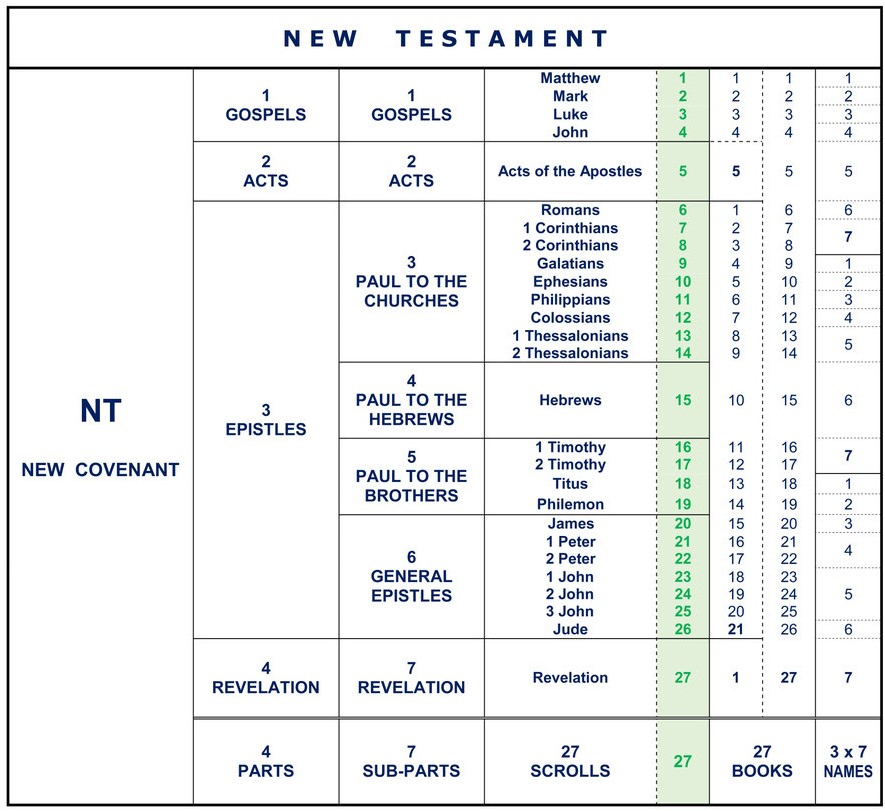
For early Christians, the concept of a canon was originally associated with the Tanakh (the Hebrew Scriptures). During the Patristic Period, a similar effort was undertaken to define which Christian texts were divinely inspired and should be included in the New Testament. Over time, consensus was reached regarding the list of books to be recognized as Scripture and the order in which they should appear. A key milestone occurred in 367 C.E. when Athanasius of Alexandria circulated his thirty-ninth Festal Letter, which for the first time identified the 27 books of the New Testament as they are known today. This two-part structure reflects the continuity between the Jewish roots of Christianity and the distinct theological identity that emerged in the early centuries of the faith.
The Christian Bible, as finalized, consists of two parts:
- Old Testament
- The Christian Old Testament is the Jewish Tanakh and initially was based on the Septuagint. The Septuagint is Koine Greek translation of the Jewish canon dating to c. 100 B.C.E. The term “Old Testament” was coined by Paul. It was used to reference the writings of the Mosaic covenant (See 2 Cor. 3:14)
- New Testament
- By the fourth century C.E., the term New Testament was commonly used to refer to a collection of twenty-seven early Christian texts composed in Greek. Early Christians thought it was composed by the original Apostles. Today it is believed that the texts were written by Christians from 50 to 150 C.E. New Testament canon was established through a process that took hundreds of years to complete. The culmination of this process is beleived to be found in St. Athanasius’s Easter letter of 367 C.E. which provides the first known list containing the present twenty-seven books of the New Testament.
The canon of the New Testament is divided in the following way:
- Gospels (Good News). These works tell of the beginnings of Christianity through the life of Jesus of Nazareth.
- Acts. These works tells of spread of Christianity through the apostles.
- Epistles. These works are composed of letter written by Christian leaders that detail the beliefs, practices, and ethics of Christianity.
- Revelation. This work deals with the culmination of Christianity.
Two of the most influential figures in the early Christian Church were Saint Jerome and Saint Augustine of Hippo.
Saint Jerome (340–420 C.E.), born in Stridon, was the most renowned biblical scholar and exegete of his time. His greatest achievement was the translation of the Bible from its original Hebrew and Greek into Latin, a monumental project completed in 383 C.E. This translation, known as the Vulgate Bible, became the standard version of the sacred text throughout the Middle Ages and remained highly influential in shaping Western Christianity.
Saint Augustine of Hippo (354–430 C.E.), born in Tagaste, was one of the foremost apologists of the Church, defending Christianity against pagan criticisms and heretical teachings. His most significant written work, The City of God (413–426 C.E.), was a response to accusations that Christianity had weakened the Roman Empire. In this text, Augustine reinterpreted the philosophical insights of Plato through a Christian lens, asserting that the natural world was a mere shadow or reflection of its divine source. His writings profoundly shaped Christian theology and Western philosophy, emphasizing the relationship between the temporal and the eternal, as well as the role of divine grace in human salvation.
Benedict of Nursia (480-543 C.E.) was born in Monte Cassino and is known as the founder of monasticism in the West. He established a monastic order with a rule to bring men back to a religious life and faith This monastic order, termed the Benedictine, would serve as a model for future orders in the West. The importance of this order along with others is that they became the preservers of classical knowledge. Many of the monasteries established by these orders preserved ancient works that would be consulted in the middle ages.
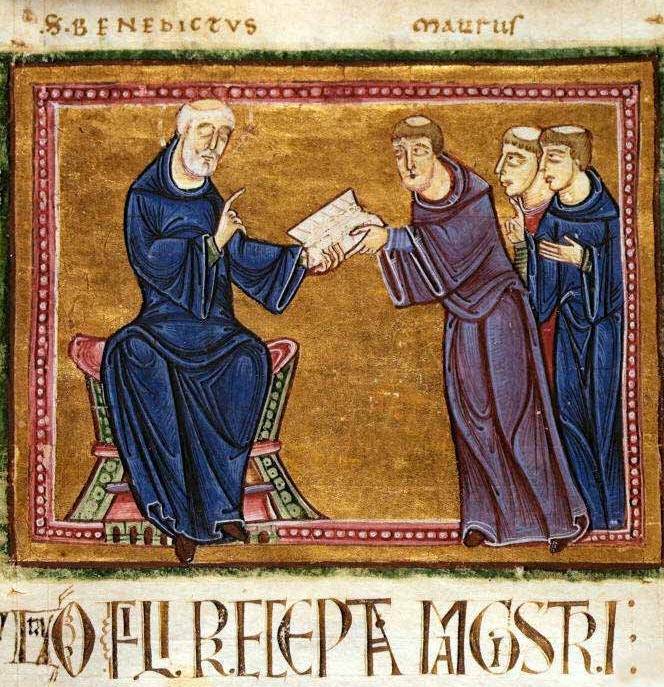
Benedict of Nursia (480–543 C.E.), born in Monte Cassino, is regarded as the founder of Western monasticism. He established a monastic order guided by a strict yet balanced Rule designed to bring men back to a life of religious devotion and faith. This monastic order, known as the Benedictines, became the blueprint for future monastic communities throughout the West.
The significance of the Benedictine order, and other monastic orders that followed, extended beyond their spiritual mission. These monasteries became vital centers for the preservation of classical knowledge. Monks meticulously copied and safeguarded ancient texts, including works of literature, philosophy, and science, that might otherwise have been lost to history. During the Middle Ages, these preserved manuscripts were consulted, studied, and transmitted, ensuring the survival of classical learning and its eventual revival during the Renaissance. Benedict’s monastic model thus played a critical role not only in the spiritual life of medieval Europe but also in the preservation and continuation of its intellectual heritage.
In Closing
As Christianity became intertwined with the Roman state, it adopted many characteristics of the Roman world, including its administrative structure, legal traditions, and cultural elements. This fusion of Roman and Christian influences shaped the development of Christianity and helped establish it as a dominant force in the Western world. How?
- Christianity absorbed Roman language, law, administrative hierarchy, and much of its culture.
- Christianity also filled the void left by the political disintegration of the Western Roman Empire.
- Christianity provided unity in a disordered world and would become a conduit for classical civilization during the middle ages.
 World History Portal