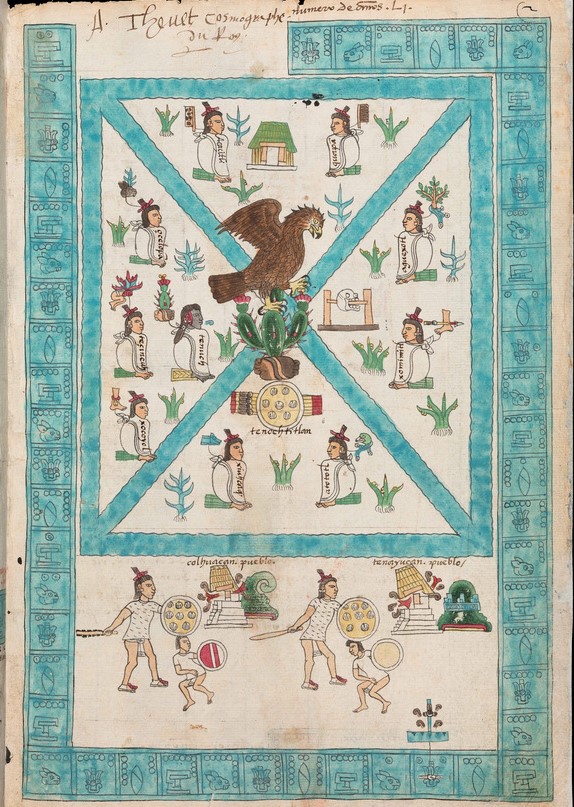
The Codex Mendoza was compiled for Charles V (r. 1516-1556) to aid the Spanish monarch in learning more about the Mexica and their Empire. It was named after Antonio de Mendoza, the first Spanish Viceroy of New Spain (1535-1550). It is believed by many specialists that it was the master painter Francisco Gualpuyogualcal who produced this work. As it made its way to Spain on the Carrera de Indias, it first fell into French hands and eventually made its way to the Bodleian Library in Oxford, England. The Codex Mendoza is painted on European paper with 71 folios bound at the spine in book style and is semasiographic. It combines pictorial representations with Náhuatl and Spanish commentary. It is divided into three sections. The first section covers the pre-Conquest history of the Mexica. The second section documents the tributes extracted by the Mexica from subjugated altepetls. The third section records an ethnographic account of the Mexica. Consider the following questions as you analyze the Folio 2r from the Codex Mendoza:
- What do you believe Folio 2r is recording in the top panel?
- What do you believe Folio 2r is recording in the bottom panel?
- What does the pattern on the folio’s border record?
Complete the Primary Source Analysis Form when finished for your records.
View the following video for further details about the Codex Mendoza.
Folio 2r
 World History Portal