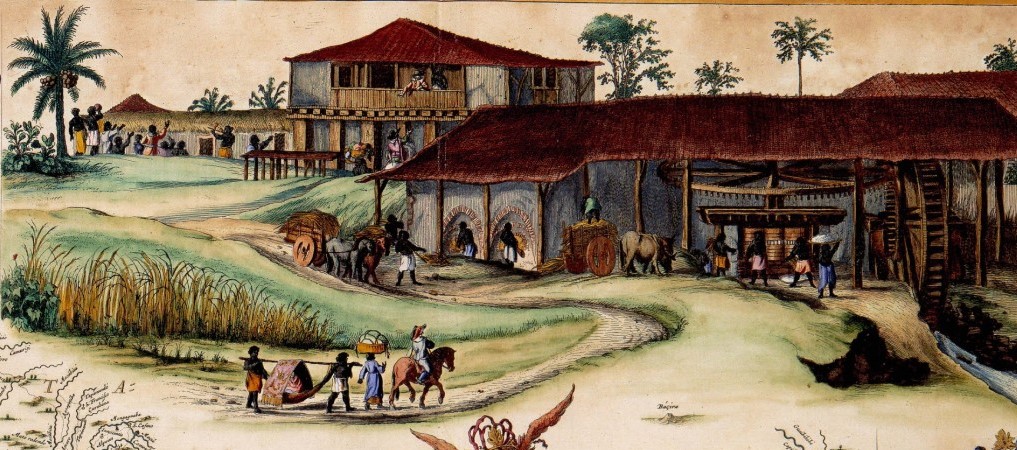
The Portuguese focused their early economic efforts in Brazil in the northeast coastland. It was extremely fertile and conducive to the growing of sugarcane. A plantation economy would dominate this region. Individuals appointed to settle early Brazil did so with an iron fist. Once such a person was Duarte Coelho who established the captaincy of Pernambuco. Consider the following questions as your read the selections below:
- What was the population composition like under Coelho’s leadership?
- Who posed a threat to the colonization efforts of Coelho?
- How did Coelho secure his personal wealth?
- What was the outcome for many of the colonizers that migrated to Pernambuco?
Complete the Primary Source Analysis Form when finished for your records.
Gabriel Soares de Souza, On the Exploits of Duarte de Coelho (1587)
The town of Olinda is the capital of the captaincy of Pernambuco, which was settled by Duarte Coelho, a gentleman of whose courage and chivalry I shall not speak here in detail, for the books that deal with India are full of his deeds. After Duarte Coelho returned from India to Portugal to seek a reward for his services, he sought and obtained from His Highness the grant of a captaincy on this coast; this grant began at the mouth of the São Francisco River in the northwest and ran fifty leagues up the coast toward the captaincy of Tamaracá, ending at the Igaruçu River. . . . Since this brave captain was always disposed to perform great feats, he determined to come in person to settle and conquer this, his captaincy. He arrived there with a fleet of ships that he had armed at his own cost, in which he brought his wife and children and many of their kinsmen, and other settlers. With this fleet he made port at the place called Pernambuco, which in the native language means “hidden sea,” because of a rock nearby that is hidden in the sea. Arriving at this port, Duarte Coelho disembarked and fortified himself as well as he could on a high point free of any dominating peaks, where the town is today. There he built a strong tower, which still stands in the town square, and for many years he waged war against the natives and the French who fought at their side. Frequently he was besieged and badly wounded, with the loss of many of his people, but he courageously persisted in his aim, and not only defended himself bravely but attacked his enemies so effectively that they abandoned the neighboring lands. Later his son, of the same name, continued to wage war on them, harassing and capturing these people, called Cayté, until they had abandoned the whole coast and more than fifty leagues in the interior. In these labors Duarte spent many thousands of cruzados that he had acquired in India, and this money was really well spent, for today his son Jorge de Albuquerque Coelho enjoys an income of ten thousand cruzados, which he obtains from the retithe, from his tithe of the fishing catch, and from the quit rent paid him by the sugar-mills (fifty of these have been established in Pernambuco, and they produce so much sugar that the tithes on it yield nineteen thousand cruzados a year). This town of Olinda must have about seven hundred householders, but there are many more within the limits of the town, since from twenty to thirty people live on each of these plantations, aside from the many who live on farms. Hence if it were necessary to assemble these people with arms, they could place in the field more than three thousand fighting men, together with the inhabitants of the town of Cosmos, which must have four hundred mounted men. These people could bring from their estates four or five thousand Negro slaves and many Italians. This captaincy is so prosperous that there are more than a hundred men in it who have an income of from one to five thousand cruzados, and some have incomes of eight to ten thousand cruzados. From this land many men have returned rich to Portugal who came here poor, and every year this captaincy sends forty to fifty ships loaded with sugar and brazilwood; this wood is so profitable to His Majesty that he has lately farmed out the concession for a period of ten years at twenty thousand cruzados a year. It seems to me that such a powerful captaincy, which yields this kingdom such a great store of provisions, should be better fortified, and should not be exposed for a corsair to sack and destroy—which could be prevented with little expense and less labor.
 World History Portal