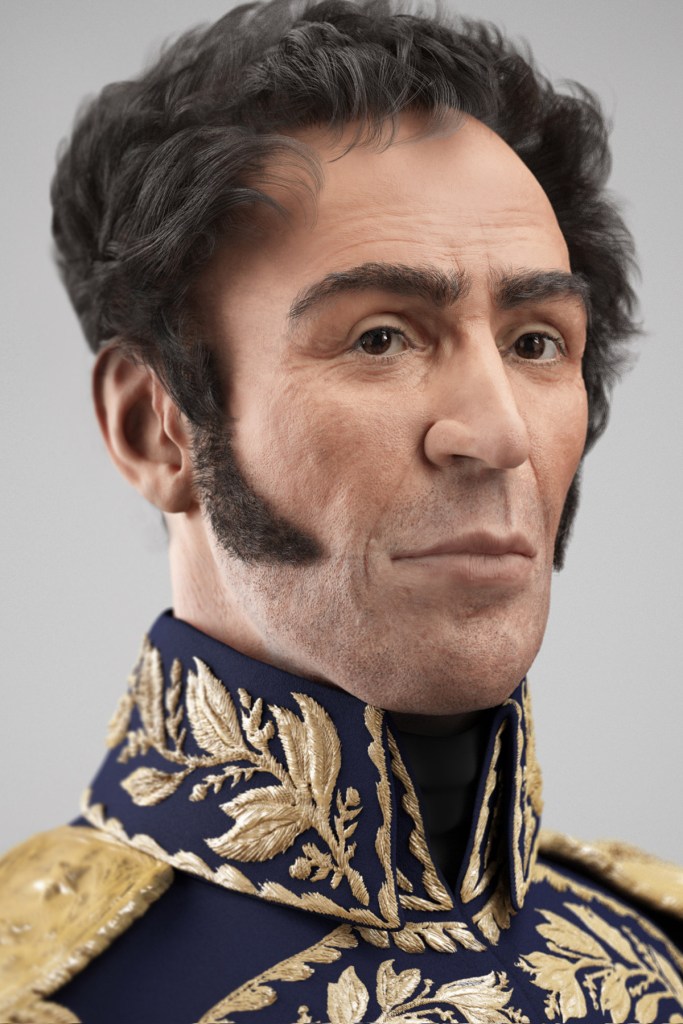
Simón Bolivar (1783-1830) is considered to be one of the greatest leaders of Latin American
independence movements. Even so, Bolívar faced numerous challenges to consolidate
independence and the aftermath of creating a strong nation-state. Although influenced by
the Enlightenment and the age of Atlantic Revolutions, in the end Bolívar believed that an
authoritarian government was the only way possible to bring success to the newly formed states of Latin America. Consider the following questions as you read the selections below taken from Bolívar’s writings.
- What solutions did Bolívar provide to address these challenges?
- What challenges did post-independence Latin America (Venezuela) face?
- What kept leaders from achieving the goals of independence?
- What caused these challenges?
Complete the Primary Source Analysis Form when finished for your records.
The Cartagena Manifesto: Memorial Addressed to the Citizens of New Granada by a
Citizen from Caracas (1812)
The doctrine behind this conduct had its origin in the philanthropic maxims of certain writers
who defend the idea that no one has the right to take the life of a human being, even one who has committed the crime of treason against the State. Shielded by this pious doctrine, each
conspiracy was followed by a pardon, and each pardon by another conspiracy, subsequently
pardoned, because, you know, liberal governments feel obliged to distinguish themselves by the quality of mercy. But this is a criminal mercy that contributed more than anything else to the destruction of the machine we had not yet finished building! This was the source of the
determined opposition to the practice of calling up veteran troops, disciplined and capable of
appearing on the field of battle, fully trained and ready to defend freedom with success and
glory. Instead, countless poorly disciplined militias were established, which had the effect not
only of exhausting the national treasury with exorbitant salaries but also of destroying
agriculture, tearing the farm workers away from their farms, and turning the government into an object of hatred, because it forced them to take up arms and abandon their families. But what most weakened the government of Venezuela was the federalist structure it adopted, embodying the exaggerated notion of the rights of man. By stipulating that each man should rule himself, this idea undermines social pacts and constitutes nations in a state of anarchy. Such was the true state of the confederation. Each province governed itself independently, and following this example, each city claimed equal privilege, citing the practice of the provinces and the theory that all men and all peoples have the right to institute whatever form of government they choose. The federal system, although it is the most perfect and the most suitable for guaranteeing human happiness in society, is, notwithstanding, the form most inimical to the interests of our emerging states. Generally speaking, our fellow citizens are not yet ready to take on the full and independent exercise of their rights, because they lack the political virtues marking the true citizen of a republic. Such virtues are impossible to attain in absolutist governments, where there is no training in the rights or duties of citizenship.
“Letter from Jamaica,” Simón Bolívar (1815)
The role of the inhabitants of the American hemisphere has for centuries been purely passive. Politically they were nonexistent. We have been harassed by a conduct which has not only deprived us of our rights but has kept us in a sort of permanent infancy with regard to public affairs. If we could at least have managed our domestic affairs and our internal administration, we could have acquainted ourselves with the processes and mechanics of public affairs. More than anyone, I desire to see America fashioned into the greatest nation in the world, greatest not so much by virtue of her area and wealth as by her freedom and glory. Although I seek perfection for the government of my country, I cannot persuade myself that the New World can, at the moment, be organized as a great republic. . . . The American states need the care of paternal governments to heal the sores and wounds of despotism and war. It is a grandiose idea to think of consolidating the New World into a single nation, united by pacts into a single bond. It is reasoned that, as these parts have a common origin, language, customs, and religion, they ought to have a single government to permit the newly formed states to unite in a confederation. But this is not possible. Actually, climatic differences, geographic diversity, conflicting interests, and dissimilar characteristics separate America. Undoubtedly, unity is what we need to complete our project of regeneration. However, our division is not surprising, for such is the nature of civil wars, usually fought between two factions: conservatives and reformers. Generally, the former are more numerous, because the rule of custom inclines us to obedience to established powers; the latter are always less numerous but more passionate and enlightened. In this way physical mass is balanced by moral force, so that the conflict is prolonged, and the results are uncertain.
“Address at the Congress of Angostura,” Simón Bolívar (1819)
We are not Europeans; we are not Indians; we are but a mixed species of aborigines and
Spaniards. Americans by birth and Europeans by law, we find ourselves engaged in a dual
conflict: we are disputing with the natives for titles of ownership, and at the same time we are
struggling to maintain ourselves in the country that gave us birth against the opposition of the invaders. Thus our position is most extraordinary and complicated. But there is more. As our role has always been strictly passive and political existence nil, we find that our quest for liberty is now even more difficult of accomplishment; for we, having been placed in a state lower than slavery, had been robbed not only of our freedom but also of the right to exercise an active domestic tyranny. . . . We have been ruled more by deceit than by force, and we have been degraded more by vice than by superstition. Slavery is the daughter of darkness: an ignorant people is a blind instrument of its own destruction. Ambition and intrigue abuses the credulity and experience of men lacking all political, economic, and civic knowledge; they adopt pure illusion as reality; they take license for liberty, treachery for patriotism, and vengeance for justice. If a people, perverted by their training, succeed in achieving their liberty, they will soon lose it, for it would be of no avail to endeavor to explain to them that happiness consists in the practice of virtue; that the rule of law is more powerful than the rule of tyrants, because, as the laws are more inflexible, everyone should submit to their beneficent austerity; that proper morals, and not force, are the bases of law; and that to practice justice is to practice liberty. Therefore, let the entire system of government be strengthened, and let the balance of power be drawn up in such a manner that it will be permanent and incapable of decay because of its own tenuity. Precisely because no form of government is so weak as the democratic, its framework must be firmer, and its institutions must be studied to determine their degree of stability…unless this is done, we will have to reckon with an ungovernable, tumultuous, and anarchic society, not with a social order where happiness, peace, and justice prevail.
 World History Portal