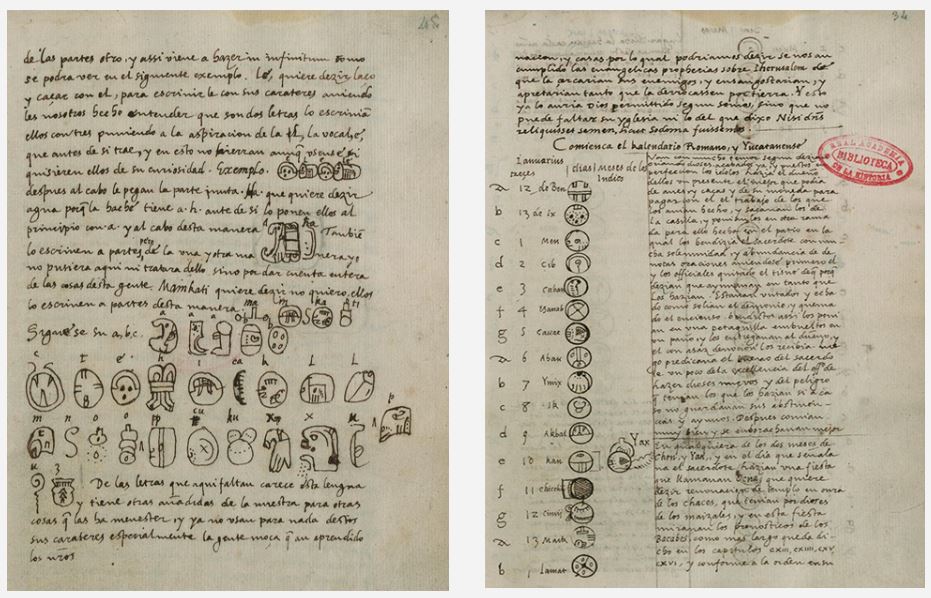
Fray Diego de Landa’s Relación de las Cosas de Yucatán (1566) is a pivotal historical and ethnographic account of the Maya civilization, written during the Spanish colonization of the Yucatán Peninsula. As a Franciscan missionary, Landa meticulously documented Maya culture, language, religious practices, and daily life. However, he is also infamous for orchestrating the 1562 auto-da-fé in Maní, which led to the destruction of Maya codices and religious artifacts. Despite this contradiction, his work remains an invaluable resource, offering crucial insights into Maya glyphs and traditions that later contributed to the decipherment of the Maya script. Notably, Landa’s original Relación de las Cosas de Yucatán has never been found. The version that survives today is an abridged copy, transcribed by unidentified bureaucrats. This preserved text remains a key source on the Maya calendar and writing system, ensuring that some of Landa’s observations endure despite the loss of the original manuscript. As you analyze this selection from the abridged manuscript, consider the following questions:
- According to Landa, what materials did the Maya write on?
- What happened to many of these works?
- How does Landa describe the workings of the Maya writing system?
- Use these questions to guide your analysis as you engage with the text.
Complete the Primary Source Analysis Form when finished for your records.
Relación de las Cosas de Yucatán
These people also used certain characters or letters with which they wrote in their books their
ancient affairs and their sciences, and with these and with figures and some signs in the figures,
they understood their affairs and they made others understand them and taught them. We found
among them a large number of books in these their letters, and because they had nothing in
which there was not superstition and lies of the devil, we burned them all, which they regretted
to an amazing degree and which caused them sorrow. Of their letters I will give here an A, B, C,
since their ponderousness permits nothing more, for they use one character for all the aspirations
of the letters and, later, they unite with it part of another and thus it goes on ad infinitum, as will
be seen in the following example. le means noose and to hunt with it; to write le with their
characters (we having made them understand that these are two letters), they wrote it with three,
placing for the aspiration of I the vowel e, which it carries in front of it, and in this way they do
not err even though they might use [another] e if, out of curiosity, they so wish. Example:

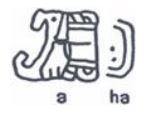
Afterwards, at the end, they affix the part which is joined. Ha means water, and because the h
has a before it, they put it at the beginning with, and at the end in this fashion:
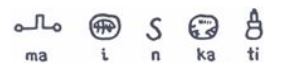
They also wrote in parts, but in one way or another that I shall not give here nor will I deal with
it except by giving a full account of this people’s affairs. Ma in kati means I don’t want to and
they write it in parts in this fashion:
There follows their A, B, C:

Of the letters which are missing, this language lacks them and has others added from our own for
other things of which it has need, and already they do not use these their characters at all,
especially the young people who have learned ours.
Source: Coe, Michael D. Breaking the Maya Code (Third Edition) (Kindle Locations 1797-1805). Thames & Hudson. Kindle Edition.
 World History Portal