BREAKING THE MAYA CODE
| INTRODUCTION In this topic you will learn about the Maya writing system. Maya writing was the most complex of the Mesoamerican scripts, consisting of approximately 1,000 signs, many of which were variations of the same symbol. It was a glottographic system that used both logograms (whole words) and syllabograms (syllables), allowing scribes flexibility in representation. Today, ongoing research continues to expand our understanding of this intricate writing system. LEARNING OBJECTIVES *Describe the structure and complexity of the Maya writing system, including its use of logograms, syllabograms, and glyph blocks. *Explain the contributions of key figures in the decipherment of Maya writing, including Fray Diego de Landa, Tatiana Proskouriakoff, Yuri Knorozov, and David Stuart. *Demonstrate an understanding of Maya glyph organization and reading order, including the zigzag reading pattern and the use of main signs and affixes. Timeline: Maya Decipherment |
MAYA DECIPHERMENT: A BRIEF OVERVIEW
Maya writing was the most complex of the Mesoamerican writing systems. It consists of 1,000 signs of which many of these are variations of the same sign. As a glottographic writing system, Maya writing consists of signs representing whole words (logograms) and signs representing syllables (syllabograms). In fact, under this system a Maya scribe could make a word known through a logogram or could write it strictly syllabically.
The history of Maya decipherment must begin with a Spanish missionary by the name of Fray Diego de Landa (1524-79). Landa, a Franciscan friar who eventually became the Bishop of Yucatan, was responsible for the destruction of many of the pre-Columbian Maya codices. Believing these works contained “superstitions and lies of the devil,” Landa ordered the burning of codices and other Maya objects during the auto de fé de Mani conducted in 1562. Ironically, it was Landa who recorded what scholars refer to as the Rosetta Stone of Maya decipherment. It was through an interview with a Mayan by the name of Juan Nachi Cocom that Landa was able to create a chart that had Maya signs with alphabet letters attached to them (see below).

This chart was recorded in Relación de las Cosas de Yucatán (1562), a work Landa wrote when he was recalled to Spain to account for his overzealous actions against the Maya. It would take years and years for scholars to realize what Landa had truly recorded was not an alphabet but a syllabary. Eventually, Landa was exonerated for his actions and returned to Yucatán in 1572.
The French linguist Leon de Rosney (1837-1914) pushed for a phonetic approach to deciphering the Maya glyphs. Rosney was able to identify a glyph group that designated directions (east, west, north, and south) and the glyphs for earth and turkey. Another early contributor to the phonetic approach to Maya decipherment was the American anthropologist Cyrus Thomas (1825-1910) who uncovered that Maya glyphs were read from left to right “in pairs of columns from top to bottom.” Unfortunately, Thomas’s use of Landa’s alphabet produced phonetic readings of Maya glyphs that were incomprehensible. This led his critics to conclude that Landa’s alphabet was a fabrication, and that the Maya writing system was not phonetic. With time, Thomas himself succumbed to the idea that phoneticism was not a characteristic of Maya writing.
In contrast to the short gains in decipherment, major advances were being made in understanding Maya astronomy, calendrics, and mathematics. One key contributor to this knowledge base was Ernst Förstemann (1822-1906), the Royal Librarian at the Dresden Library, Germany. In the late 1800s Förstemann studied both the Codex Dresden, which was housed in this library and Landa’s recording of days and months. From analyzing these sources, Förstemann concluded that the Maya counted in base twenty (vigesimal) and also uncovered the recording of a Venus Table.
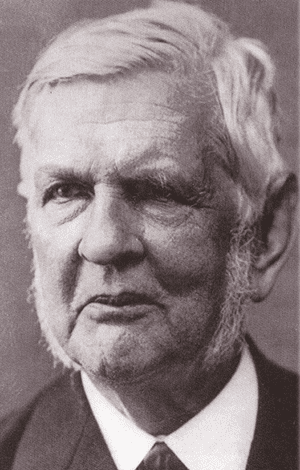
The turn of the century would see more accessibility to Maya glyphs that ever before. Added to the facsimile reproduction of existing codices were photographs of Maya inscriptions. These photographs, such as those taken and cataloged by Alfred P. Maudslay, provided scholars with a detailed and precise corpus of Maya writing to work with. However, even with access to this corpus of material little had changed on how the Maya writing system was viewed by scholars. As one historian has noted,
“Although the nineteenth century had seen breakthroughs in the Maya calendars, the reading order, and the complex mathematical system, by the time of the second World War scholars were generally agreed that Maya inscriptions contained only calendrical, astronomical, and divinatory formulas. The intellectual straitjacket of Western academics proclaimed that reading the script in terms of language was an impossibility in all but the most limited sense.”
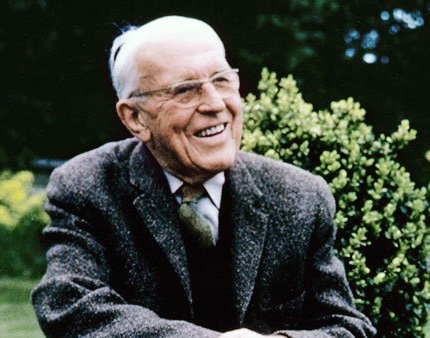
A fundamental figure who held this straitjacket position was the English scholar Sir John Eric Sidney Thompson (1898-1975) who was the foremost authority on the Maya writing system in the mid-20th century. Scholarship on Maya writing ceased to advance since there were few if any that challenged Thompson’s views. Thompson is known for cataloging all the Maya glyphs and assigning them a number in a seminal work entitled Catalog of Maya Hieroglyphs (1962). The notion held by Thompson was about to change with the work of Tatiana Proskouriakoff (1909-1985), a Russian-born immigrant to the United States. Proskouriakoff was first exposed to Maya writing when she participated in a 1930 archaeological project conducted by the University of Pennsylvania in Piedras Negras. She later become a research associate at Harvard’s Peabody Museum where her studies of the Piedras Negras inscriptions led her to conclude that they recorded the birth, rise, and death of a series of rulers. She challenged the prevailing conception that Maya script only focused on recording calendrical, astronomical, and divinatory formulas arguing that the glyphs provided a history of the Maya in a seminal article entitled “Historical Implications of a Pattern of Dates at Piedras Negras, Guatemala.”

Things were to change for the phoneticists in 1952 when Yuri Valentinovich Knorozov (1922-1999) began making groundbreaking strives in solving the Maya mystery. A linguist from Russia, Knorozov was isolated from the influence of Eric Thompson and freely explored the possibility that Maya script could be read phonetically.

Knorozov concluded from studying Landa’s alphabet that the Maya writing system was syllabic. In fact, as a linguist Knorozov believed that Maya writing had too many glyphs to be an alphabet based written system and too few glyphs for it to be strictly logographic. Thus he concluded that Maya writing had to be logosyllabic. Along with Landa’s chart, Knorozov also used a Yucatec dictionary to begin identifying Maya syllabograms.
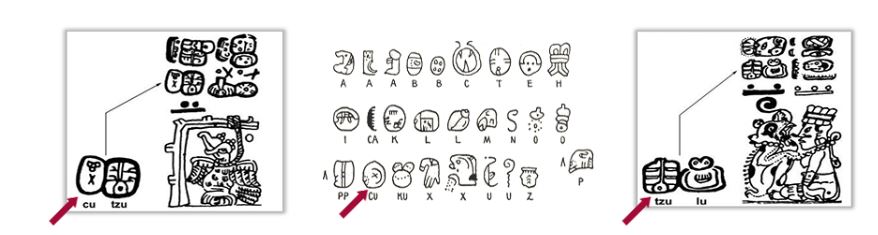
Recall Landa’s work recorded glyphs with letters underneath. These letters did not represent an alphabet, but rather sound attributed to the glyph. By examining Maya writing, Knorozov noticed that some of the glyphs recorded by Landa appeared in surviving texts. For example, cu, which appears next to a turkey. Next to cu there is an unknown glyph. To try to uncover the sound of this unknown glyph, Knorozov turned to the colonial and modern Maya term for turkey which is cu-tz(u) (Cutz: pavo desta tierra.). To the unknown glyph, he attached the sound tzu. He now needed to test his method. Knorozov tested his methodology by comparing the glyph sounds he identified with other glyphs. In the Codex Dresden he found the glyph he designated with the sound tzu positioned next to an image of a dog. Remember, he now knew what the sound for tzu was from his work with the word turkey. He also found it was paired with an unknown glyph. The Yucatec Maya term for dog is tzul (Tzul: Perro domestico). He now assigned the new unknown glyph the sound of lu.
With the passing of Eric Thompson and his influence over Maya studies, a new wave of specialists approach decipherment from the phonetic approach using Knorosov’s methodology. Many of these scholars gathered for the first time and collaborated at the Palenque Mesa Redonda Conference held in 1973. This collaborative effort and others that would follow produced important advances in the decipherment of Maya glyphs.
Today, David Stuart is recognized as the leading authority of Maya glyphs. As a Maya specialist, David Stuart’s father regularly took his son to Maya archaeological sites when conducting field research. Consequently, David as a child grew up working with Maya glyphs. What David uncovered through his analysis of the glyphs was that the Maya in many cases had more than one glyph to make a a particular sound (homophany).
It was in his seminal work Ten Phonetic Syllables (1987) where Stuart mapped out his discovery, a discovery that has shaped the course of the present methodology used in the decipherment of Maya hieroglyphs.
MAYA WRITING STRUCTURE: BRIEF OVERVIEW
Maya writing is composed of glyph blocks. These glyph blocks could combine two to nine Maya glyphs at a time to convey a word or phrase. Classic Maya writing organized glyph blocks in vertical columns. The inscriptions were read two columns at a time from left to right using a zig zag pattern. Using the first four columns of the Yaxchilán Stela 11 (see image to the right) as an example, the inscriptions would be read in the following order:
- A1
- A2 B3
- A4 B5
- A6 B7
Having completed reading the first two columns (A and B), one would next move to the next two columns (C and D):
- C8 D9
- C10 D11
- C12 D13
- C14 D15
Should the last column not be paired with another, it is then read vertically.

There are several challenges one faces when reading the Maya writing system. First, Maya scribes had a wide latitude of flexibility on how they drew their glyphs, or whether they chose to use logograms or syllabograms.

Along with these factors, what also impacts the appearance of glyphs and glyph blocks is that in Maya writing more than one glyph could be used to make a particular sound. For example, in our writing system each letter of the alphabet has a particular sound attached to it. In the Maya writing system, more than one glyph can share a sound.
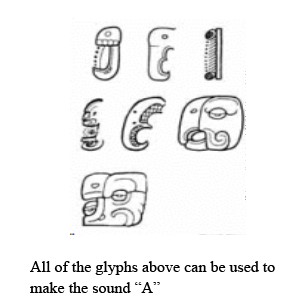
Maya scribes had iconographic forms to select from when writing which could be mixed. Most commonly used were geometric variants and head variants.

A Maya scribe could write using glyphs that denote a word or glyphs that denote a sound.

Glyphs identified as main signs are the largest group in Maya writing. More than 700 types of glyphs have been identified. These glyphs were rendered larger than others and many times served as a logogram. If there was more than one main glyph, overlapping, conflation, or infixation was applied by the scribe.

Affixes formed another category of glyphs of which there exist several hundred. In appearance, they are smaller than the main glyphs and can take the form of a prefix, postfix, superfix, subfix, and infix. The affixes modified the main sign’s value by:
- Spelling a word in conjunction with the main sign
- Complementing the main sign
- Grammatical functions ranging from third-person possessive pronouns to numerical classifiers

Maya numerical system compared.


IN CLOSING
The Maya writing system as you have learned was the most complex of the five indigenous scripts identified in Mesoamerica. Recall that its complexity stemmed from the scribes’ use of both phonetic glyphs, representing sounds, and logographic glyphs, representing entire words. Additionally, Maya scribes had considerable artistic freedom in how they depicted glyphs, making the script not only visually rich but also challenging to decipher. This flexibility and creativity set Maya writing apart, blending linguistic sophistication with artistic expression.
Your discussion board for this topic will grant you the opportunity to decipher Maya glyph blocks. Historically, students express frustration with this decipherment activity that you will be working on. Unfortunately, they miss the point. I am not concerned about whether your decipherment is correct or incorrect. My reasoning for assigning the decipherment activity is so that you explore in depth what is one of the most fascinating writing systems created in human history. At the same time, it is an opportunity to practice the process of decipherment. it is an activity that requires some time, effort, and imagination. Remember, the glyphs do not need to be identical, rather they need to be similar. Again, keep in mind that Maya scribes had a tremendous amount of latitude on how to represent the glyphs. These are very important points.
As always, be sure to contact me or visit me during office hours should you have any questions about the content we have covered or the assignments that you need to complete.
 World History Portal