CONQUEST, COLONIZATION, AND CONVERSION
| INTRODUCTION This topic will focus on the medieval precedent set for conquest, colonization, and conversion of indigenous Mexico. The start will be with the fall of the Western Roman Empire in 476 C.E. This marked a turning point in European history, leading to political fragmentation, economic decline, and the emergence of feudalism. As Europe entered the Middle Ages, the Iberian Peninsula witnessed the rise and fall of the Visigothic Kingdom, which was ultimately overtaken by Muslim forces in 711 C.E. Under Islamic rule, al-Andalus became a center of intellectual and cultural exchange, fostering religious coexistence and serving as a bridge between Eastern and Western knowledge. Meanwhile, the Catholic Church solidified its influence over Europe, shaping political affairs through conflicts like the Investiture Controversy and the Crusades. These military campaigns of the Crusades not only deepened Christian-Muslim tensions but also revived trade and expansionist ambitions, setting the stage for Spain’s Reconquista and the eventual colonization of the Americas. As European monarchies centralized power, they turned their attention to overseas exploration, leading to the creation of vast maritime empires. As you will learn, this period of transformation facilitated Spain’s expansion into the Americas and witnessed the transference of its medieval experience into Mexico. LEARNING OBJECTIVES *Discuss the significance of al-Andalus as a cultural and intellectual center, including the coexistence of Muslim, Jewish, and Christian communities and the transmission of knowledge from the East to Europe. *Assess the impact of the Crusades on Europe and the Islamic world, including their role in reviving trade, expanding European military and economic ambitions, and shaping justifications for conquest. *Analyze how the concepts of limpieza de sangre (purity of blood) and genealogical accounting contributed to the development of racial hierarchies and the casta system in the Spanish colonial world. Oxford History Timelines: Spain | Portugal |
THE FALL OF ROME AND THE ARRIVAL OF ISLAM
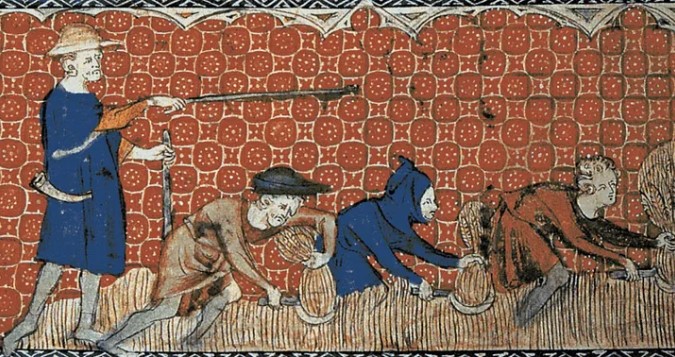
From the third century B.C.E. to 476 C.E., the Mediterranean world was centralized under the Roman Empire. Plagued by overextension, economic decay, political chaos, and Germanic invasions, the western part of the Roman Empire finally collapsed in 476 C.E. With the Roman Empire being a thing of past, feudalism eventually took hold of Europe. Under feudalism, Europe became politically decentralized, distant trade networks collapsed, and knowledge was lost or retreated to monasteries as the Roman education system disintegrated. What emerged in the place of Rome was a series of kingdoms that fused Roman culture, Germanic culture, and Christianity.
In Iberia, the Visigoths had established one such kingdom. King Leovigild (568-586 C.E.) made Toledo the center of Visigoth power and sought to bring unification to Iberia. By 672, the Visigoth kingdom had reached its apex. Early details about the Visigoths come from sources such as Isidore of Seville’s (early 7th century C.E.) History of the Kings of the Goths and John Biclaro’s (late 6th century C.E.) Chronicle.

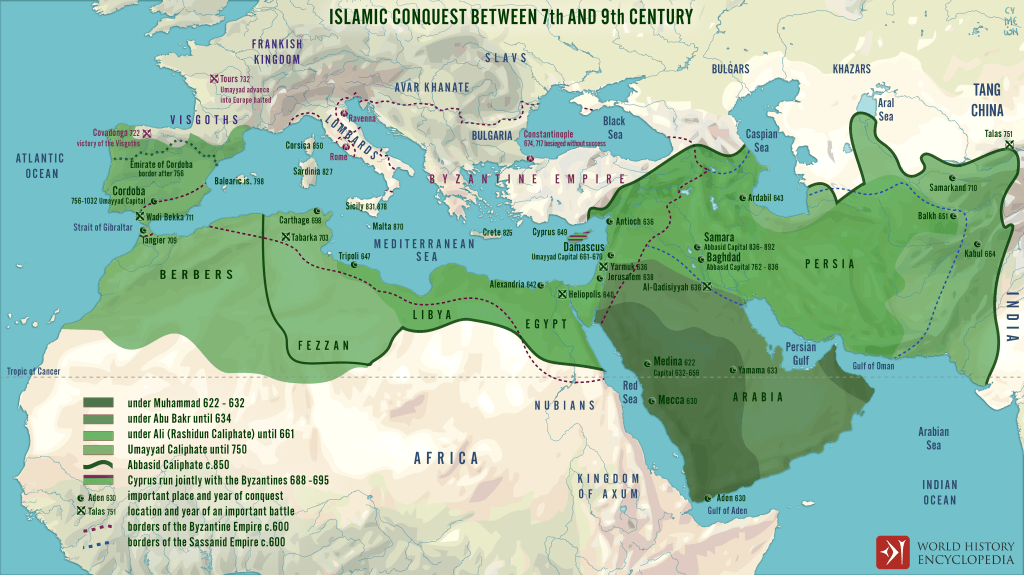
The year 711 was a pivotal point in Iberian history as it marked the ascendancy of Islam and the collapse of Visigoth dominion in Spain. With the arrival of Islam to this part of the world, the Visigoths were forced into northern Spain. From the Visigoth remnants in northern Spain evolved a series of Christian kingdoms that eventually would lead the reconquest of Iberia. The region of Iberia under Muslim control was referred to as al-Andalus and became a cultural and intellectual center. In part, this was due to the environment of coexistence that was established between Muslims, Christians, and the Jewish community under Islamic leadership. Equally important to the fruition of knowledge in this region was Islam’s role as a conduit for the infusion of ideas from the East into the West. For example, the Hindu-Arabic numbering system that we still use today and made the rise of modern science possible.
The early history of Muslim Spain ushered in a period historians refer to as convivencia, or coexistence, among Muslim, Jewish, and Christian cultures. In fact, many historians stress that the Jewish communities residing in Spain since Roman times welcomed the arrival of the Muslim’s as liberators from anti-Jewish legislation initiated by the Visigoths. These laws originated in Visigoth Spain after king Reccared I (r. 586-601) converted from Arian Christianity to Catholicism in 589. His successors, now also Catholic, enacted legislation that was aimed at isolating and suppressing the Jewish community in Spain. For example, Canon III of the Sixth Council of Toledo convened in 638, recorded that King Khintila (r. 636-40) “inflamed by the ardor of the Faith and in union with the bishops of his kingdom, has chosen to obliterate the very foundations of the superstitious prevarication [of the Jews], and does not permit anyone who is not Catholic to reside in his kingdom.” Article X of Book XII in the Lex Visigothorum (653) legislated that “Jews, whether baptized or not baptized, are forbidden to give testimony in court.”
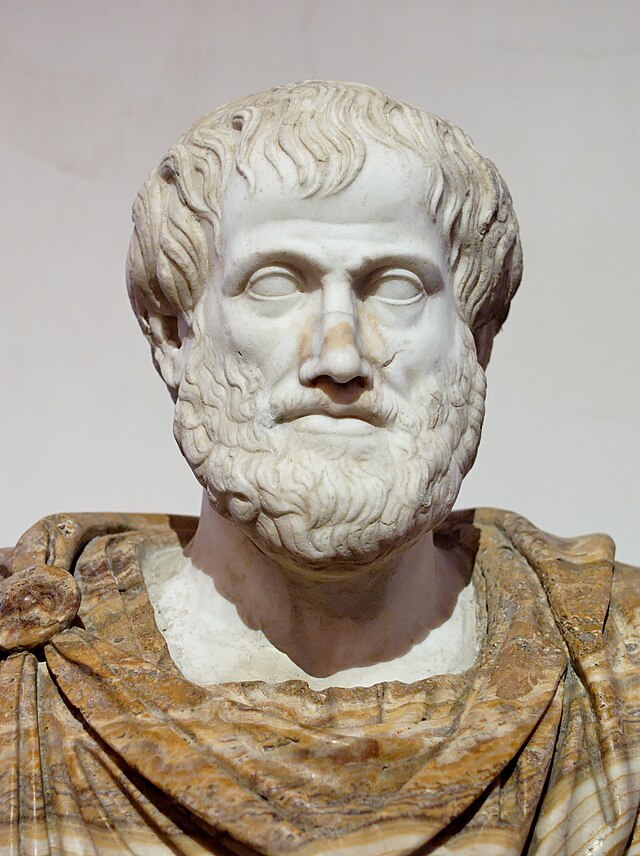
The intellectual importance of al-Andalus was measured by accessibility to knowledge, in many cases knowledge that was new or lost to Europe. For example, the city of Córdoba alone housed over 400,000 books in its libraries, a figure that was unheard of throughout the rest of Europe. Many of the books included Greek and Arab works on natural philosophy (science). By the year 1200, an entire corpus of Greek and Arabic works on natural philosophy and philosophy had been made available to Europe. Many of these works would influence the worldview of the Iberians. For example, Aristotle’s writings. In the case of Spain, Aristotelian philosophy would dominate its intellectual world even into the 16th century. On more than one occasion the Spanish turned to his Politics (c. 350 BCE) to justify the subjugation of indigenous.
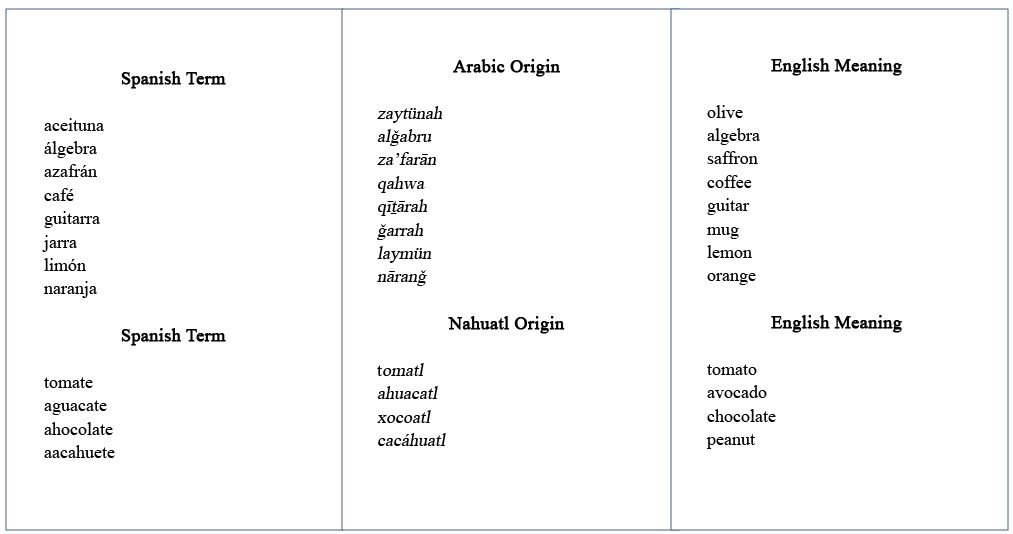
Below are few examples of how the Spanish language has been influenced by Arabic and Nahuatl. Nahuatl is the language spoken by the Mexica (Aztecs).
THE PAPACY TAKES THE LEAD
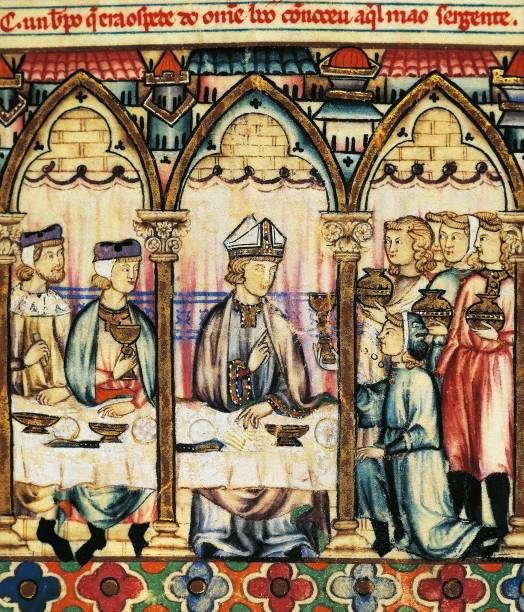
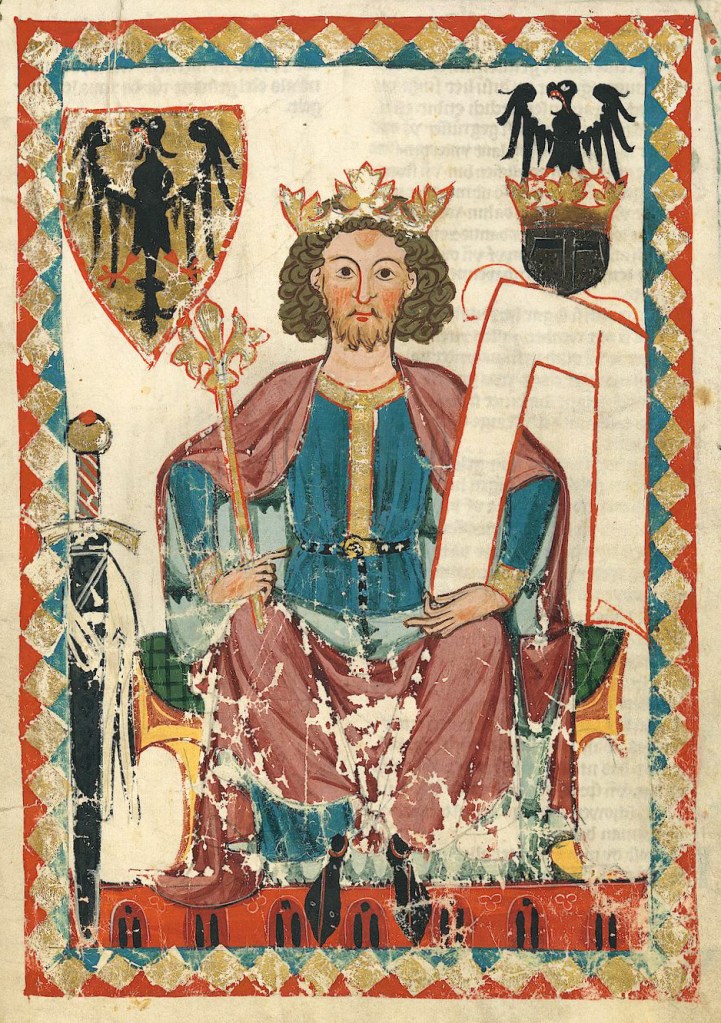
Throughout the early Middle Ages, the Papacy (spiritual authority) and secular rulers struggled over who should lead Europe. In particular, it was the Papacy and Holy Roman Emperors who clashed over the leadership of this region of the world. This struggle was in part resolved by the Investiture Controversy, a battle that pitted Pope Gregory VII (r. 1073-85) against Henry IV (r. 1056-1106), the Holy Roman Emperor. What was at stake? First, who had the right to appoint and invest bishops, an important and powerful member of the Church’s hierarchy. Investment itself was a ceremony in which the bishop was given a staff and ring. The staff symbolized he was the shepherd of the flock and the ring that he was married to the church. Second, who was the rightful leader of Christendom (Christian Europe). Henry IV’s struggle with Gregory VII resulted in his ex-communication forcing the king to ask for Gregory VII’s forgiveness at Canossa in 1077. For now, the Papacy was on top. In response to his success, Gregory VII issued the Dictatus Papae (1085), a Papal Bull that outlined the authority of the church over all matters. The Papacy’s new position of power was further demonstrated in 1095 when it directed Europe’s foreign policy through the Crusades. This would impact al-Andalus and would be one of the main factors that set the tone for the conquest of America with its fusion of militarism and Christianity.
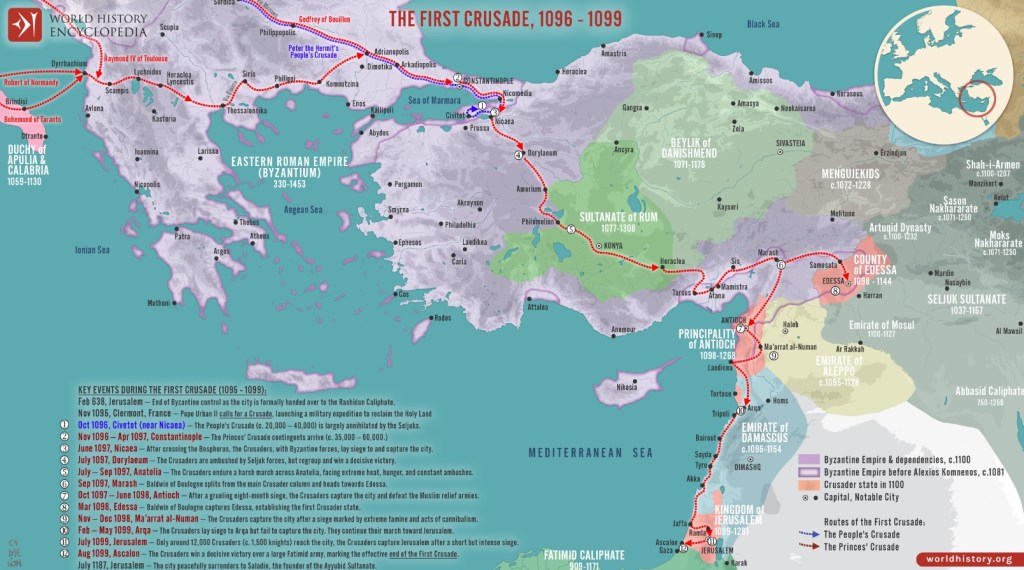
In 1095, Pope Urban II (r. 1088-1099) called for a crusade against the Seljuk Turks (Islam) at the Council of Clermont (France). In response to his call, Christian forces left Europe and conquered parts of the “Holy Land” (Levant). What caused the call for this crusade? What is truly the fear of Islam making its way to Europe? Was it Europe wanting to access the trade routes originating in the Asia and ending in Muslim held territory?
The bottom line is that the early military success of the crusades re-introduced Europe to “exotic” goods and international trade routes originating in the East. What type of goods were making their way from the east? An answer to this question can be found in a document describing the Christian capture of a trade caravan. See a source fragment to the right. In 1192 a group of crusaders led by Richard I (r. 1189-1199) “the Lionheart” captured this caravan and noted the contents it carried.
The crusades and the revival of Europe’s economy stimulated the quest for ways to circumnavigate the Islamic world and find a new way to reach Asia. Two waves would be initiated. One attempted to go circumnavigate Africa and the other sought to reach Asia by heading in a westerly direction.
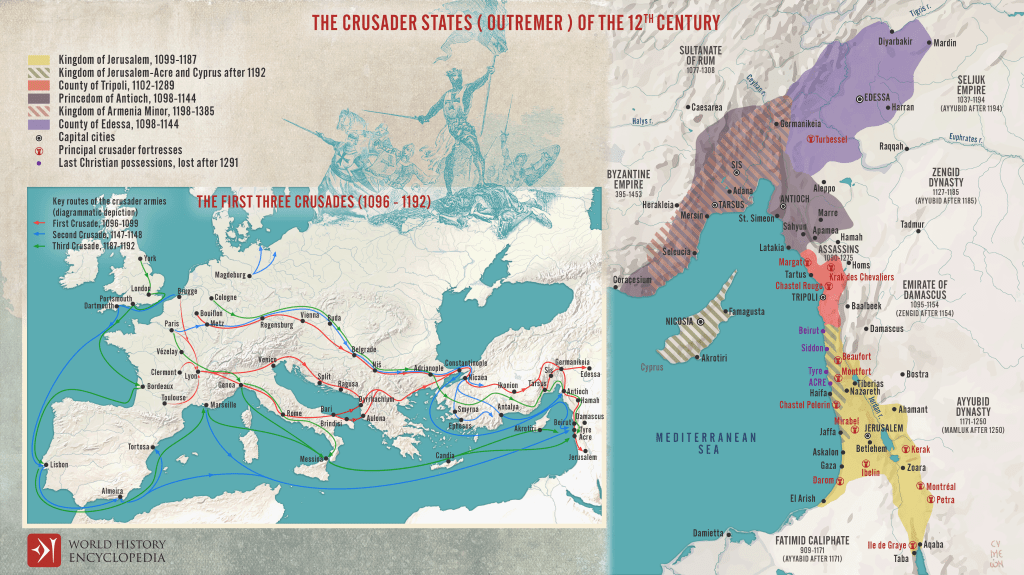
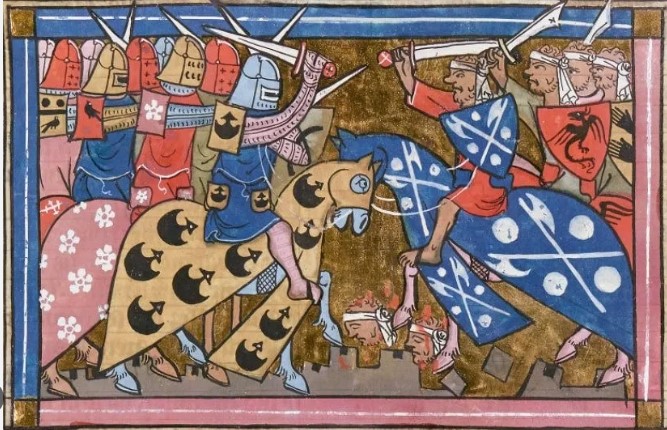
The crusades also successfully fused Christianity and militarism thus laying the foundations for the concept of just war. For example, Saint Bernard of Clairvaux’s (1090-1153) In Praise of the New Knighthood argued that the, “. . . the knights of Christ may safely fight the battles of their Lord, fearing neither sin if they smite the enemy, nor danger at their own death; since to inflict death or to die for Christ is no sin, but rather, an abundant claim to glory.” This notion that war could be justified even made its way into Iberian medieval law.
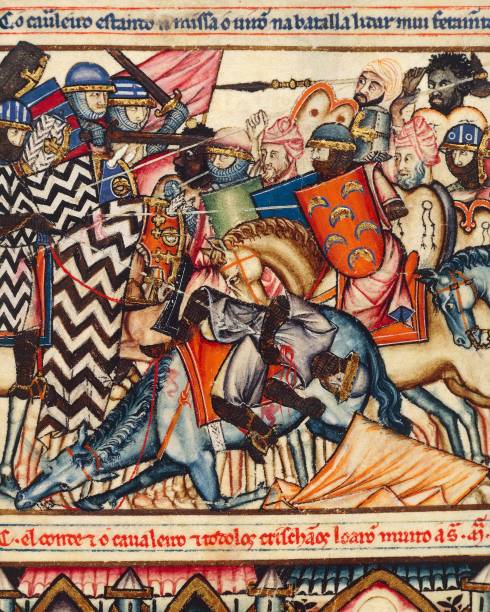
This crusading spirit was not just limited to fighting Islam in the East. It also found its way to Spain where a Muslim presence had existed since 711. The crusading spirit that reached Spain put an end to co-existence between the Muslim, Christian, and Jewish communities as Iberia’s Christian rulers began to conquer and colonize Muslim territories. This offensive enterprise was known as the Reconquista or Reconquest. Certain institutions and the ideology of expansion used in the conquest, colonization, and conversion of the Americas had their origin in Iberia during the Reconquista. One could argue that Iberia’s medieval experience in waging war against Islam prepared it for the conquest of the Americas. The frontier would no longer be with Islamic Spain but instead would shift to the Americas and the indigenous world. In essence Iberia’s medieval experience made it a society prepared for conquest, colonization, and conversion.
GENOLOGICAL ACCOUNTING AND THE CASTA SYSTEM
The process of recovering Spain specifically from Muslim dominance was a gradual one that formally came to an end in 1492 with the surrender of Muhammad XII (Boabdil) and the fall of the Kingdom of Granada. Papal encouragement, through religious-political backing and from subsidies, did much to help ensure Christian success in waging war against the Muslims in Spain. When the Reconquista was nearing its end, Spanish monarchs, Isabel of Castile and Ferdinand of Aragon, moved to create a unified state in Spain, and in the process, also channeled their energies into developing a national identity. In order to distance themselves from Jewish and Muslim communities, Christians in Spain invoked a series of rituals of separation that included genealogical accounting. Through these rituals of separation, it was possible for Christians to distinguish themselves from recent converts to Christianity, or from families who had Converso (Jewish community member converted to Christianity) or Morisco (Muslim converted to Christianity) heritage.
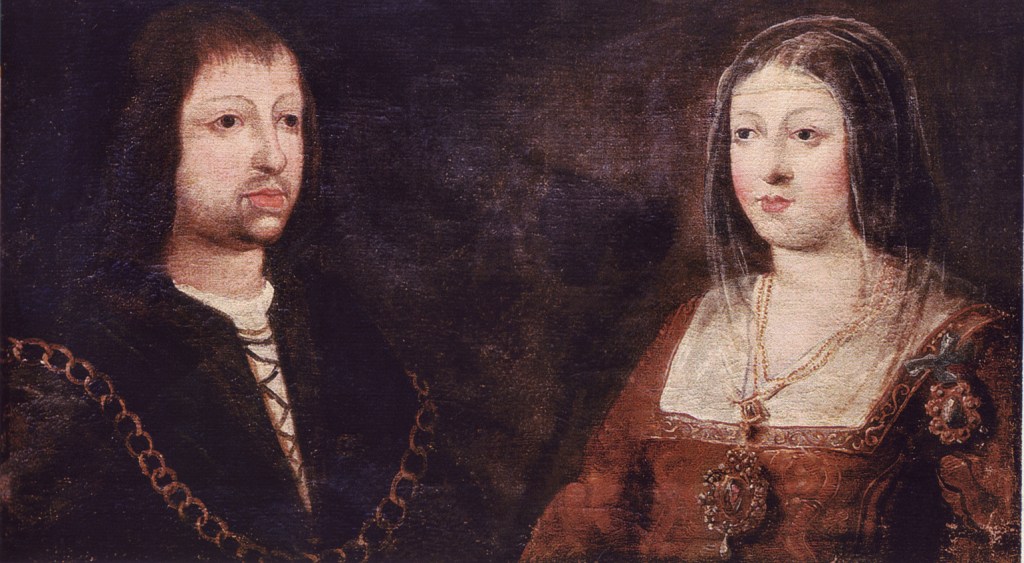
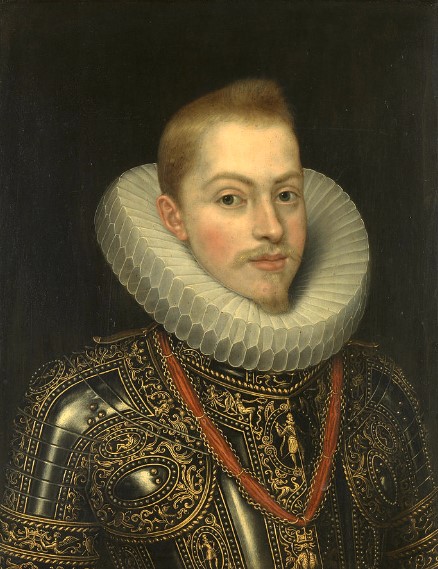
Genealogical accounting thus became an important part of the Spanish world after 1492 as it mirrored the proliferation of statutes of purity-of-blood as a measure for justifying exclusion and defining social boundaries. More extreme measures of separation adopted in Spain came in the form of expulsion. For Spain’s Jewish community, this form of separation was invoked in 1492 when Isabel of Castile and Ferdinand of Aragón issued a charter commanding, “the said Jew and Jewesses of our kingdom to depart and never to return or come back to them or to any of them.” Over one hundred years later, in 1609, Philip III followed the precedent set by Isabel and Ferdinand by issuing a decree declaring, “I have resolved that all of the Moriscos of that kingdom [Valencia] be expelled and sent to the land of the Berbers.”
The emphasis placed on blood as a measure of exclusion was not just limited to distinguishing old Christians from new Christians in the Spanish world, or those who had pure blood as opposed to those whose blood was tainted. This emphasis on blood also played an important part in defining hidalguía itself, the basis of all nobility in Spain. Early codification of this concept can be found in the Siete Partidas which records that “hidalguia is nobility that comes to men through lineage.” This emphasis placed on lineage as a means of identifying hidalguía is also found in works such as a sixteenth century manuscript on nobility, which like the Siete Partidas, declared that hidalguía “comes from lineage.” In a society where so much stress was placed on hidalgía de sangre and limpieza de sangre as measures of exclusion, these values would make their way to the Americas and evolve into the casta system, a “racialized” system where privilege, power, and status was defined by your heritage.
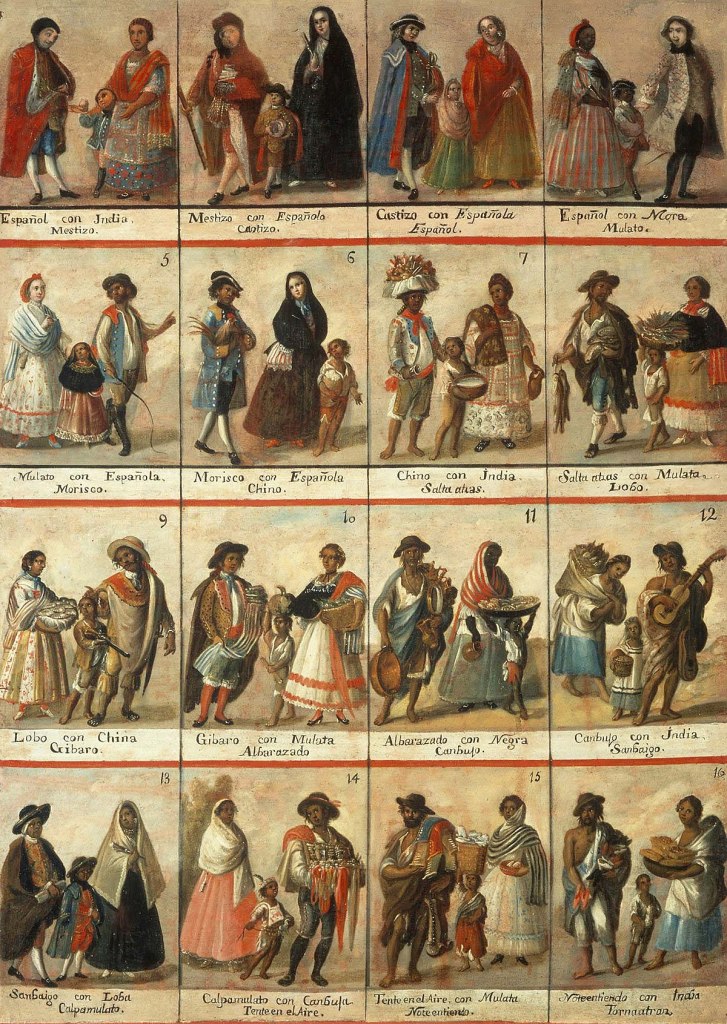
In addition to this social criterion, medieval institutions would also make their way to colonial Latin America and shape the relationship between Spanish and indigenous cultures. For example, encomiendas (grants) which frequently included a unit of territory which supplied its incumbent with rents paid by the inhabitants of a designated region in exchange for the services of providing “a militia and exercising arms against” against Islam. These grants would appear in colonial Latin America with a different focus. What was granted to the encomandero (grant’s holder) was not land but indigenous labor in exchange for indoctrination to Spanish ways. Encomienda became a labor exploitation system used throughout Spanish America.
THE SPIRITUAL CONQUEST AND THE MENDICANT ORDERS
One of the most important developments in the history of Western Christianity was monasticism. Benedict of Nursia (480-543 C.E.), born in Monte Cassino, established a monastic order with a rule to bring men back to a religious life and to have them withdraw from the sins and distraction of the material world. Called the Benedictines, this monastic order served as a model for future orders in the West.
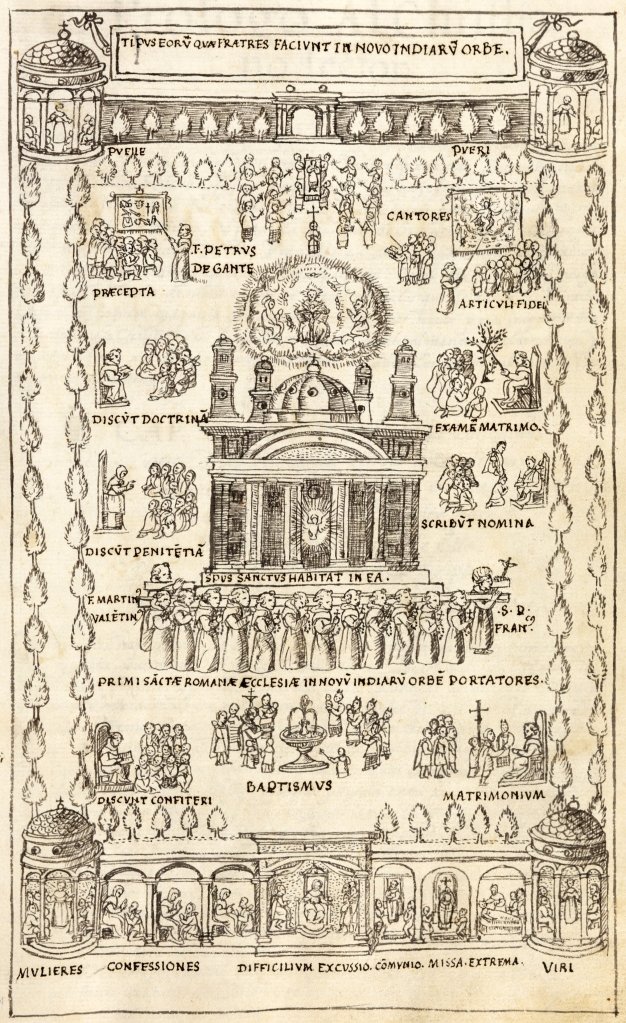
By the 13th century, a new form of monastic order came into being that sought not a cloistered life, but one that can be described as living in the imitation of Christ. Called mendicant orders, the Franciscans would be the first to come into being followed by the Dominicans, Augustinians, and the Jesuits. It was the Franciscans, in particular, that would first lead the spiritual conquest of the Americas, then followed by the Dominicans, Augustinians, and the Jesuits.
IN CLOSING
By the 13th century, Europe had experienced an economic revival that would eventually facilitate its expansion into the Atlantic world. In part, this could be attributed to the Crusades. The revival of commerce and industry in Europe facilitated the monarchical assertion of authority through the power of taxation. Politically, this meant that feudal states were now slowly evolving into sovereign centralized states that would even challenge the authority of the Papacy. In England, new monarchy came with the ascension of the Tudor Dynasty (1485-1603). France, the Valois Dynasty (1328-1589) further solidified its monarchical authority. In Spain, the Trastamara Dynasty (1369-1516) would give way to the Habsburg Dynasty (1516-1700). In Portugal, the Avis Dynasty (1385-1578) provided stability. Theoretical claims to power by monarchs now became a reality with taxation since it provided the revenue necessary to organize an army and create a bureaucracy. These very same rulers became very interested in facilitating exploration and the quest for resources as a means of fueling their states. Thus begins the age of European expansion into the Atlantic which would culminate with the creation of maritime empires with colonies in the Americas.
As always, be sure to contact me or visit me during office hours should you have any questions about the content we have covered or the assignments that you need to complete.
 World History Portal


