IDENTITY AND THE SOCIAL CONSTRUCTION OF DIFFERENCE
| Key Points: *Recognizing the social construction of difference helps us challenge norms, expose inequality, and work toward equity. It urges us to move beyond superficial diversity and examine the systems that shape social reality. *Differences (race, gender, class, etc.) are not natural or biological, but socially constructed through cultural, political, and institutional processes. *These constructed differences serve to maintain power structures, creating hierarchies between “us” (dominant groups) and “them” (marginalized groups). *These categories shape identity, opportunity, and belonging. Consider the Following: 1. What does it mean to say that identity and difference are “socially constructed”? How does this perspective challenge common assumptions about race, gender, or class? 2. How do the mechanisms of social categorization, cultural narratives, and institutional structures work together to create and sustain social hierarchies? Can you think of real-world examples where these are visible? 3. How can recognizing the social construction of difference help foster more inclusive institutions? What would “deconstructing difference” look like in education, media, or politics? 4. Can societies ever fully move beyond constructed categories like race, gender, or class, or should the goal be to transform how we understand and relate to these differences? |
Identity and the Social Construction of Difference
The concept of the social construction of difference challenges the idea that distinctions among people—such as those based on race, gender, or class—are natural or biologically determined. Instead, it argues that these differences are created, maintained, and given meaning through social processes. Societies construct categories of “us” and “them,” often placing certain groups in positions of privilege and others in positions of marginalization. For instance, while skin color is a biological trait, the meaning assigned to skin color—such as assumptions about intelligence, morality, or worth—is socially constructed and often tied to historical systems like colonialism and slavery.

This construction of difference serves particular social, political, and economic functions. By categorizing people and assigning them roles or statuses, institutions reinforce hierarchies that maintain power for dominant groups. Media representations, laws, religious teachings, and educational curricula all participate in normalizing these distinctions. For example, the portrayal of white, heterosexual, cisgender males as the “default” or “universal” human experience reinforces the marginalization of those who do not fit that mold. These constructed differences become internalized, affecting how individuals see themselves and how they relate to others.
Importantly, the construction of difference does not only oppress—it also creates spaces for resistance, solidarity, and identity-based empowerment. Marginalized groups have often reclaimed identities imposed on them, transforming sources of stigmatization into sources of pride and strength. For instance, movements like Black Pride, queer liberation, or Indigenous resurgence challenge dominant narratives and assert the value of diverse lived experiences. Identity politics, though often misunderstood or maligned, has been a crucial strategy for demanding recognition, rights, and justice in societies that have long erased or devalued certain identities.
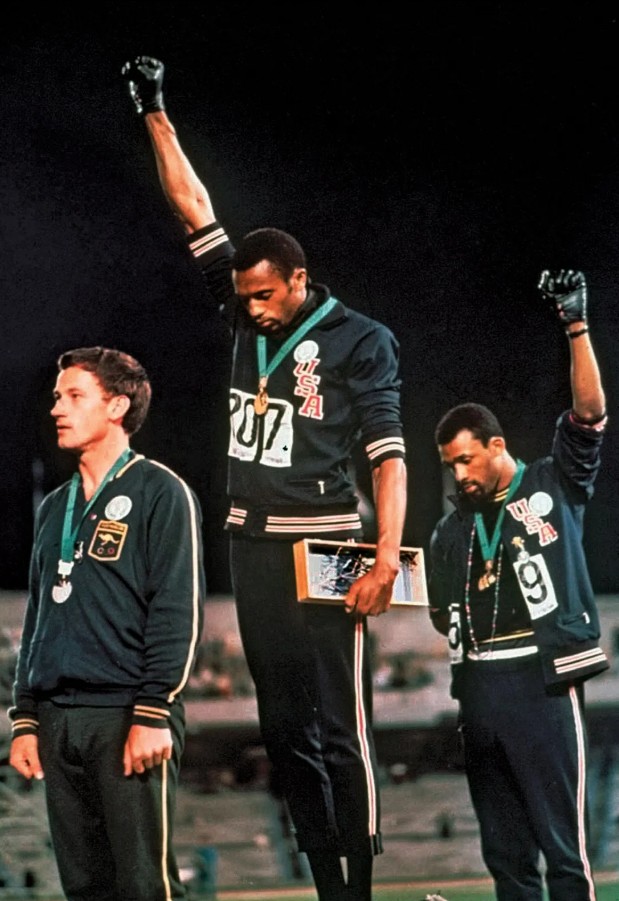
American track medalists Tommie Smith (center) and John Carlos raising black-gloved fists in protest at the 1968 Olympic Games in Mexico City.
Furthermore, intersectionality reminds us that identity and difference are never experienced in isolation. One’s experience of gender, for example, is profoundly shaped by their race, class, sexuality, and more. Thus, the social construction of difference must be understood as a layered process that operates simultaneously across multiple dimensions. A working-class immigrant woman experiences the world differently than an upper-class white woman or a working-class white man, due to how systems of power intersect.
Identity and the social construction of difference are foundational to understanding how society organizes power, belonging, and exclusion. Recognizing these processes allows us to question assumptions about what is “normal” or “natural” and to work toward more equitable ways of seeing and relating to one another. It challenges us to move beyond superficial understandings of diversity and to examine the deep-rooted systems that shape our lives and institutions. Ultimately, it opens up possibilities for transforming how we live together in a world marked by difference.
Key Mechanisms
The construction of social difference operates through several key mechanisms—social categorization, cultural norms and narratives, and institutional structures—which work together to define, reinforce, and legitimize perceived distinctions between groups. Social categorization is the process by which individuals are grouped based on perceived characteristics such as race, gender, class, or religion. This process simplifies complex human identities but often leads to stereotyping, labeling, and the creation of “in-groups” and “out-groups,” fostering exclusion and inequality. These categories are not natural—they are shaped by history, power dynamics, and collective assumptions. Cultural norms and narratives further entrench these categories by embedding them in the stories, symbols, and representations circulated in media, literature, religion, and national discourse. These narratives shape how society understands difference, often by elevating one group as the “norm” while marginalizing others as deviant or inferior. For instance, media portrayals can reinforce racial stereotypes or gender roles, subtly shaping public perception and personal identity. Finally, institutional structures—such as education systems, legal frameworks, healthcare, and the labor market—formalize these categories by embedding them into policies and practices. These structures can perpetuate discrimination through systemic bias, unequal access to resources, or exclusionary rules that favor dominant groups. Together, these mechanisms construct and sustain social difference not as a natural fact, but as a socially produced and maintained hierarchy that influences identity, opportunity, and belonging.
Peter Berger and Thomas Luckmann’s The Social Construction of Reality (1966) is a foundational sociological text that argues reality is not objective or fixed but socially constructed through human interaction, shared meanings, and institutional frameworks. They propose that what we understand as “knowledge” or “truth” is created by society, varying across cultures and historical contexts. Language plays a central role in this process by naming, classifying, and maintaining shared meanings across generations, essentially constructing the symbolic universe in which we live. Berger and Luckmann’s work has had profound influence on sociology, particularly in fields such as social constructionism, symbolic interactionism, and the sociology of knowledge. Importantly, it shows that identity is not innate or static but shaped through institutional structures and cultural narratives, reinforcing that much of what we take for granted as “normal” or “real” is actually a product of social construction.
The Social Construction of Difference and Race
Race is not a biological fact but a powerful social construct—an idea created and sustained by societies to categorize, differentiate, and often rank human beings based on perceived physical traits, particularly skin color. While humans share over 99% of the same genetic material, societies have long assigned meaning to superficial physical differences to create social hierarchies and justify unequal treatment. The social construction of difference refers to this very process: the ways in which societies manufacture and maintain distinctions among people in ways that serve political, economic, and cultural interests.
The origins of racism lie not in biology or inherent human differences but in historical processes that assigned meaning to physical characteristics in order to justify systems of domination, control, and exploitation. While human societies have always been aware of physical and cultural differences, the concept of race as a rigid, hierarchical system is relatively modern, emerging prominently during European colonial expansion in the 15th and 16th centuries. As European powers colonized vast parts of Africa, Asia, and the Americas, they developed racial ideologies to rationalize the subjugation, enslavement, and dispossession of non-European peoples. These ideologies portrayed white Europeans as superior in intellect, culture, and morality, while depicting Indigenous peoples and Africans as primitive, uncivilized, or even subhuman. This racial thinking became deeply embedded in colonial policy, religious doctrine, and later, scientific discourse. The 18th and 19th centuries saw the rise of scientific racism, where pseudoscientific theories claimed that races were biologically distinct and unequal—often ranking white Europeans at the top of a natural order. These ideas were used to justify slavery, segregation, apartheid, and eugenics programs, solidifying race as a social and legal category that governed access to rights, resources, and citizenship. Importantly, racism is not just about individual prejudice—it is a system of power that operates through institutions, laws, and cultural narratives.
While explicit racial hierarchies have been challenged and dismantled in many places, the legacy of these origins continues to shape contemporary inequalities. Understanding the historical construction of race and racism is essential to dismantling the myths of racial superiority and addressing the structural roots of racial injustice in modern societies. Over time, institutions such as education, the media, law, and religion have continued to reproduce these racial distinctions, often implicitly, reinforcing dominant power structures. Racial categories are not fixed—they shift over time and across contexts, revealing their socially constructed nature. For example, in the United States, who is considered “white” has changed over time, once excluding groups like the Irish or Italians. The consequences of these constructions are very real: they shape access to resources, safety, opportunity, and representation. Importantly, recognizing race as a social construct does not mean denying the lived realities of racism. On the contrary, it highlights how arbitrary classifications can have deep and lasting impacts on individuals and communities. By examining how difference is constructed, especially in relation to race, we are better equipped to challenge systems of inequality and imagine more just, inclusive futures.
A central concept within this system is “Whiteness” as an unmarked category of power. Unlike other racial identities that are explicitly named and scrutinized, whiteness often functions as the invisible norm—the standard against which all others are measured. It carries social, political, and economic privileges that often go unacknowledged by those who possess them. This unmarked status allows whiteness to present itself as neutral or universal, masking its role in sustaining racial hierarchies. For instance, in many Western countries, whiteness is associated with citizenship, intelligence, beauty, and moral authority, while non-white identities are often subjected to suspicion, exoticization, or exclusion. By remaining unnamed, whiteness maintains its dominance while appearing racially neutral. Together, the historical invention of race and the privileged invisibility of whiteness reveal how racial difference is not natural but constructed and maintained to serve systems of power and inequality.
The Social Construction of Difference and Ethnicity
Ethnicity, like race, is not a fixed or purely biological trait—it is a socially constructed concept that reflects shared cultural practices, languages, histories, and traditions. While often viewed as more fluid and self-ascribed than race, ethnicity is also shaped and influenced by broader social, political, and historical forces. The social construction of difference operates by emphasizing distinctions between groups in ways that reinforce boundaries, power relations, and social hierarchies. Ethnic identities are often romanticized as natural or ancient, yet they are frequently redefined in response to migration, colonization, state policies, and global movements. For example, ethnic categories can be politicized or manipulated to justify exclusion, assimilation, or violence, as seen in nationalist movements or ethnic cleansing.
Governments may categorize populations along ethnic lines for census, education, or political representation, thereby institutionalizing certain identities while erasing or suppressing others. Even multicultural societies, which appear to celebrate ethnic diversity, can still reproduce systems of dominance by privileging certain ethnic norms—often those aligned with the dominant or settler culture—over others. The process of “othering” plays a central role, where ethnic differences are exaggerated or stigmatized to maintain boundaries between “us” and “them.” At the same time, marginalized groups often resist these imposed narratives by reclaiming, preserving, and redefining their ethnic identities as sources of pride, resistance, and community. Thus, ethnicity is not just about where someone is “from”—it is about how cultural identities are constructed, contested, and lived within a broader web of power and historical memory. Understanding the social construction of ethnic difference is essential to unpacking how inequality is maintained, and how belonging and exclusion are negotiated in both national and global contexts.
The Social Construction of Difference and Gender
Gender is one of the most prominent examples of how societies construct difference, assigning meaning and value to biological distinctions in ways that shape identity, behavior, and access to power. While sex refers to physical and biological characteristics such as chromosomes and reproductive organs, gender is a social construct—a system of classification rooted in cultural norms, expectations, and historical contexts. From early childhood, individuals are socialized into gender roles that dictate how they should speak, dress, express emotions, and interact with others based on whether they are perceived as male or female. These roles are not universal; they vary widely across cultures and time periods, underscoring the constructed nature of gendered differences. The social construction of gender difference reinforces hierarchies by naturalizing unequal power relations—masculinity is often associated with authority, rationality, and strength, while femininity is linked to emotion, dependency, and care. These associations justify structural inequalities in labor markets, politics, education, and even intimate relationships. Additionally, those who do not conform to the gender binary—such as transgender, non-binary, and genderqueer individuals—are often marginalized, revealing how rigid and exclusionary gender norms can be. Feminist and queer theories have challenged the essentialist view of gender, showing that gender is not something we are but something we do—performed and reinforced through daily practices and institutional norms. Recognizing gender as a socially constructed difference allows us to critically examine how these norms are maintained, who benefits from them, and how they can be transformed to create more inclusive and equitable societies.
Both gender and sexuality are enforced and policed by societal institutions, but they are also dynamic and open to redefinition. The increasing visibility and advocacy of queer and trans communities have exposed the limitations of rigid binaries and opened up new ways of understanding identity. These case studies show that difference is not inherently deviant or biological—it is socially constructed through norms, language, and power, often to maintain control over who is considered “normal” and who is “other.”
The Social Construction of Difference and Class
Social difference based on class is another powerful example of how identity and inequality are socially constructed rather than purely economic or merit-based. While class is often associated with income or wealth, it extends far beyond financial resources to include behavior, taste, education, and cultural knowledge—factors that are deeply embedded in social systems and expectations. One of the most influential theorists on this subject is Pierre Bourdieu, who introduced the concept of cultural capital to explain how class distinctions are maintained and reproduced across generations.
Bourdieu argued that individuals from different social classes possess varying degrees of cultural capital—non-economic assets like language style, manners, educational credentials, aesthetic tastes, and familiarity with dominant cultural norms. These forms of capital are often invisible but serve as powerful tools in maintaining class boundaries. For example, knowing how to speak in a “refined” or academic manner, appreciating fine art or classical music, or understanding how to navigate elite institutions like prestigious universities are all forms of cultural capital that signal belonging to the upper or middle classes. Conversely, working-class behaviors, dialects, or tastes may be seen as “less cultured” or even “incorrect,” leading to marginalization or limited upward mobility.
Class performance also plays a key role in this construction. People are often expected to “perform” their class status through clothing, body language, consumption habits, and even career choices. A person wearing designer clothing, ordering expensive wines, or discussing world travel may be read as upper class—even if their actual income is modest—because they exhibit the right cultural cues. This performance is judged constantly, especially in professional and social settings, shaping who gets access to power and respect.
Moreover, institutions such as schools, job markets, and media reinforce these class divisions by valuing certain forms of cultural capital over others. For instance, education systems often reward students who already have access to enriched vocabularies, books, and cultural exposure—advantages typically found in middle- and upper-class households. This contributes to a cycle where privilege is misrecognized as merit, and structural inequality is seen as personal failure.
In sum, economic difference is not the only marker of class; it is the cultural, behavioral, and symbolic aspects of class that deeply influence social inclusion or exclusion. Class is not simply a matter of money, but a socially constructed hierarchy, shaped by the ability to accumulate and display the “right” forms of knowledge, taste, and behavior—often to the benefit of those already in privileged positions.
 World History Portal