Course Introduction
WELCOME TO SOCIAL SCIENCES 101 HYBRID
Hello, my name is Jason Suárez, and I am thrilled to be your instructor this semester in Social Sciences 101: Introduction to the Social Sciences. This course provides an introduction to the diverse fields that make up the social sciences and examines their interconnectedness. Students will explore foundational theories and research methods used in social science disciplines, gaining insight into how these fields help us understand the complexities of human societies, cultures, and the challenges faced by contemporary communities. Additionally, this course introduces key concepts and techniques used in social science research, as well as career opportunities available to students pursuing a degree in this field. Students will have the opportunity to explore various majors and career pathways within the social sciences.
This is an 8-week hybrid course. Hybrid courses are conducted partially online and also have required on campus class meetings. This course has one regular class meeting per week every Tuesday from 9:35-11:00 am in BSSB 104. There are no textbooks or materials that need to be purchased for this course. All of your required readings will be included in the Canvas course modules.
Your success is extremely important to me. I’ve worked hard to design a course that is hopefully interesting, well-structured, and insightful, and I hope you’ll find it both enjoyable and rewarding. To make things easier, you don’t need to purchase any texts for this course—everything you need is available through Canvas, El Camino College’s course management system.
I’m passionate about helping students engage with the social sciences and develop the tools to think critically about themselves and society. Please don’t hesitate to reach out if you have questions or need support during out 8-week journey through the social sciences. I am here to help.
WHAT TO EXPECT FROM ME
- I will create a course that facilitates your learning through content that is informative, meaningful, and relevant and provide a learning environment that promotes dialog and the exchange of ideas amongst you and your colleagues.
- I will administer a variety of assessments that will indicate if course objectives and student learning outcomes are being met.
- I will be regularly available to you and actively collaborate with you during this course to ensure your success.
WHAT I EXPECT FROM YOU
- You will be an active learner in this course by completing the course material assigned in a timely fashion and you will regularly engage your colleagues about the course’s content.
- You will actively seek out my support if you have any questions about course content and assignments or encounter any challenges in this course.
- You will contact me if any assignment or assessment due date established cannot be met.
BEFORE WE BEGIN SOMETHING ABOUT ME
- I was born in Wichita Falls, Texas. I have lived in many places and countries since my father was in the U.S. Air Force.
- I attended Santa Barbara City College and transferred to the University of California, Santa Barbara (UCSB) where I majored in history. I also completed my graduate work at UCSB.
- My first teaching appointment was at Seattle Central College (1998-2001). I was hired by El Camino College in 2001. I am currently tenured at El Camino College and also serve as the Faculty Coordinator of Student Equity.
- I have been married since 1995 and my wife is a tenured Counselor/Articulation officer at Santa Barbara City College.
- I live in Carpinteria, California. Yes, I have been commuting back and forth to LA since 2001. One hundred miles to work and one hundred miles home. Covid-19 temporarily put a stop to my commute.
- Five months out of the year I live in Spain where my wife and I have a second residence.
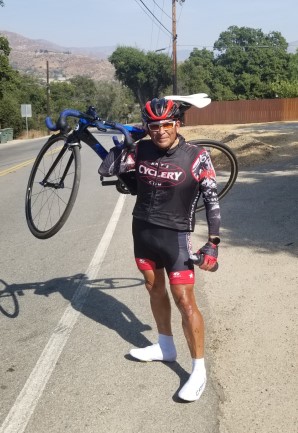
- And yes, as you can tell from the picture, my passion outside of the classroom is cycling. Broken wheel! I had to walk partially up Denison Grade in Santa Paula until I was picked-up.
HARDWARE/SOFTWARE REQUIREMENTS AND TECHNICAL ASSISTANCE
Let’s review some of this course’s hardware and software requirements. Students must have at a minimum the following:
- A computer (PC with Windows and a Pentium processor or a Macintosh with at least system 9.0 recommended).
- A recent version of a web browser such as Microsoft Explorer, Opera, Firefox, or Chrome.
- An Internet Service Provider.
- An ECC email address provided by the college.
- PDF reader software.
- Access to a word processor that can convert text files to a PDF format.

As for the technical aspects of Canvas, I’ll be upfront: I’m not a computer or Canvas technician, so I may not be able to assist you with technical issues. However, I want to make sure you’re fully supported if you encounter any challenges. For help with Canvas, please contact the Online Education Office at El Camino College by calling (310) 660-3593 ext. 6453.
To ensure you’re prepared for online learning, I encourage you to familiarize yourself with the following resources:
- El Camino College Online Education
- El Camino C0llege Canvas Resources
- El Camino College Online Support for Success
- El Camino College Distance Education Handbook
COMMUNICATION
There are three ways you can contact me this semester should you have any questions about the course.
- First, you contact me via email (jsuarez@elcamino.edu) or Canvas. Your communication is extremely important to me so I will do my best to reply within 24 hours. To ensure that I see your message among my emails, please use the class name and number SOCSCI 101 in your subject line. Be sure to use your ECC email account when contacting me. I cannot address official course details with you if you use a personal email account.
- Second, you can visit me during my office hours which are posted on the course home page in Canvas.
- Third, you can schedule an appointment via email for a virtual office meeting.
For those enrolled in this course outside of the state of California please be aware of time zone differences.
PROCRASTINATION
I want to take a moment to address an important topic early in the course: staying on top of deadlines in this condensed format. Social Science 101 is a fast-paced version of a 16-week course, and as such, I must be firm about not accepting late work. With so much material to cover and so many students enrolled, it’s critical that all assignments are submitted on time. Planning ahead will be your best ally in this course.
Why do we procrastinate? What doe studies suggest? How can we address our procrastination? Procrastination is one of the biggest obstacles in college courses, and it’s something I struggled with during my own time as a college student. I know how easy it is to put things off, but I also know how much better it feels to stay ahead of deadlines. Here is the bottom line on procrastination. It often masks deeper issues like fear of failure, perfectionism, lack of clarity, or low energy. The first step to overcoming it is understanding why you’re procrastinating in the first place. Ask yourself reflective questions such as, “What am I avoiding?” or “What’s making this task uncomfortable?” Once you’ve identified the root cause, break down big, vague goals into manageable pieces. For example, instead of telling yourself to “write the report,” break it into smaller, actionable steps like outlining sections, finding three key sources, and writing the introductory paragraph.
Another effective method is using the “5-minute rule.” Tell yourself, “I’ll just do this for five minutes.” This psychological trick often lowers resistance and gets you started, which usually leads to doing more than you initially intended. Combine this with time management techniques like the Pomodoro Technique—25 minutes of focused work followed by a 5-minute break, with a longer break after four cycles. Tools like Pomofocus or even a simple timer can help you stay on track.
Eliminating distractions is also essential. Create an environment that supports focus by turning off phone notifications and keeping your workspace clean and ready to go. In addition, try setting “if-then” plans to incorporate rewards after task completion. For instance, “If I finish this slide, then I’ll get a coffee.” Rewards work best when they follow the effort, not precede it.
It’s also important to recognize that perfectionism is often just procrastination in disguise. Instead of aiming for perfection, aim for progress—done is better than perfect. Accountability can also make a huge difference. Share your goals with someone or use co-working apps like Focusmate, or even join an accountability or study group.
Finally, don’t forget to reflect on your wins. Keep track of what you’ve completed—no matter how small. This practice builds motivation and helps you break the “I’m never getting anything done” mindset, reinforcing positive momentum.
SEMINARS
Class seminars are designed to allow you to engage in historical problem-solving and critical analysis with your colleagues. They are a key part of your learning experience in this course, as they encourage you to apply your knowledge, consider different perspectives, and develop your skills in critical thinking and communication. A quality seminar discussion requires thoughtful analysis and detailed academic expression—hallmarks of any college-level course. Well-prepared seminars create a more engaging and rewarding experience for everyone involved, including you.
Remember, your contributions to the seminar are an essential part of your growth as a college student.
SCHOLARLY ARTICLES
When I transferred to the University of California at Santa Barbara, one of the first things I noticed in my upper-division history courses was the requirement to read articles from scholarly journals. As a transfer student, I was new to the academic culture of research institutions like UCSB and found myself unsure of how to approach these types of readings. I didn’t have a clear methodology, which made the process overwhelming at first.
Scholarly journals, also called peer-reviewed journals, are an essential part of academic research. They house the latest findings and debates across disciplines such as history, mathematics, music, sociology, and psychology. Understanding how to engage with these articles is crucial because they represent the foundation of academic knowledge in each field.
When reading a scholarly article, I don’t expect you to master every technical term or detail. Instead, focus on the following key aspects:
- What is the author’s main question or problem?
- What sources does the author use to address the question or problem?
- What conclusions does the author reach?
- How is the article relevant to the topic we are studying?
Not everything in the article will be relevant, and that’s okay! The goal is to extract the most important information and connect it to the themes and topics of this course.
To help you organize your thoughts, I will provide you with article analysis forms. These forms are a tool to help you summarize the key points of each article and reflect on how the content fits into your assignments. While I won’t collect these forms, I strongly encourage you to use them, as they will make it much easier to integrate the article’s ideas into the essays you’ll be writing. Personally, I relied on tools like this throughout my undergraduate and graduate studies to manage the information I was responsible for, and I found them invaluable.
Remember, learning to engage with scholarly articles is a skill that will serve you well beyond this course. It may seem challenging at first, but with practice, it will become second nature. I’m here to support you, so don’t hesitate to ask if you have any questions or need guidance. You’ve got this!
Three steps for approaching scholarly articles.
- Check to see if the article has an abstract. If it has an abstract, I want you to read that first. If not, go directly to the introduction.
- I want you to read the article’s introduction and the article’s conclusion. After completing this you should know what this article is about.
- I want you to read the article’s introduction and the article’s conclusion. After completing this you should know what this article is about and be ready to fill out the article analysis form.
A THEME BASED COURSE
Social Sciences 101 is a theme-based course, and this semester, we will examine identity and self through the lens of social science disciplines. Our discussions and studies will center around the following key topics:
- Self, identity, theories and the social world
- Gender, race, and ethnicity
- Class and economic identity
- Identity and power
- The self in a global perspective
- Identity and social change
- Identity and mental health
- The social sciences and career pathways
- Social science research methods
By the end of the course, you will have a deeper understanding of the social sciences’ role in analyzing societal structures and addressing pressing global issues. Let us begin our journey.
DEFINING IDENTITY AND SELF
Identity refers to the characteristics, traits, beliefs, and affiliations that define who a person is, both in their own perception and in the eyes of society. It is shaped by multiple factors, including culture, upbringing, social interactions, and personal choices. Identity is often categorized into different aspects, such as:
- Personal Identity: The unique attributes and experiences that differentiate one individual from another.
- Social Identity: How one relates to groups, such as gender, ethnicity, nationality, or profession.
- Cultural Identity: The connection to cultural traditions, languages, and beliefs.
- Psychological Identity: The self-concept that develops over time based on personal experiences and introspection.

The self is a broader and deeper concept, referring to an individual’s internal sense of being. It includes self-awareness, self-concept, and consciousness. Philosophers and psychologists have explored various dimensions of the self, such as:
- The Physical Self: One’s body and physical existence.
- The Psychological Self: Thoughts, emotions, and personal experiences.
- The Social Self: How a person interacts with others and perceives themselves in a social context.
- The Experiential Self: Consciousness and personal awareness of the present moment.
- The Narrative Self: The way a person constructs their life story, giving meaning to their experiences.
| ASPECT | IDENTITY | SELF |
| Definition | External characteristics and labels that define a person | Internal sense of existence and awareness |
| Formation | Shaped by society, culture, and experiences | Rooted in consciousness and self-reflection |
| Focus | Social recognition and categorization | Personal awareness and self-perception |
In essence, identity is how you define yourself in relation to society, while the self is your inner consciousness and sense of existence. Though interconnected, they serve distinct roles—the self forms the core of identity, while identity is the external expression of the self in a social context. The self is internal and reflective, whereas identity is shaped by interactions, labels, and roles. They continuously influence each other: shifts in identity can reshape the self, just as deeper self-awareness can redefine identity.
IN CLOSING
As you have learned, Social Sciences 101 is a theme-based course exploring self and identity through various social science disciplines. It examines how factors like gender, race, class, power, and globalization shape identity while emphasizing key social science concepts such as socialization, structure and agency, inequality, and intersectionality. The course introduces research methods, distinguishing between qualitative and quantitative approaches, and explores different types of research, including pure, applied, policy, and action research. You will learn to critically analyze identity within societal structures, develop research and analytical skills, and explore career pathways in social sciences. Additionally, the course highlights the transferable skills gained through social science studies, such as critical thinking, research, communication, and cultural competence, which are valuable across various professions.
Be sure to stop by office hours or contact me should you have any questions about the course, its content, or your academic journey.
 World History Portal