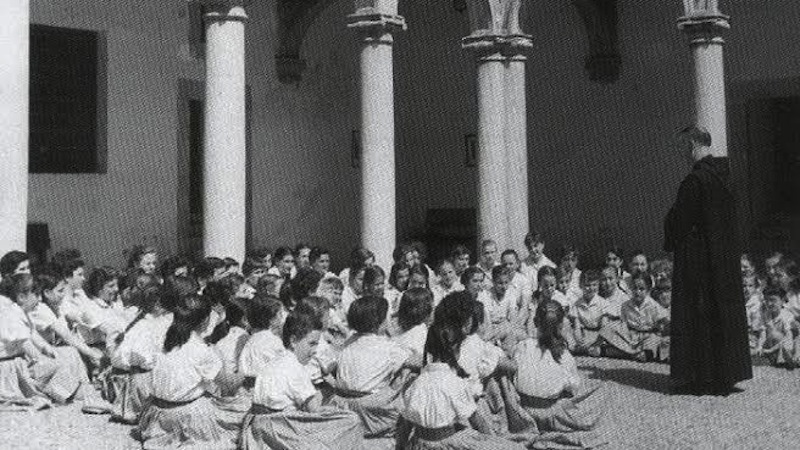
For liberals, the Church in post-independence Latin America was problematic at all levels. Its immense wealth and influence were seen as roadblocks to the creation of a modern, free-market economy. Liberal thinkers also viewed the Church’s control of education as an obstacle to progress, claiming it prevented the state from providing the rational, scientific, and utilitarian education they believed essential for societal advancement. However, defenders of the Church in Mexico presented counterarguments, portraying it as a stabilizing force in the nation’s social and cultural life. These perspectives reveal the complexity of the Church’s role during this period, as well as the ideological battle lines between liberal reformers and religious institutions.
Consider the following as you analyze these sources:
- What does Lucas Aleman’s argument that Catholicism serves as the “only common bond” uniting Mexicans suggest about the role of religion in national identity and stability?
- How does Francisco Bilbao distinguish between the teachings of Jesus and the practices of Catholicism, and what implications does this distinction have for understanding the role of religion in the subordination of women and citizens?
- In what ways does Bilbao argue that the union between the clergy and monarchy perpetuates systems of control and subjugation, and how does this connect to the broader critique of tradition versus free thought?
Complete the Primary Source Analysis Form when finished for your records.
Lucas Aleman (1853)
First and foremost is the need to preserve the Catholic religion, because we believe in it and because even if we did not hold it to be divine, we consider it to be the only common bond that links all Mexicans when all the others have been broken; it is the only thing capable of sustaining the Spanish-American race and of delivering it from the great dangers to which it is exposed. We also consider it necessary to maintain the ceremonial splendour of the Church, as well as its temporal properties, and to settle everything relating to ecclesiastical administration with the Pope.
Francisco Bilbao, Chilean Sociability (1844)
America came from Spain and carries her stamp; the Spanish past on American soil brings us to Chile. Let us quickly review the relations that the Catholic Church sanctions with regard to the state, the customs, and the philosophy of the time in which we live. There is no doubt that
Christianity was a major advance in the religious rehabilitation of men; but Catholicism . . . reacted with hostility to the primitive purity of the doctrine of Jesus. Under Catholicism, women are subordinated to their husbands. The result is the slavery of women. Paul, the primary founder of Catholicism, did not follow the moral religion of Jesus Christ. Jesus emancipated women. Paul subordinated them. Jesus was Western in his spirit, that is to say, liberal. Paul was oriental and authoritarian. Jesus founded a democratic religion, Paul an ecclesiastical aristocracy. From there originates the logical consequence of the slavery of women.
When individuals are subordinated to authority, the result is the slavery of citizens. “Obey the
authorities,” says Saint Paul. A diplomatic principle in origin, it began so as to avoid the persecution of pagan authorities and was converted later into an active instrument of subjugation. This also explains the union that has almost always existed between the clergy and the Catholic monarchies. Monarchy is a government of divine or heroic tradition, of privilege or authority; of course it needs the aid of religion. The clergy dominate individual citizens and obstruct free analysis and free thought, which are the enemies of tradition. The clergy, for its part, needs the aid of earthly power for the creation and maintenance of its private interests, for the persecution of heresy. How clearly the logic of the French Revolution appears now. The people, free individuals, free analysis, the present cut loose from the past. Bury the monarchy, the clergy, and the nobility; bury the Catholic synthesis of the past. When thought is chained to the text and intelligence molded by beliefs the result is slavery of the mind. Education, logically, was entrusted to the convents. This also explains the predominance of Aristotle in the Middle Ages. Aristotle was logic then. One could only deduce from given principles.

