THE WRITING SYSTEMS OF MESOAMERICA
| LEARNING OBJECTIVES 1. Define writing as a system of recording language using visible or tactile marks and explain its role in communication, memory, and social organization. 2. Differentiate between glottographic and semasiographic writing systems within various Mesoamerican civilizations. 3. Identify and compare the major Mesoamerican writing systems (Zapotec, Epi-Olmec/Isthmian, Mixtec, Maya, and Nahua). |
WHAT IS WRITING?
For many scholars, the visual representation of language is one of humanity’s greatest cultural and technological achievements and one of the very cornerstones of modern life. It’s difficult to imagine our world functioning without this essential technology. Writing’s connection to civilization is perhaps best captured by Florian Coulmas in The Writing Systems of the World (1989), where he states: ‘Writing has to be seen as a result as well as a condition of civilization, as a product shaped by civilization and a tool shaping it.

Writing has been defined as “a system of recording language by means of visible or tactile marks which relate in a systematic way to units of speech.” These marks can appear on a wide range of mediums or prepared surfaces which include clay, paper, and stone. The purpose of these marks is to communicate something.
Specialists regard writing as a relatively recent technology with diverse applications. It serves a mnemonic function, extending human memory by recording information. It fulfills an aesthetic role through literature and poetry. It regulates social conduct by documenting laws. And it expands communication across vast distances, allowing information to travel far beyond its point of origin.

The earliest writing systems were highly complex, requiring mastery of a vast number of graphic symbols. As a result, early scribes underwent years of rigorous training to become proficient. Because learning to write was both time-consuming and costly, literacy was largely restricted to a select elite social class. In many early civilizations, scribes were members of the priestly elite.
Unlike today, mass literacy was not encouraged in early societies. Many scholars argue that widespread literacy is essential for modern civilization, but in ancient times, maintaining social order took precedence. The majority of the population was expected to focus on manual labor, particularly in agriculture, rather than education.
Why study writing systems and their history? Studying the history of writing systems helps us understand how humans developed complex thinking, communication, and organization. These systems were essential for recording laws, trade, religion, and culture. They reveal how societies evolved, interacted, and influenced each other.
WRITING SYSTEMS OF MESOAMERICA
Several Mesoamerican cultures developed writing traditions, and scholars have deciphered or partially deciphered five of these surviving writing systems: Zapotec, Epi-Olmec (Isthmian), Mixtec, Maya, and Nahua. These writing systems employed either glottographic and semasiographic writing forms. The Zapotec, Epi-Olmec, and Maya writing systems were glottographic, meaning their visual symbols represented sounds or whole words. In contrast, the Mixtec and Nahua systems were semasiographic, relying on non-phonetic symbols to convey ideas or concepts. Among these, the Maya script was the most complex. It combined logograms (representing entire words), phonetic symbols, and semantic qualifiers to create a rich and sophisticated writing system capable of fully expressing spoken language.
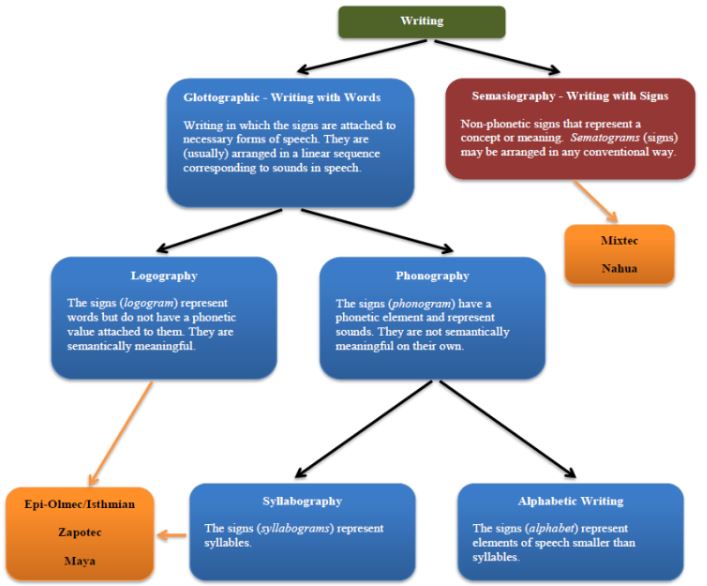
When studying non-alphabetic writing systems, it is essential to focus on the function of writing itself. This perspective broadens our understanding and encourages a more inclusive definition of what writing is. It is also important to view writing as a cultural product, shaped by the societies that created it. The writing systems of Mesoamerica highlight the remarkable diversity that existed in this region long before the arrival of Europeans.
| Partially Deciphered | Deciphered |
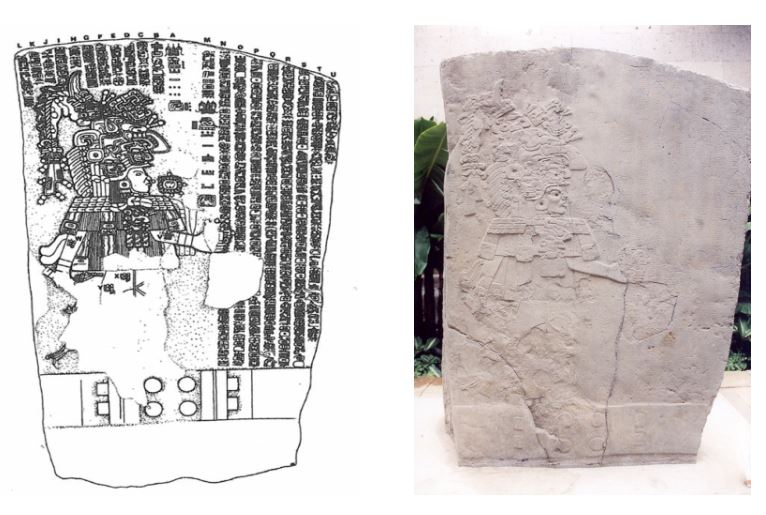
Epi-Olmec / Isthmian Script (c. 300 B.C.E.-500 C.E.): Glottographic From Isthmus of Tehuantepec. La Mojarra Stela 1 Tuxtla Statuette Zapotec Script (c. 500 B.C.E-700 C.E.): From Monte Albán, Oaxaca. Glottographic Monument 3 at San José Mogote Mixtec Codices (c. 11th -16th centuries): From Oaxaca. Semasiographic Codex Zouche-Nuttall Codex Selden | Maya Scrip (c. 250B.C.E.-1500 C.E.): Southern Mexico, Guatemala, Belize, Honduras. Glottographic Codex Dresden Nahuatl Pictorial Writing (c. 1300-1500 C.E.): Central Mexico. Semasiographic Codex Mendoza |
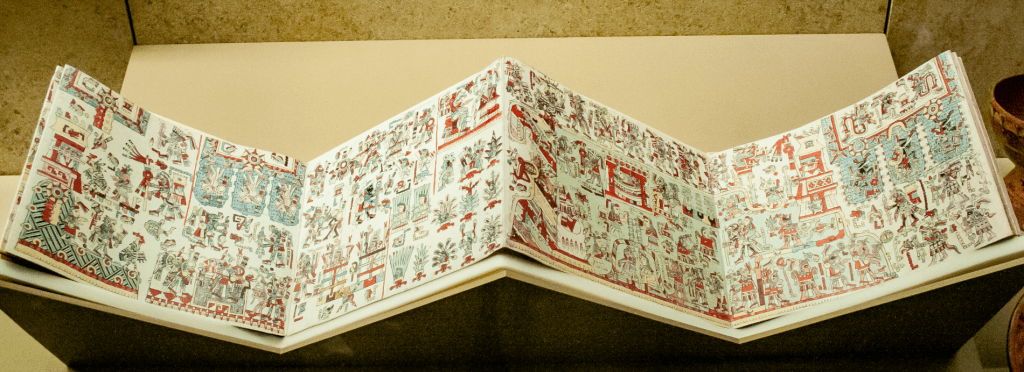
Mesoamerican writing was found on a variety of materials that reflected both everyday and ceremonial use. These codices (painted manuscripts), monuments, stone sculptures, deerskin, and ceramic vessels. The Nahua, for example, created codices using amatl, a form of paper made from the inner bark of the Ficus cotonifolia (fig tree). Because this bark paper was thick, Mesoamerican codices often took the form of screen-fold books, as seen in the Codex Zouche-Nuttall below.
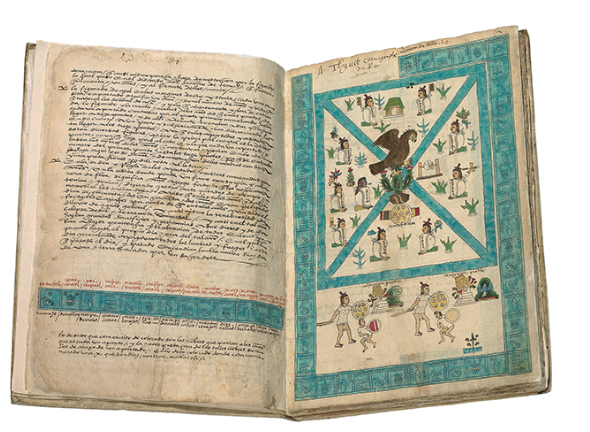
After the conquest, European paper-making techniques were introduced, resulting in codices that resembled traditional books, such as the Codex Mendoza.
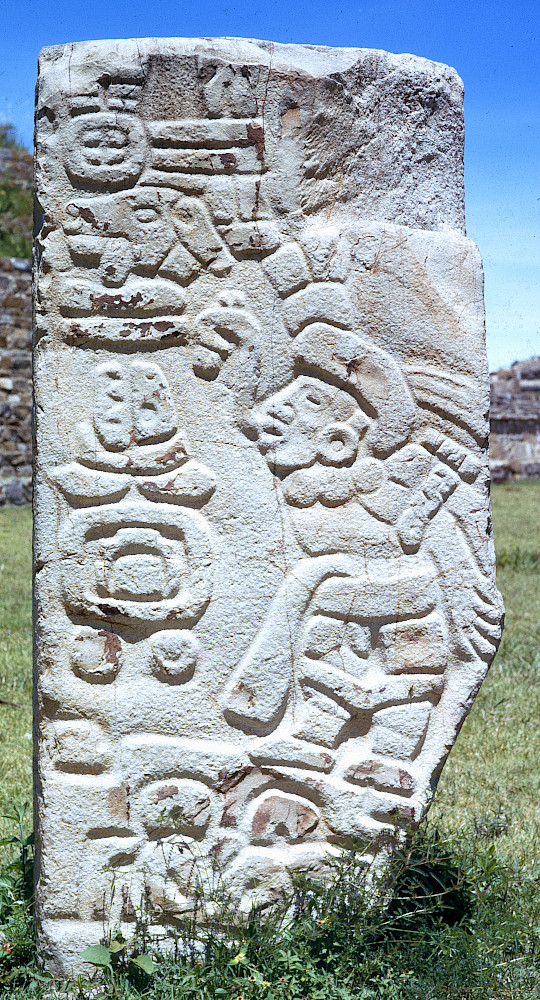
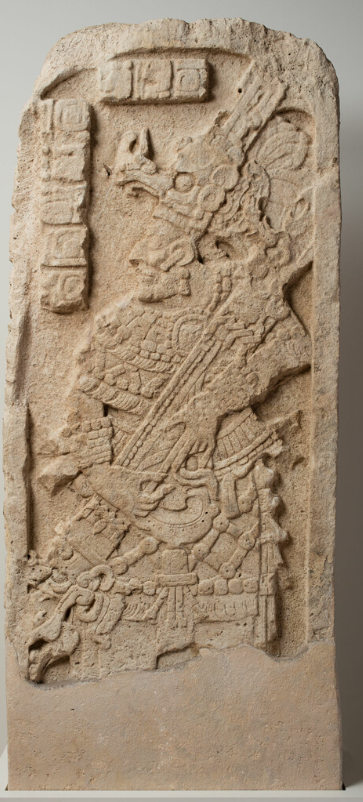
However, there are exceptions to this general pattern. For some Mesoamerican cultures, our knowledge of their writing systems comes primarily from inscriptions rather than codices. This is the case for the Zapotec, whose writing survives mostly on monuments and stone carvings.
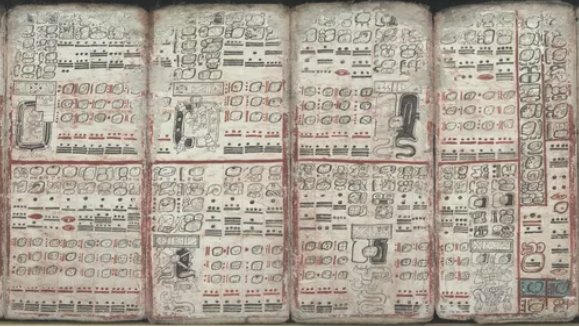
The Maya, in contrast, left behind both codices and inscriptions, providing a broader record of their writing tradition.
ZAPOTEC
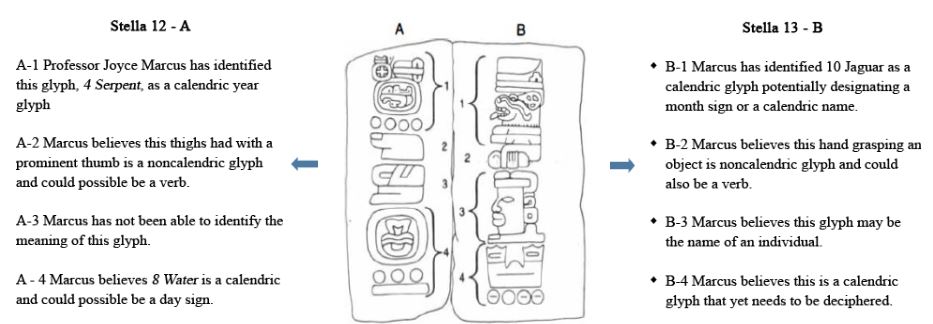
The Zapotec writing system is glottographic in composition. Originating in the Valley of Oaxaca, this writing system has been dated to c. 500 B.C.E. and is considered the earliest evidence of “writing” in Mesoamerica. Zapotec writing has come down to us solely through inscriptions such as you see in the image below (Stela 12 and 13).
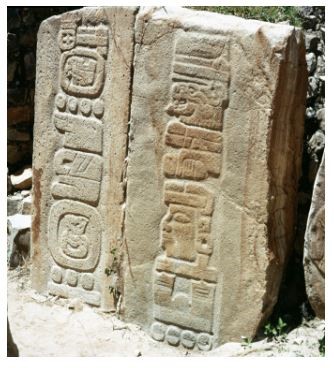
Monte Albán, one of the main Zapotec urban centers has the largest corpus of inscribed monuments and has been the focus of the decipherment process for this writing system. Unfortunately, the corpus of Zapotec writing is limited in number and length. It appears that names and calendrical information are what the surviving Zapotec inscription record most often.
EPI-OLMEC/ISTHMIAN
The Epi-Olmec/Isthmian writing system (also called La Mojarra script), like the Maya and Zapotec, is believed to be glottographic as it appears to be composed of both logograms and syllabograms. This writing system, attributed to the Olmec of the Late and Terminal Formative periods (c. 300 B.C.E.–500 C.E.), is believed to have had its origin with earlier Olmec civilization. However, a lack of epigraphic material from earlier Olmec civilization makes it difficult for scholars to reconstruct the connection between the two.
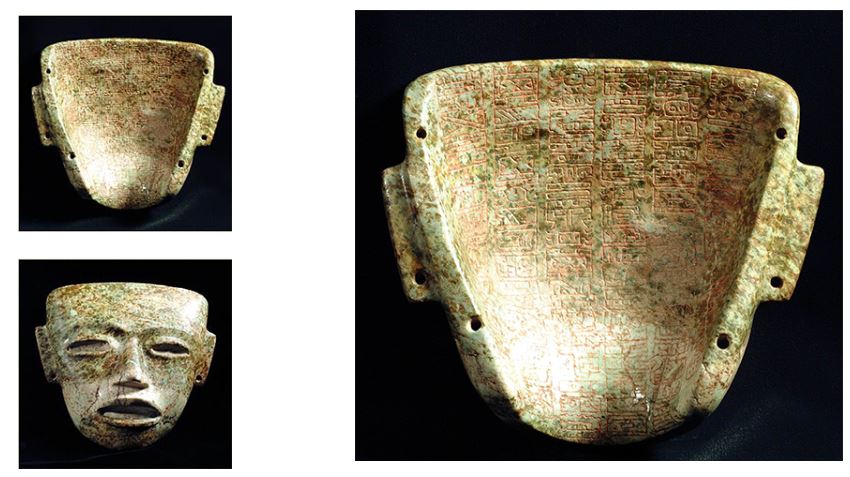
The understanding of this script was facilitated by the 1986 discovery of the Mojarra Stela in Veracruz, Mexico. What this stela showed was that the Epi-Olmec/Isthmian script seemed to be related to Mayan writing. The language that has been identified through the surviving inscriptions is a precursor to proto-Zoquean which eventually will lead to the languages spoken today in Veracruz, Tabasco, Chiapas, and Oaxaca.
MIXTEC
Mixtec writing was semasiographic in nature. One of the most important Mixtec codices is the Codex Zouche-Nuttall. Currently housed in the British Museum, it is a screen fold manuscript composed of 47 deerskin leaves.
The Codex Zouche-Nuttal records the history of important centers in the Mixtec region and the genealogy, marriages, and political and military feats of the Mixtec ruler, 8 Deer Jaguar-Claw. 8-Deer Jaguar-Claw was the second ruler of the second dynasty of Tilantongo and lived from 1011 C.E. to 1063 C.E.


MAYA
Maya writing was the most complex of the Mesoamerican writing systems. It consists of 1,000 signs of which many of these are variations of the same sign. As a glottogtaphic writing system, Maya writing consists of signs representing whole words (logograms) and signs representing syllables (syllabograms). In fact, under this system a Maya scribe could make a word known through a logogram or could write it strictly syllabically. As a general rule, Maya texts were laid out in a grid pattern and read left to right.
Surviving Maya writing comes down to us in two forms. There are inscriptions found on a variety of mediums and from codices. Presently, there are only four Maya codices that have survived. These are the Dresden Codex, the Paris Codex, the Grolier Codex, and the Madrid Codex. A fifth is still under debate as to its authenticity. You will have an opportunity to learn more about this writing system and participate in a Maya writing decipherment exercise in our next topic.
NAHUA
Unfortunately, no pre-conquest Nahua codices are known to have survived. As a result, scholars must rely on post-conquest codices to infer what early Nahua writing may have been like. During the colonial period, the Nahua adopted the Latin alphabet, marking the end of their traditional semasiographic writing system. As you have learned already, the Codex Mendoza, is one of the most familiar of the Nahua codices. Along with the Codex Mendoza, there is the Florentine Codex which integrates the Latin alphabet with traditional indigenous writing. To see additional codices visit this site: Codices de Mexico.
The adoption of the Latin alphabet by Nahua society after Spanish subjugation occurred relatively quickly, and some of the earliest surviving indigenous documents written in Latin script date back to the mid-1500s. Indigenous communities used this new writing system to record their histories, document land disputes, and navigate the Spanish legal system, allowing them to preserve aspects of their identity and agency within New Spain.
IN CLOSING
Great job! You’ve just completed the second topic in our quest to explore Mexico’s history. I hope you have found this brief overview of writing in Mesoamerica interesting. Up next, in Breaking the Maya Code, you’ll uncover the secrets of the ancient Maya writing system in detail and even try your hand at deciphering a Maya glyph block.
As always, be sure to contact me or visit me during office hours should you have any questions about the content we have covered or the assignments that you need to complete.
| APPENDIX: DEFINITIONS OF TERMS ASSOCIATED WITH THE STUDY OF WRITING Semasiographic System: A form of writing that conveys ideas through independent graphic symbols, not tied to a specific spoken language. Glottographic System: A writing system that represents elements of a particular spoken language through visible marks. Writing System: A structured set of visible or tactile symbols used to systematically represent language. Epigraphy: The study, classification, and interpretation of inscriptions. Script: The visual representation or graphic form of a writing system. Decipherment: The process of unlocking the meaning of an unfamiliar/unknown writing system. Transcription: The process of converting spoken language, sounds, or text from one form into another. Transliteration: The process of converting text from one script to another while preserving the original pronunciation as closely as possible. Translation: The process of converting text or speech from one language into another while maintaining its meaning, context, and intent. Syllabogram: A symbol representing a phonetic syllable. Logogram: A symbol representing a word or concept without indicating pronunciation. Hieroglyph: A writing system composed of signs that are assumed to be non-phonetic. Codex/Codices: An ancient, handwritten book. |

