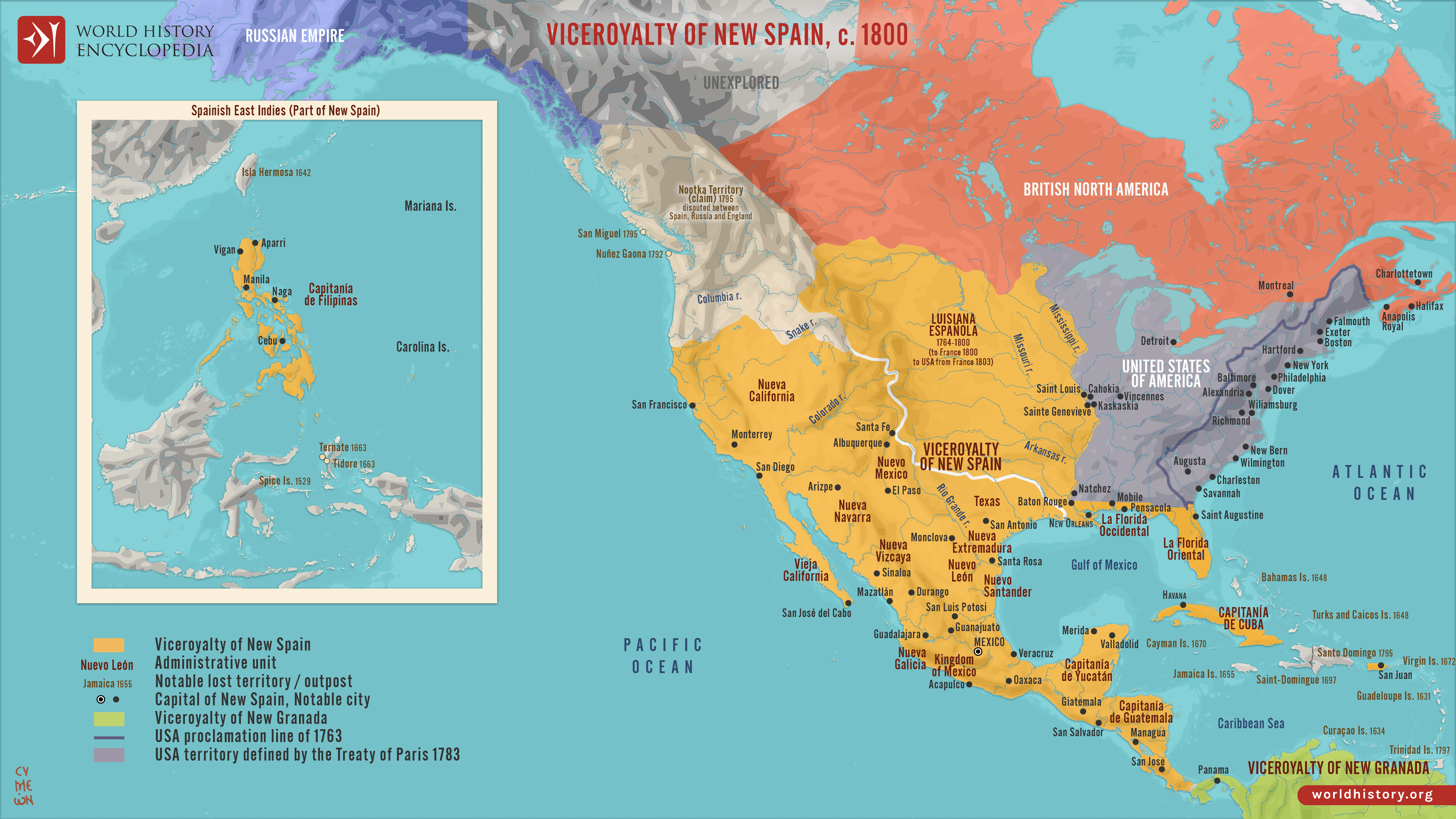
THE ORDERING OF THE COLONIAL WORLD – Part 1
| LEARNING OBJECTIVES 1. Analyze the structure of Spanish colonial governance in New Spain. 2. Evaluate the impact of Spanish colonial systems on Indigenous populations. 3. Assess the economic and cultural transformations of New Spain. |
The Role of the Iberian Political Organization
With the defeat of the Empire of the Triple Alliance in 1521, the Spanish Crown undertook the process of consolidating its vast new territories. Drawing from administrative models previously tested in the Caribbean, as well as Iberian governance traditions, the Spanish sought to impose a structured colonial system that would ensure political stability, economic exploitation, and religious conversion.
A cornerstone of this transformation was the establishment of a highly hierarchical and urban-centered administrative framework. While Spanish rule introduced Iberian governance principles, it also strategically incorporated and co-opted elements of indigenous political structures to maintain order and facilitate control. This approach allowed for the smoother integration of colonial rule, leveraging existing indigenous nobility and socio-political hierarchies while imposing Spanish legal and bureaucratic systems.
At the heart of Spain’s colonial administration was the Council of the Indies (Consejo de Indias), established in 1524 and based in Madrid. This institution held supreme authority over Spanish America, drafting laws and regulations, appointing viceroys, governors, and high-ranking officials, overseeing trade and taxation, and managing judicial disputes. Although the Council of the Indies dictated policies for the colonies, its ability to directly enforce these policies was limited. As a result, it relied on a complex network of local governing institutions in Spanish America to implement its decisions.
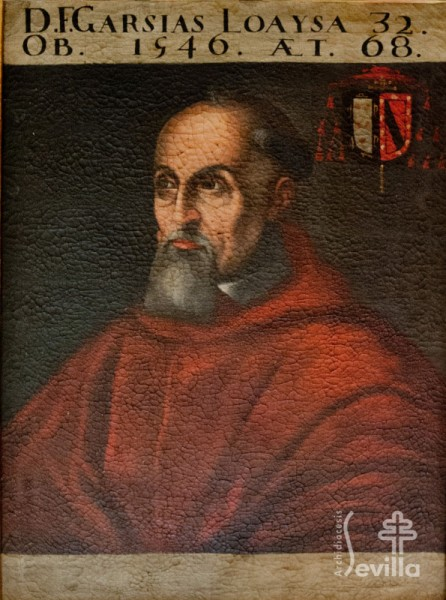
To strengthen royal authority and that of the Council of Indies, Spain introduced the viceroyalty system in 1535. Viceroys wee the highest-ranking colonial officials and acted as direct representatives of the king in Spanish America.
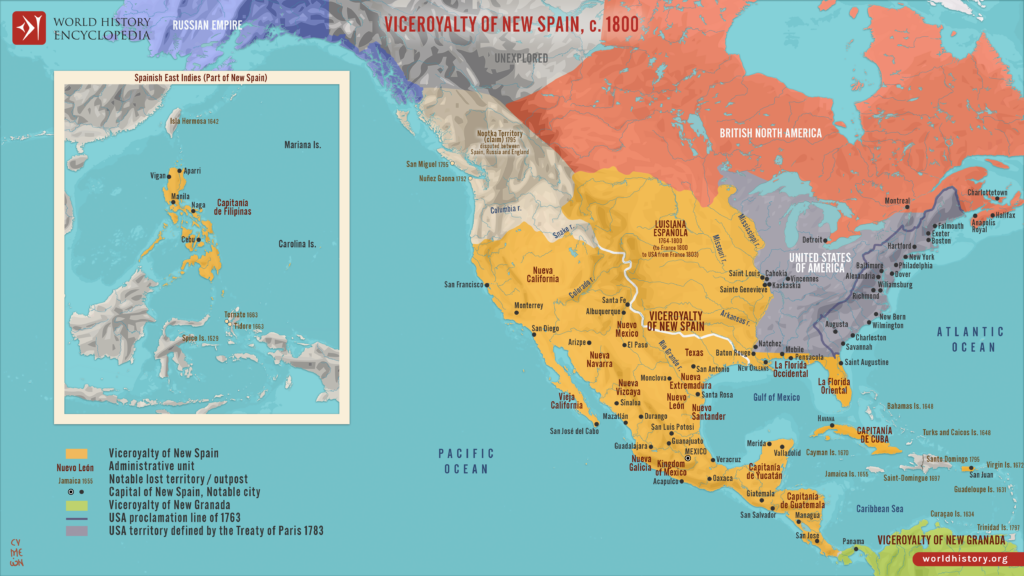
Antonio de Mendoza, appointed in 1539, became the first Viceroy of New Spain (colonial Mexico) and wielded extensive executive, military, and judicial power. The viceroy enforced royal decrees, supervised economic affairs, managed colonial officials, and defended the colony against external threats.
TABLE 1: EARLY VICEROYS OF NEW SPAIN
| Viceroy | Years in Power | Key Actions / Importance |
|---|---|---|
| Antonio de Mendoza | 1535–1550 | First viceroy; established stable government, supported Indigenous rights (New Laws), expanded exploration |
| Luis de Velasco (the Elder) | 1550–1564 | Enforced limits on Indigenous slavery; continued reforms and economic growth |
| Gastón de Peralta | 1566–1567 | Short rule; removed after accusations of disloyalty |
| Martín Enríquez de Almanza | 1568–1580 | Strengthened colonial administration; dealt with Indigenous revolts; improved infrastructure |
| Lorenzo Suárez de Mendoza | 1580–1583 | Fought corruption and tried to improve justice system |
To assist the viceroy and provide judicial oversight, the Spanish established the Audiencia, a high court of law that functioned as both a legal and advisory body. The first Audiencia of New Spain was created in 1529 and was composed of a presidente (presiding officer), oidores (judges), and licenciados (legal experts). The Audiencia had the authority to review legal disputes, handle land claims, and resolve conflicts between settlers, indigenous communities, and colonial officials.
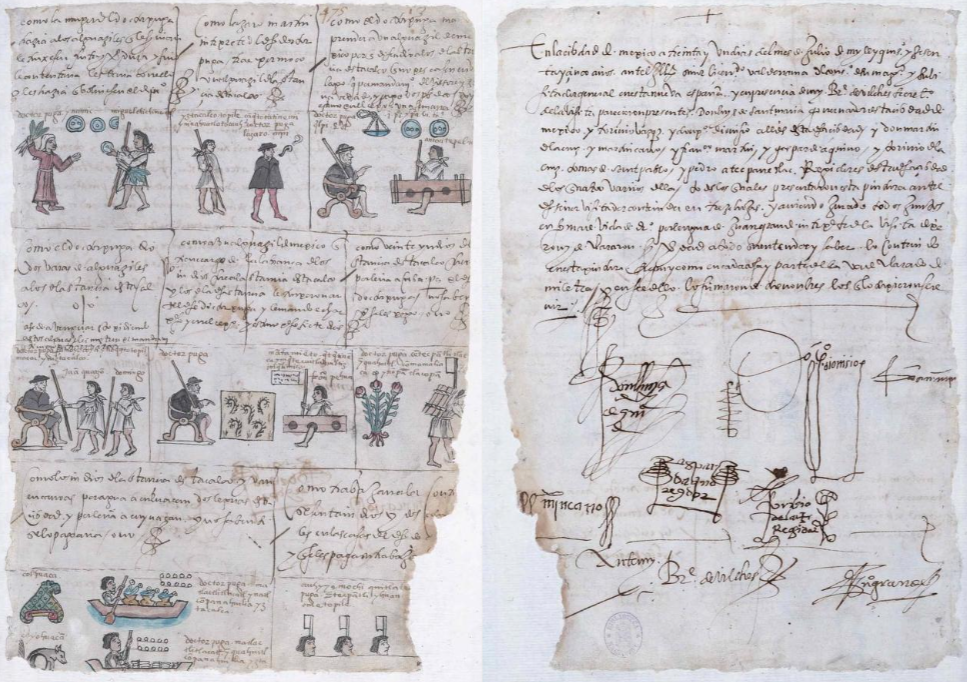
This codex is a colonial Mexican document that combines Indigenous drawings with Spanish written explanations to present a formal complaint. Created by Indigenous leaders, it records their claims that Spanish officials forced them to provide labor and good such as construction work and domestic service without proper payment. The images show these activities in detail, while the Spanish text explains the legal case.
Audiencias were strategically established in important colonial cities, typically in regions of high population density and economic significance. Conflicts often arose between audiencias and viceroys as both sought to exercise political and economic influence over New Spain.
TABLE 2: THE AUDIANCIAS OF COLONIAL SPANISH AMERICA
| Audiencia | Location | Established | Region Covered | Role & Importance |
|---|---|---|---|---|
| Audiencia of Mexico (Mexico City) | Mexico City | 1527 (reorganized 1530) | Central New Spain | Most important audiencia; highest court; advised the viceroy and sometimes governed in his absence |
| Audiencia of Guadalajara | Guadalajara | 1548 | Western & Northern New Spain (Nueva Galicia) | Governed frontier regions; handled legal cases and administration far from Mexico City |
| Audiencia of Guatemala | Santiago de Guatemala (later Antigua) | 1543 | Central America (southern New Spain territories) | Oversaw Central American provinces; semi-independent from Mexico City |
| Audiencia of Santo Domingo | Santo Domingo (Caribbean) | 1511 | Caribbean & early mainland territories | First audiencia in the Americas; early administrative and judicial center (less central over time to Mexico) |
Below the viceroy and audiencia, the governance of Spanish America depended on a complex local administrative structure, which allowed the Crown to maintain order while efficiently managing indigenous populations and economic activities. Gobernadores (Governors) acted as regional administrators, overseeing larger provinces within New Spain. Corregidores (Royal Officials Over Indigenous Towns) were appointed directly by the Crown to oversee indigenous communities, ensuring the collection of tribute and labor quotas as part of the colonial economy. Cabildos (Town Councils) were responsible for managing local affairs in cities and towns. These municipal councils were composed of Spanish settlers, usually wealthy landowners or merchants, who regulated markets, land distribution, public works, and urban development. Spain’s ability to maintain control over New Spain and its other American colonies rested on this elaborate bureaucratic system, which combined legal institutions, military authority, and economic exploitation.
TABLE 3: STRUCTURE OF COLONIAL GOVERNMENT IN SPANISH AMERICA REVISITED
| Level | Position/Institution | Role & Responsibilities |
|---|---|---|
| Spain (Top Authority) | King of Spain | Ultimate authority; made laws and controlled the empire |
| Council of the Indies | Advised the king; created laws and oversaw colonial administration | |
| Viceroyalty (New Spain) | Viceroy | King’s representative; enforced laws, governed colony, led military |
| Audiencia (High Court) | Highest court; advised and checked the viceroy’s power | |
| Regional / District | Corregidores / Alcaldes Mayores | Key local officials who governed districts; supervised towns, collected tribute, enforced laws, and controlled Indigenous labor and communities |
| Governors / Captain Generals | Governed larger provinces or frontier regions; military authority | |
| Local (Cities & Towns) | Cabildo (Town Council) | Local government; managed city affairs like markets, taxes, and public works |
| Alcaldes (Local Judges) | Handled local legal matters and administration | |
| Indigenous Government | Indigenous Nobles / Caciques | Local Indigenous leaders; helped govern and collect tribute |
| Repúblicas de Indios | Indigenous towns with limited self-rule under Spanish oversight |
Municipal Models: Administration
A key component of Spanish colonial organization in the Americas was the municipio (municipal system), a governance model deeply rooted in medieval Castilian law. Spain had long relied on urban-centered administration, in which towns and cities functioned as the core units of governance, justice, and taxation. This system was successfully transplanted to the New World, where it was strategically adapted to accommodate existing indigenous political and social infrastructures.
Rather than completely dismantling indigenous political institutions, the Spanish repurposed existing structures such as the altepetl (city-state) system and its associated tribute networks to facilitate colonial administration. This strategic incorporation of pre-Hispanic governance mechanisms helped maintain order while extending Spanish rule. By initially incorporating indigenous elites into the Spanish colonial framework, the Crown ensured smoother governance and minimized resistance.
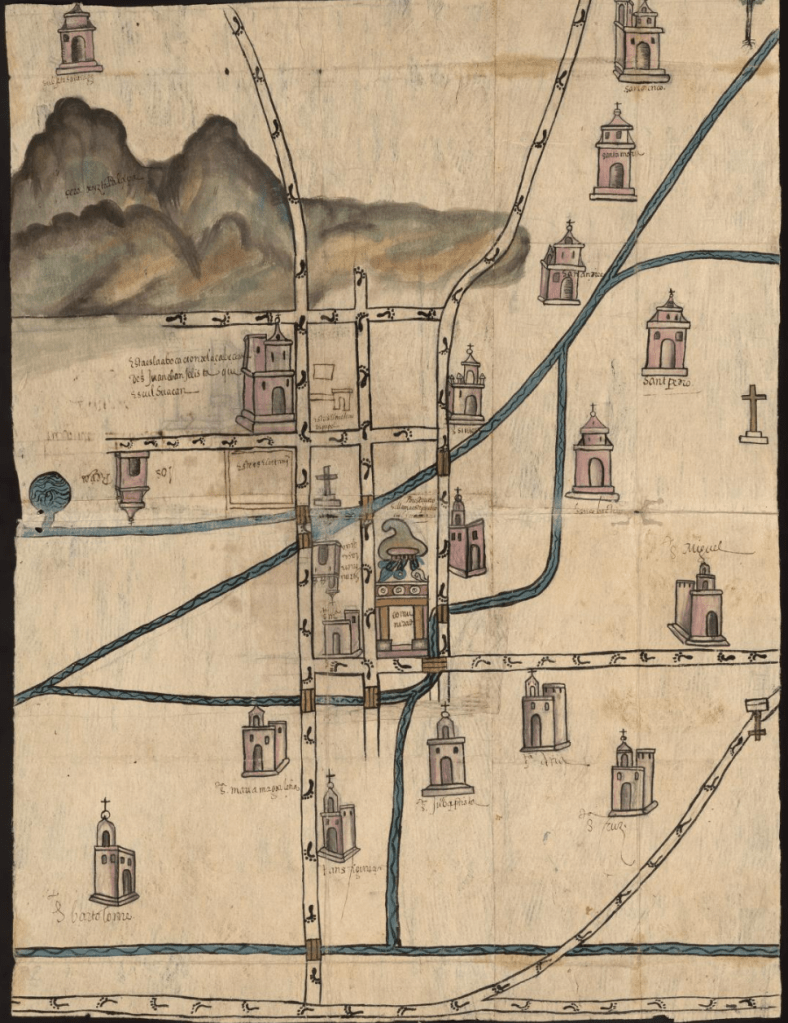
As noted above, the cabildo was the primary institution overseeing local administration, justice, and public order, ensuring that Spanish royal directives were enforced effectively at the municipal level. These councils were established in major cities such as Mexico City (Tenochtitlán), Puebla, and Guadalajara, which became key administrative centers of the colonial system.

Below these primary centers were secondary administrative cities such as Puebla, Mérida, and Oaxaca, which acted as regional hubs for implementing royal policies. These cities were home to Spanish bureaucrats, merchants, and clergy, reinforcing colonial authority over trade, taxation, and religious conversion efforts. They served as economic and religious focal points, ensuring that Spanish interests extended beyond the capital.
At the local level, tertiary centers encompassed smaller towns and indigenous settlements, which were integrated into the colonial framework under the supervision of Spanish-appointed corregidores. These officials were responsible for governing Indigenous populations, overseeing labor allocation, and managing tribute collection, ensuring that colonial administration reached even the most remote communities. By structuring their settlements into this hierarchical urban network, the Spanish effectively maintained control over vast territories while maximizing economic and political stability.
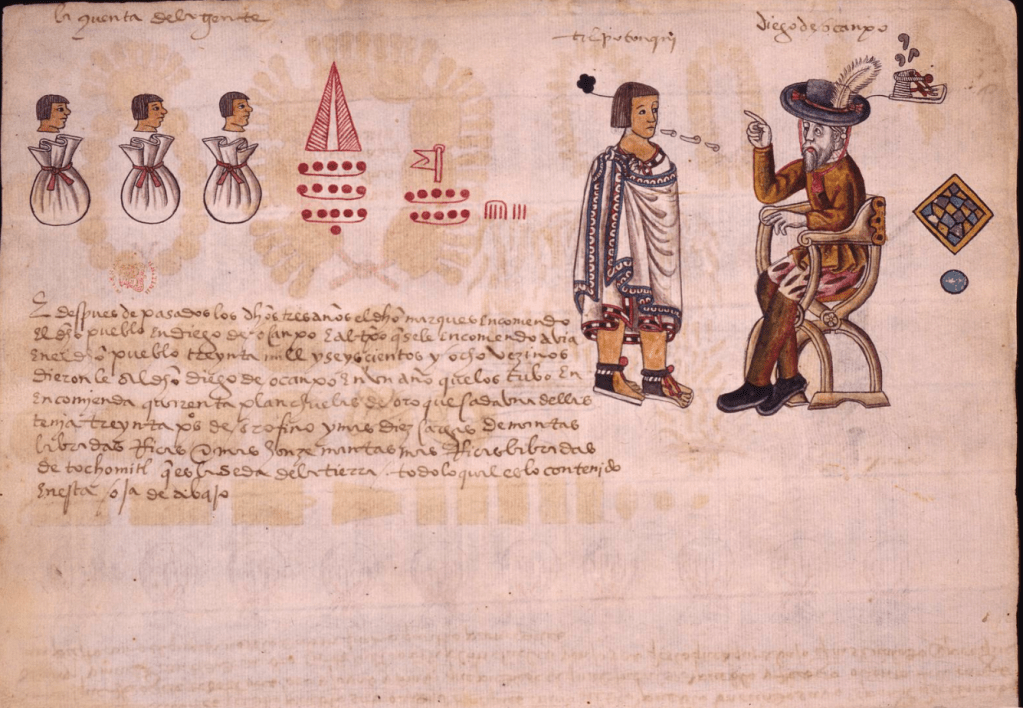
This source shows the history of the people of Tepetlaoztoc, a community in the Valley of Mexico located between Texcoco and Otumba. It also illustrates the tribute (taxes and labor) they were required to provide to the Spanish around the year 1550.
Rather than relying exclusively on Spanish officials to govern their newly acquired territories, the colonial administration strategically co-opted indigenous rulers to serve as intermediaries between the Spanish Crown and native populations. Recognizing the deep-rooted authority of Indigenous elites, the Spanish incorporated them into the colonial system, ensuring local compliance and administrative efficiency. These Indigenous leaders played a crucial role in managing their own communities under Spanish oversight, collecting tribute, enforcing labor policies, and promoting religious conversion efforts.
Municipal Models: Economy and Society
Economically, the municipal system played a crucial role in controlling trade, taxation, and resource extraction. Urban centers became commercial hubs, where Spanish merchants, colonial officials, and indigenous traders converged.
TABLE 4: ECONOMIC EXPORTS FROM NEW SPAIN
| Export | Region(s) Produced | Who Produced It | Importance |
|---|---|---|---|
| Silver | Zacatecas, Guanajuato | Indigenous laborers, enslaved Africans, wage workers | Most important export; made New Spain a key part of the global economy |
| Gold | Various regions (less than silver) | Indigenous and African labor | Early colonial wealth, but declined in importance compared to silver |
| Sugar | Veracruz, Morelos | Enslaved Africans, Indigenous labor | Major cash crop; exported to Europe and other colonies |
| Cacao (Chocolate) | Southern Mexico (Chiapas, Tabasco) | Indigenous farmers | Valuable trade good; widely consumed in New Spain and exported |
| Cochineal (red dye) | Oaxaca | Indigenous communities | Highly prized dye used in European textiles; very profitable |
| Hides & Leather | Northern and central regions | Ranch workers (vaqueros) | Supported livestock economy; exported for manufacturing goods |
| Tobacco | Veracruz | Indigenous and mixed labor | Important cash crop; later controlled as a royal monopoly |
| Indigo (dye) | Southern regions | Indigenous labor | Exported as a blue dye for European markets |
| Wool & Textiles | Central Mexico | Indigenous and mestizo labor | Produced in workshops (obrajes); some exported regionally |
| Agricultural Goods (maize, wheat) | Throughout colony | Indigenous farmers | Mainly for local consumption, but supported the export economy |
The Spanish integrated indigenous economies into the colonial system, using municipal regulations to control land distribution, agricultural production, and labor systems such as the encomienda and repartimiento (indigenous labor draft). Cities became focal points for exporting valuable resources, including silver from Zacatecas, and agricultural goods from large haciendas (estates), ensuring the flow of wealth to the Spanish Crown.
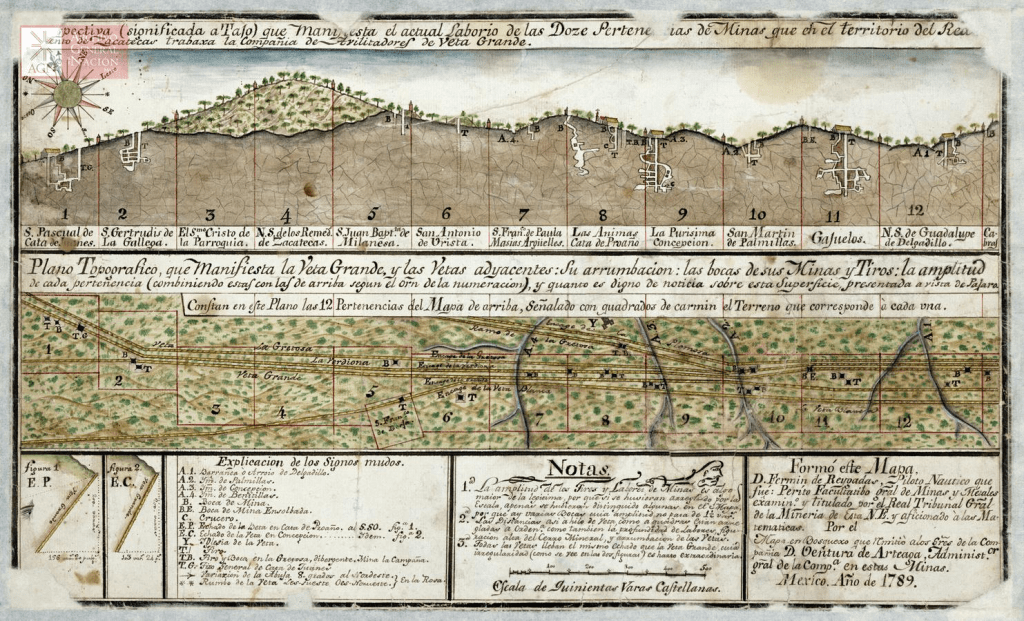
Silver mining in places like Zacatecas and Guanajuato was the backbone of New Spain’s economy and connected this colony to a global trade network linking Europe, Asia, and the Americas.
TABLE 5: MAJOR GOLD AND SILVER MINING CENTERS IN COLONIAL MEXICO
| Mine / Mining Region | Resource | Location (Modern State) | Established | Importance |
|---|---|---|---|---|
| Zacatecas | Silver | Zacatecas | 1546 | One of the richest silver mines in the world; major driver of Spain’s global wealth |
| Guanajuato (La Valenciana) | Silver | Guanajuato | 1550s (major boom 1700s) | Extremely productive; La Valenciana mine was among the richest ever discovered |
| San Luis Potosí | Silver | San Luis Potosí | 1592 | Important northern mining center; supported expansion into frontier regions |
| Taxco | Silver | Guerrero | 1530s | One of the earliest silver mining areas; key in early colonial economy |
| Pachuca–Real del Monte | Silver | Hidalgo | 1550s | Known for refining innovations (patio process); major production center |
| Sombrerete | Silver | Zacatecas | 1555 | Significant contributor to northern mining economy |
| Durango (Nombre de Dios region) | Silver | Durango | Late 1500s | Supported northern expansion and settlement |
| Parral (Santa Bárbara) | Silver | Chihuahua | 1630s | Major northern mining hub; boosted regional development |
| El Oro | Gold & Silver | State of Mexico | 1700s (earlier activity) | Important for both gold and silver extraction |
| Oaxaca (various sites) | Gold | Oaxaca | Early colonial period | Source of gold, especially in early years before silver dominated |
Religious conversion was another key function of the municipal system. Cities served as bases for missionary activity, where mendicant orders established churches, monasteries, and schools to convert and indoctrinate the indigenous population. The Franciscans, Dominicans, and Augustinians, played a vital role in organizing mass baptisms, religious instruction, and the construction of religious institutions. Municipalities helped reinforce Catholic orthodoxy, ensuring that indigenous belief systems were systematically replaced with Spanish religious and cultural norms.
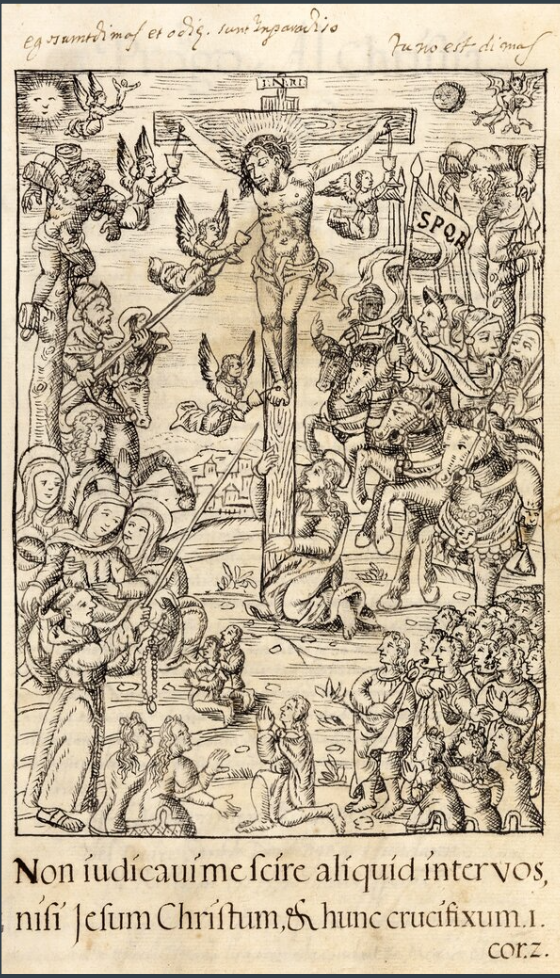
This image shows a hand-drawn scene of the crucifixion of Jesus Christ, surrounded by symbolic and religious figures. At the top, an angel near the sun and a demon near the moon represent opposing forces of good and evil. On the left, a soldier on horseback has just pierced Jesus with a spear, while the Virgin Mary and other women mourn below. On the right, more soldiers appear with weapons and banners. Angels collect Christ’s blood in chalices as it flows from his wounds, and a woman kneels at the base of the cross. At the bottom of the image, a Franciscan friar points toward the scene while holding a rosary, appearing to teach a group of Indigenous people seated before him. As you study the image, think about how it was used to explain Christian beliefs and how it combines religious storytelling with teaching in a colonial context.
Socially, the municipal system reinforced Spanish racial and class hierarchies, shaping the casta based society that characterized Spanish America. The peninsulares (Spanish-born officials) and criollos (American-born Spaniards) dominated municipal councils, holding the most powerful administrative and economic positions. Below them were mestizos, Indigenous people, and African slaves, who occupied lower levels of the colonial social order. This structure institutionalized the casta system, a racial and social classification system that dictated economic opportunities, legal rights, and access to political power.
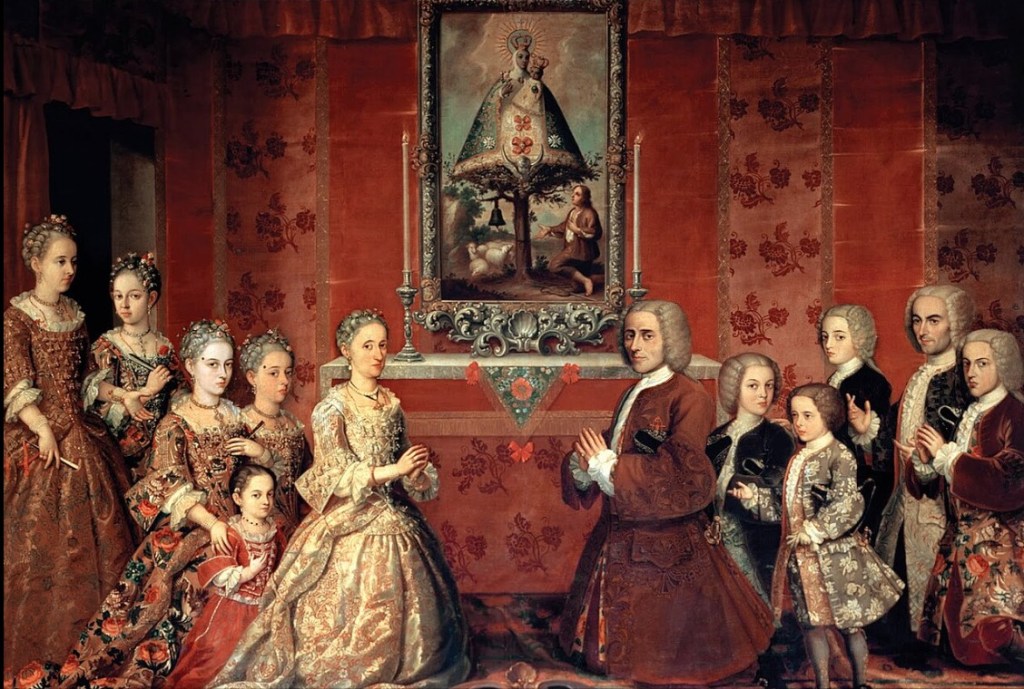
In the long term, the municipal system established during the Spanish colonial period left a lasting legacy on urban development, governance, and social structures in Mexico. Many of today’s major cities in the region retain elements of colonial-era urban planning, while the bureaucratic and social systems introduced by the Spanish continue to influence modern governance and societal organization.
The Role of the Encomenderos
In New Spain, encomenderos, those Spanish settlers who were granted control over indigenous labor, played a pivotal role in the region’s economic expansion. Under the encomienda system, encomanderos were entrusted with the labor and tribute of indigenous communities in exchange for a supposed commitment to protect, educate, and convert them to Christianity. However, in practice, the encomienda system became little more than a form of coerced labor, with Indigenous peoples subjected to harsh conditions, forced tribute payments, and exploitation.
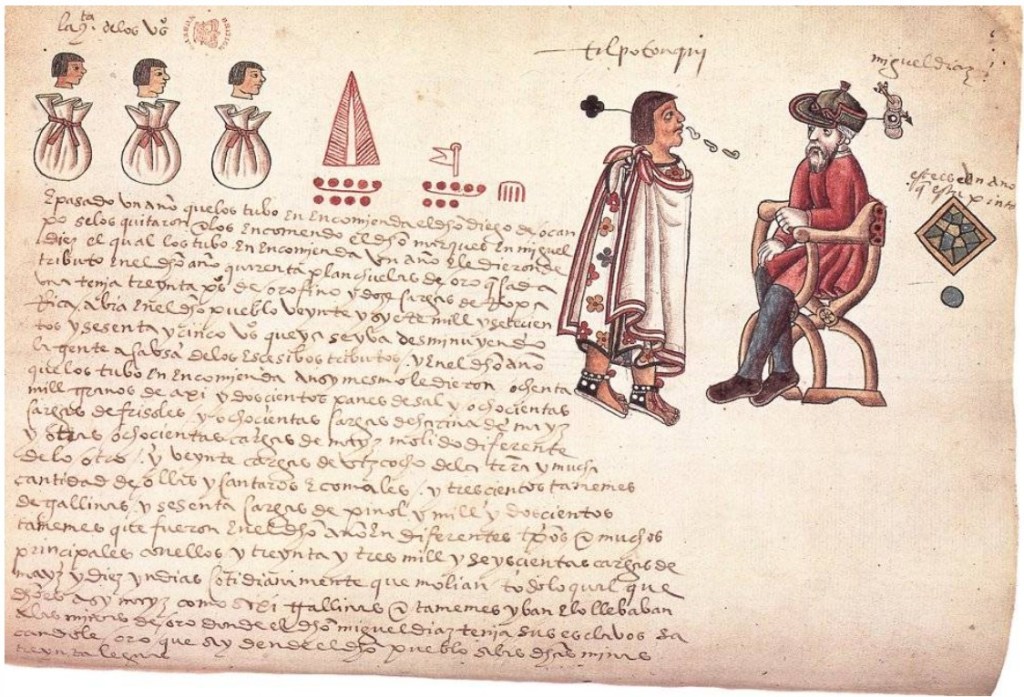
The economic activities of encomenderos were not limited to subsistence agriculture but also encompassed a wide range of industries that fueled the Spanish colonial economy. The availability of Indigenous labor, and later, enslaved African laborers, allowed encomenderos to expand their ventures into diverse economic sectors. However, the role and functioned of encomanderos, their accumulation of local power, and their exploitation of indigenous populations through encomienda would not go unnoticed. In 1542, the Spanish crown issued a set of reforms called the New Laws that aimed to end Indigenous labor abuse, limit the power of encomenderos, and improve working conditions. The laws also stated that encomiendas could not be passed down to future generations, with the goal of eventually ending the system. While the New Laws were meant to protect Indigenous people and limit the power of encomanderos, in practice they were often resisted or only partially enforced.
TABLE 6: NEW LAWS
| Issue | What the New Laws Said | Why It Mattered |
|---|---|---|
| Indigenous Slavery | Banned the enslavement of Indigenous people | Recognized Indigenous people as subjects of the Crown, not property |
| Encomienda System | Encomiendas could not be inherited after the holder’s death | Aimed to gradually end the encomienda system |
| Treatment of Indigenous People | Required fair treatment and better working conditions | Tried to reduce abuse and exploitation |
| Forced Labor | Limited the use of forced Indigenous labor | Attempted to prevent extreme exploitation in mines and farms |
| Tribute (Taxes) | Allowed tribute but regulated it | Ensured the Crown—not individuals—controlled Indigenous labor and resources |
| Authority of Encomenderos | Reduced power of encomenderos over Indigenous communities | Strengthened royal control over the colonies |
| Royal Oversight | Increased enforcement by royal officials (like viceroys and judges) | Helped the Crown monitor and enforce reforms |
One of the most lucrative industries established by encomenderos was sugar cultivation. Sugar plantations emerged in regions like Veracruz, Oaxaca, and Morelos, where the warm climate and fertile soil favored sugarcane growth. These plantations operated under brutal conditions, with Indigenous workers and African slaves enduring long hours, harsh punishments, and dangerous milling processes to meet the increasing demand for sugar in European markets. Spanish settlers also introduced silk farming to New Spain, particularly in Puebla, where the climate was conducive to silkworm cultivation. Indigenous laborers were tasked with tending silkworms, harvesting cocoons, and spinning silk fibers into textiles, which became an important export commodity.
Encomenderos also invested in shipyards, especially in Veracruz, to support Spain’s transatlantic trade and naval needs. These shipyards produced vessels for transporting goods, military operations, and coastal defense, further integrating New Spain into the global Spanish empire. The establishment of large estancias (landed estates) dedicated to cattle ranching was another significant economic enterprise. Cattle ranching provided meat, leather, and tallow, which were essential for both local markets and exports. Over time, these estates grew into vast haciendas, further entrenching Spanish land ownership and indigenous labor exploitation.
The Columbian Exchange
The arrival of the Spanish in the early 16th century triggered an unprecedented demographic collapse among Indigenous populations in Mexico and throughout the Americas. One of the most devastating factors was the introduction of Old-World diseases, against which the indigenous populations had no immunity.
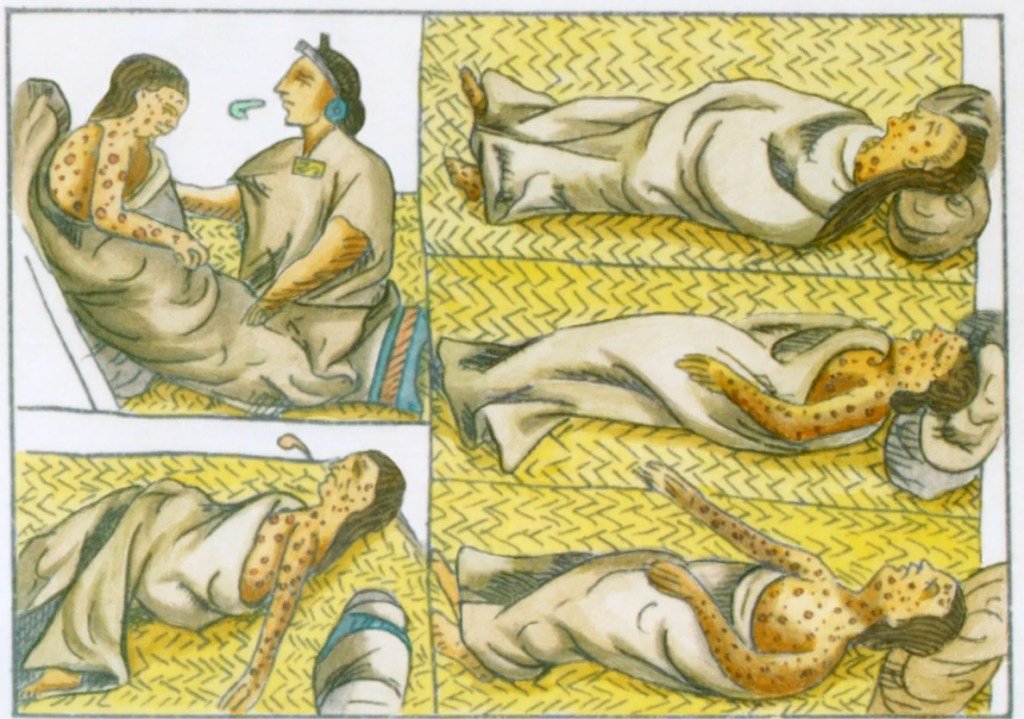
The most catastrophic of these was smallpox, which originated in the Caribbean before reaching Mexico. The disease arrived in 1520, during Hernán Cortés’s conquest of the Empire of the Triple Alliance, spreading rapidly through Tenochtitlán and killing tens of thousands, including the Mexica emperor Cuitláhuac. Other highly contagious European diseases, including measles, typhus, and influenza, continued to devastate Indigenous communities well into the colonial period. The rapid and repeated waves of epidemics led to an estimated 90% decline in Mexico’s Indigenous population within the first century of Spanish rule, leaving many regions either severely depopulated or entirely abandoned.
TABLE 7: MAJOR EPIDEMICS IN COLONIAL MEXICO
| Epidemic | Approx. Dates | Disease (if known) | Impact | Importance |
|---|---|---|---|---|
| Smallpox | 1520–1521 | Smallpox virus | Killed a large portion of the Indigenous population, including leaders | Helped weaken the Aztec Empire during Spanish conquest |
| Measles | 1531–1534 | Measles | Widespread illness and death among Indigenous communities | Continued population decline after conquest |
| Cocoliztli Epidemic | 1545–1548 | Unknown (possibly hemorrhagic fever or enteric fever) | Killed millions of Indigenous people | One of the deadliest epidemics in Mexican history |
| Second Cocoliztli | 1576–1581 | Unknown | Massive death toll; further depopulation | Deepened labor shortages and social disruption |
| Typhus | Late 1500s–1600s | Typhus | Repeated outbreaks causing high mortality | Became a recurring epidemic disease |
| Smallpox | 16th–18th centuries | Smallpox | Continued waves of infection | Ongoing population decline and instability |
| Yellow Fever | 17th–18th centuries | Yellow fever virus | Affected coastal regions like Veracruz | Disrupted trade and port cities |
| Influenza | Various outbreaks | Influenza virus | Periodic illness and death | Added to cumulative demographic decline |
Beyond disease, the Spanish introduction of domesticated animals had profound ecological consequences for Mexico’s environment and Indigenous agricultural systems. The arrival of sheep and cattle, initially intended for food and wool production, significantly altered landscapes and disrupted traditional land use. Large herds of sheep, in particular, overgrazed vast areas, stripping grasslands bare and leading to severe soil erosion. This phenomenon was particularly destructive in Tlaxcala and the Bajío, where the loss of vegetation degraded agricultural lands and disrupted Indigenous food sources. The introduction of European livestock also led to the decline of traditional indigenous crops, forcing many Indigenous farmers to alter their agricultural practices to accommodate the new colonial economy.
The environmental damage from silver mining extended beyond human health. Mining operations contaminated water sources, poisoned crops, and destroyed local ecosystems, further weakening already vulnerable Indigenous communities. The combined effects of disease, forced labor, and environmental degradation left many indigenous populations drastically reduced and displaced. By the late 16th century, entire regions of New Spain faced severe depopulation, fundamentally reshaping the social, economic, and ecological landscape of colonial Mexico.
The Spanish conquest of Mexico not only brought disease, environmental destruction, and forced labor but also facilitated the Columbian Exchange, a vast transcontinental transfer of crops, animals, and cultural practices between the Americas and Europe. This exchange reshaped global agriculture, diets, economies, and ways of life, leaving an enduring legacy on both sides of the Atlantic.
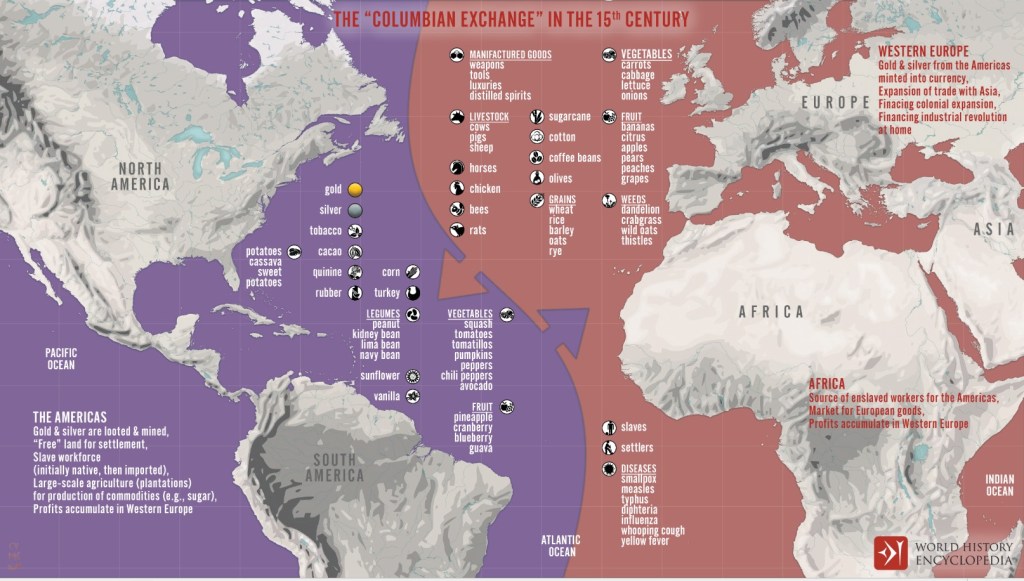
The Spanish introduced new crops and livestock, drastically transforming Mexico’s agricultural landscape and dietary habits. These additions fueled the development of plantation economies and created new sources of sustenance for the growing colonial population. One of the most significant cash crops introduced by the Spanish, as already noted above, was sugarcane. While Indigenous peoples primarily consumed maize (corn), wheat became a staple grain among Spaniards and eventually among mestizo populations, leading to the introduction of European-style bread into the Mexican diet. Oranges, lemons, and limes were cultivated in Mexico’s warmer climates, adding new sources of vitamin C to local diets and influencing Mexican culinary traditions. The introduction of horses, pigs, cows, and chickens fundamentally changed transportation, diet, and agriculture.
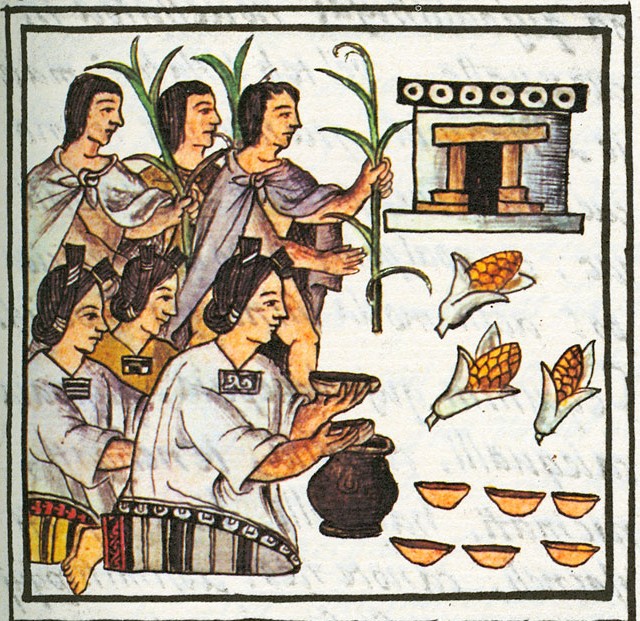
TABLE 8: CROPS BROUGHT FROM EUROPE
Item Introduced by Spanish | Origin | Use in Modern Mexican Cuisine | Example Dishes |
|---|---|---|---|
| Wheat | Mediterranean / Europe | Flour for breads & tortillas | Flour tortillas, bolillos, pan dulce |
| Rice | Asia (via Spain) | Staple side dish | Arroz rojo, arroz con pollo |
| Sugarcane | Southeast Asia | Sweeteners & desserts | Dulces, flan, aguas frescas |
| Citrus (orange, lime, lemon) | Mediterranean | Flavoring, marinades | Ceviche, tacos with lime |
| Grapes | Mediterranean | Wine production, flavoring | Mexican wines, sauces |
| Olives | Mediterranean | Oils, garnishes | Ensaladas, some moles |
| Onions | Eurasia | Base flavoring | Salsas, tacos, soups |
| Garlic | Central Asia | Seasoning | Nearly all savory dishes |
| Lettuce & herbs (cilantro introduced in new form) | Mediterranean | Salads, garnishes | Tacos, soups |
| Bananas/plantains | Africa (via Spain) | Fried or sweet dishes | Plátanos fritos |
TABLE 9: LIVESTOCK BROUGHT FROM EUROPE
| Animal Introduced by Spanish | Origin | Use in Modern Mexican Cuisine | Example Dishes |
|---|---|---|---|
| Cattle (beef & dairy) | Europe | Meat, milk, cheese | Carne asada, queso fresco |
| Pigs | Europe | Major meat source | Carnitas, chorizo, tacos al pastor |
| Sheep | Europe | Meat (especially barbacoa) | Barbacoa de borrego |
| Goats | Europe | Meat & dairy | Birria, cabrito |
| Chickens | Eurasia | Eggs & meat | Pollo en mole, huevos rancheros |
| Horses (indirect food impact) | Europe | Transport → ranching culture | Enabled cattle industry |
| Dairy animals (general) | Europe | Cheese, cream | Quesadillas, crema |
At the same time, Mexican agricultural products transformed European diets, economies, and farming practices, contributing significantly to population growth and economic expansion across Europe, Africa, and Asia. The introduction of nutrient-rich crops from New Spain helped sustain larger populations, improve food security, and fuel global trade networks. One of the most impactful crops was maize, which quickly became a staple food in regions such as Spain, Italy, and sub-Saharan Africa. In Europe, maize was highly adaptable and could be cultivated in areas where wheat and rye struggled, making it an important alternative grain in countries like Italy, where it became the foundation of polenta. In Africa, maize spread rapidly due to its high yields and resilience, becoming an essential part of local diets, particularly in West and Central Africa. It supplemented traditional grains like millet and sorghum, helping to alleviate food shortages and support population growth in the region.
TABLE 10: CROPS AND LIVESTOCK BROUGHT FROM MEXICO
| Item from Mexico (Mesoamerica) | Use in Modern European Cuisine | Example European Dishes |
|---|---|---|
| Maize (corn) | Staple grain in parts of Europe | Polenta (Italy), mămăligă (Romania) |
| Tomato | Base for sauces, stews | Pasta sauces, pizza, gazpacho |
| Chili peppers | Spice and flavoring | Paprika dishes (Hungary), Spanish chorizo |
| Cacao (chocolate) | Beverages, desserts | Hot chocolate, chocolate pastries |
| Vanilla | Flavoring for sweets | Custards, ice cream, pastries |
| Squash (pumpkins) | Soups, roasted dishes | Pumpkin soup, pies |
| Beans (varieties from Mesoamerica) | Protein source | Cassoulet (France), stews |
| Avocado (limited early adoption) | Modern gourmet cuisine | Salads, spreads |
| Sweet potatoes (regional overlap) | Side dishes | Roasted dishes, purees |
| Amaranth | Niche/health foods today | Specialty breads, cereals |
| Turkey | Major poultry meat | Roast turkey, festive dishes |
In Closing
As you have learned, Spain swiftly consolidated its new territories by implementing a structured colonial system rooted in Iberian governance traditions and Caribbean administrative models. To maintain control, Spanish authorities blended European governance with indigenous political structures, leveraging native elites while imposing Spanish legal and bureaucratic frameworks. Beyond administrative consolidation, the Spanish aggressively pursued cultural and religious transformation through widespread missionary activity. This will be the focus of the second part of the topic focusing on colonial Mexico.